How to Brief an AI Ad Generator for Better Results: A Practical Guide

Learn how to brief an ai ad generator for better results with a practical template and actionable steps to boost ad performance.
Learning how to brief an AI ad generator for better results isn't about mastering complex software. It really boils down to one simple truth: the quality of what you put in directly dictates the quality of what you get out. Think of your brief as the blueprint; it guides the AI to build ads that not only look good but actually perform and feel like your brand.
Why Your Brief Is the Key to Unlocking AI Creativity
Welcome to the new reality of advertising. Your most valuable skill is no longer editing or directing—it's briefing. It’s so common to see people approach AI ad generators like ShortGenius with a "magic button" mentality, typing in a single sentence and expecting a masterpiece. That approach almost always spits out generic, uninspired ads that need a ton of rework.
The thing is, an AI generator is an incredibly powerful creative partner, not a mind reader. It needs you to provide clear, detailed instructions to grasp the nuances of your brand, the real problems your audience faces, and the ultimate goal of your campaign. A well-crafted brief is what turns the AI from a simple tool into a genuine strategic collaborator.
The Strategic Value of a Detailed Brief
A great brief goes way beyond telling the AI what to make. It sets the entire project up for success by taking the guesswork out of the equation. Instead of vaguely asking for "a fun ad," a strong brief gets specific about the target emotion, the visual style, the core message, and exactly what you want the viewer to do next. That level of precision is what separates ads that get results from those that just get ignored.
The data backs this up. With 83% of ad executives now using AI in their creative process, the field is getting crowded. This means platforms like ShortGenius are operating in a world where your inputs are everything. As these tools become standard, the quality of your brief—how well you define your creative direction, brand rules, audience, and objectives—becomes the single biggest factor separating your ads from the noise. You can dig deeper into AI's growing role in advertising in this comprehensive report from the IAB.
By treating your brief as the foundational strategy document, you empower the AI to generate variations that are not just different, but strategically aligned with your campaign objectives. This approach saves time, reduces creative fatigue, and ultimately drives better business outcomes.
To help you build this foundation, let's look at the essential components that turn a simple idea into a detailed, actionable brief for any AI ad generator.
The Anatomy of a High-Impact AI Ad Brief
This table breaks down the core elements of a great brief. Getting these right provides the AI with the context and constraints it needs to generate truly effective creative.
| Component | Why It Matters for AI | Example Action for ShortGenius |
|---|---|---|
| Goals & KPIs | The AI needs a clear objective to optimize the ad's structure, pacing, and call-to-action for a specific outcome. | Define the primary goal as "Generate 500 first-time purchases" to guide script and CTA generation. |
| Audience Persona | Detailed psychographics and pain points help the AI generate copy and visuals that resonate on an emotional level. | Describe the audience as "time-strapped millennial moms who value convenience and get recommendations from friends." |
| Tone & Brand Voice | Specific adjectives and examples ensure the AI's language and style align perfectly with your brand identity. | Instruct the AI to use an "energetic, relatable, and slightly witty" tone in the voiceover and on-screen text. |
| Assets & Formats | Defining the platform and providing brand assets ensures the final ad is correctly formatted and visually consistent. | Specify a "15-second UGC-style TikTok video" and upload your brand's logo and color palette to the platform. |
Each of these components gives the AI a crucial piece of the puzzle, ensuring the final output is not just a guess, but a calculated and creative execution of your strategy.
Defining Your Goals and Success Metrics
Before you even start dreaming up creative hooks or audience personas, you need to answer one simple question: what does a "win" actually look like for this campaign?
If you don’t have a clear destination in mind, your AI ad generator is essentially driving blind. Asking it to just "get more sales" is like telling a GPS to "take me somewhere cool"—you might end up somewhere, but it’s probably not where you needed to be. This is where your strategy has to lead the technology.
This is, without a doubt, the most critical step. You have to translate those big-picture business objectives into specific, measurable targets that an AI can actually work with. Every single creative choice the AI makes, from the video's pacing to the exact wording of a call-to-action, will be designed to hit the goal you set right here.
From Vague Wishes to Concrete KPIs
Let's get practical. A fuzzy goal gives the AI way too much wiggle room, which almost always results in generic, ineffective ads. What you need are concrete Key Performance Indicators (KPIs) that the AI can understand and build creative around.
Think about the difference for an e-commerce brand selling sustainable sneakers.
- The Vague Goal: "Increase awareness for our new sneaker line."
- The Specific KPI: "Generate 10,000 landing page visits from our target audience of eco-conscious millennials."
See the difference? The second instruction gives the AI a clear mission. It knows the ad has to be compelling enough to earn a click and that the messaging must connect with a group that genuinely cares about sustainability.
A well-defined goal is the creative anchor for the AI. It makes sure every ad variation isn't just a random shot in the dark, but a calculated move to achieve a measurable business outcome.
Matching Goals to Your Business Model
Your campaign goals are going to look completely different depending on your business. An AI ad generator like ShortGenius is powerful enough to handle a ton of different objectives, but only if you give it the right marching orders from the get-go.
Let’s look at two totally different scenarios:
- A B2B SaaS Company: Their goal isn't an instant sale. They need to fill the pipeline with qualified leads for their sales team. A solid goal would be: "Achieve 150 demo sign-ups from marketing managers at mid-sized tech companies, keeping the cost per acquisition under $75."
- A Mobile Gaming App: Here, it's all about installs. Their goal might sound more like: "Drive 5,000 app installs on iOS in the first week, with an average cost per install of $1.50."
In both cases, the specific numbers and audience details provide the necessary guardrails for the AI to generate relevant, hard-hitting creative. The B2B ad will probably lean into professional language and business solutions, while the gaming ad will be all about exciting visuals and grabbing attention fast.
This initial direction is exactly where human strategy supercharges AI execution. Marketers are seeing huge productivity gains—completing tasks 25.1% faster and creating content up to 93% quicker—but the tech still needs a smart human in the driver's seat. In fact, 88% of marketers agree that AI can't manage an entire strategy on its own. It needs our oversight for planning and brand alignment. Your brief provides that essential strategic direction. You can dig deeper into how marketers are using AI in this insightful report.
Setting Realistic and Actionable Targets
Finally, make sure your goals are grounded in reality and tied to metrics you can actually track. Don't just pull numbers out of thin air. Look at your past campaigns or industry benchmarks to set targets you have a real shot at hitting.
Here are a few examples of strong, actionable goals you can plug right into your brief:
- Achieve a 2.5% click-through rate (CTR) on Instagram Stories ads.
- Generate 500 first-time purchases from a new customer segment.
- Increase add-to-cart events by 15% for a specific product category.
When you start with a crystal-clear definition of success, you're not just making an ad; you're building a performance-driven machine. This crucial first step ensures every single piece of creative has a purpose, a target, and a clear path to getting you results.
Getting to Know Your Audience (So the AI Can, Too)
An AI ad generator isn't a mind reader. If you want it to create ads that actually connect with people, you have to give it a deeply human audience persona to work with. This is where you go beyond flimsy demographics and build a rich, detailed profile of the person you’re trying to reach.
Think of it this way: without a solid persona, the AI is just throwing darts in the dark. You’ll get generic, forgettable ads that feel completely disconnected from your customer's reality. The goal is to paint such a vivid picture that the AI understands not just who your customer is, but why they do what they do. This is the secret to getting a great brief right.
Moving Beyond the Basics
It's so easy to just list the basics and call it a day. We've all seen personas that look something like this: "Moms, 30-40 years old, live in the suburbs, income of $80k+." While that's a start, it tells the AI almost nothing about what truly motivates these people. It’s like describing a book by its cover without ever cracking it open.
To get ads that really resonate, you have to dive into the psychographics—the beliefs, values, and emotions that drive behavior. The AI needs a window into their internal world to create something that speaks directly to them.
An AI model is a pattern-matching machine. The richer and more specific the data you feed it about your audience's emotional landscape, the more nuanced and emotionally intelligent the creative output will be.
Instead of just demographics, build your persona around what really matters:
- Pain Points & Frustrations: What keeps them up at night? What are the little daily annoyances they vent about to their friends?
- Goals & Aspirations: What are they working towards? What does their ideal life look like?
- Emotional Triggers: What makes them feel happy, confident, guilty, or seen?
- Watering Holes: Where do they hang out online? Which influencers do they trust? What communities are they part of, and what kind of slang or jargon do they use?
Building an effective persona is a core skill for anyone in the creative space. In fact, many of the foundational principles are covered in guides on how to become a successful content creator.
A Tale of Two Personas
Let's see how this plays out in a real-world scenario. Imagine you're briefing an ad for a healthy meal kit service.
Persona 1: The Vague Brief "Our target audience is busy working professionals aged 25-45 who are interested in health and wellness."
This isn't wrong, but it has no teeth. An AI tool like ShortGenius would probably spit out a super generic ad with a smiling person eating a salad at their desk. It's technically on-brand, but completely unmemorable.
Persona 2: The Deeply Human Brief "Our target is 'The Overwhelmed Achiever,' a 32-year-old project manager named Sarah. She works 50+ hours a week and is bogged down by 'decision fatigue.' She desperately wants to eat healthy but is too exhausted to meal plan or grocery shop after a long day. She feels a pang of guilt every time she orders takeout—for the third time in a week—because it feels like a personal failure. Her breakthrough moment would be reclaiming her weeknights without ditching her health goals."
See the difference? This is a game-changer. Suddenly, the AI has a story to work with. It understands Sarah's guilt, her exhaustion, and her desire to get back in control. The potential for powerful, empathetic ad concepts just skyrocketed.
Turning Persona Insights into AI Instructions
When you have a detailed persona like Sarah, you can give the AI specific, actionable creative fuel. Your brief can now include instructions that are directly tied to her emotional reality.
For instance, your prompt to ShortGenius could now include things like:
- Script Hooks: "Kick off with a hook that hits on 'decision fatigue.' Something like, 'Another long day, another battle over what's for dinner?'"
- Visuals: "Show scenes of a messy kitchen and a drained professional at the end of the day. Then, cut to a calm, easy cooking experience."
- Voiceover Tone: "The voiceover needs to be empathetic and understanding, not hyper and salesy. It should sound like a helpful friend who gets it."
- On-Screen Text: "Use text overlays that highlight key benefits, like 'No More Meal Planning' or 'Healthy Dinners in 20 Minutes.'"
This level of detail turns your brief from a simple request into a strategic creative guide. By putting in the work upfront to build a truly human persona, you give the AI the emotional context it needs to create ads that don’t just grab attention—they actually build a connection.
2. The Practical Art of Writing Your AI Brief
Alright, let's get to the heart of it. This is where you translate all that solid strategy—your goals, audience, and brand voice—into crystal-clear instructions the AI can actually use. Mastering this isn't about being a tech wizard; it’s about becoming an expert communicator.
I can't tell you how many times I've seen a fantastic campaign idea fall flat because of a weak brief. An instruction like "Make a fun ad for our new water bottle" is a recipe for disaster. It forces the AI to guess what you think "fun" is, who you're trying to reach, and what makes your bottle special. That's how you end up in an endless cycle of frustrating revisions.
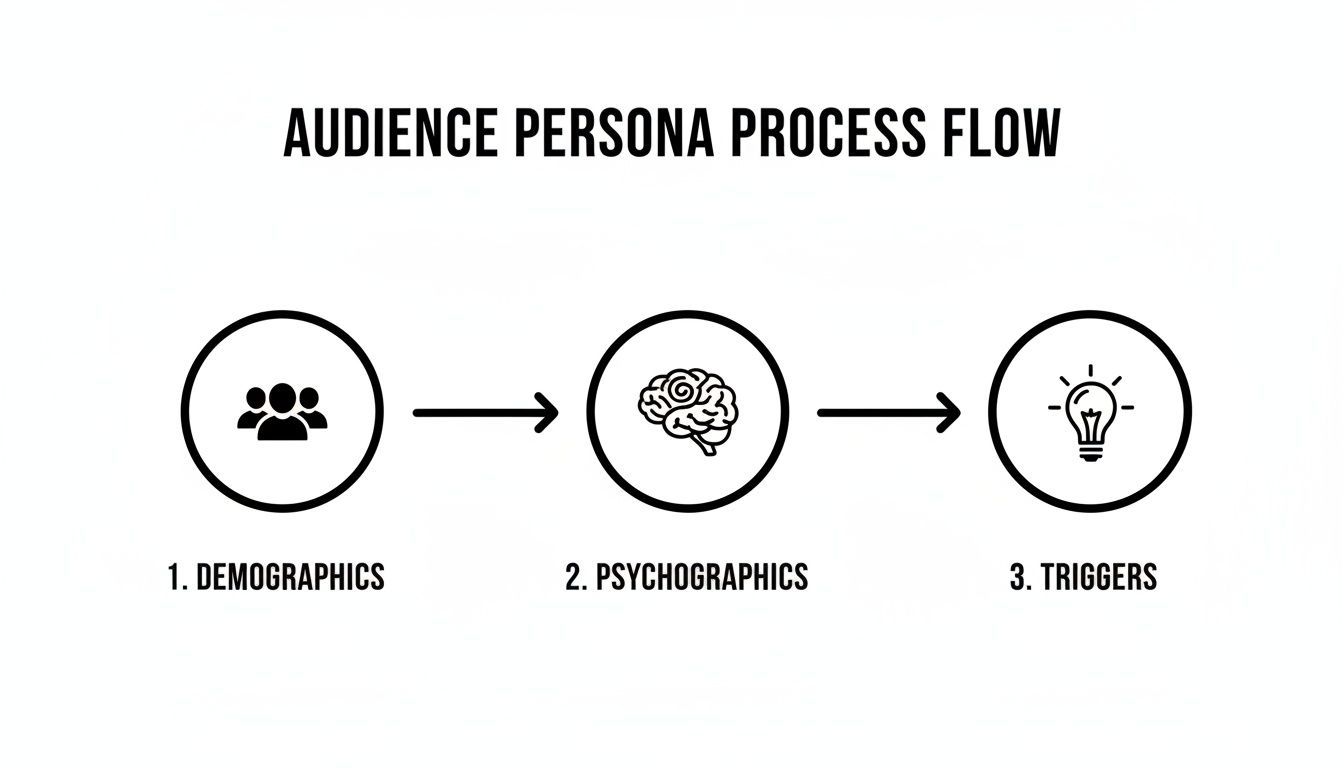
This is the process in a nutshell. You start with the basics (demographics) but then dig deeper into why people buy (psychographics and triggers). This gives the AI the emotional context it needs to create something that actually connects with people, not just a generic ad.
From Vague Ideas to Actionable Prompts
Let’s ditch that weak water bottle prompt and build something that works. A killer brief breaks your request down into specific, non-negotiable components. This detail strips away any ambiguity and points the AI directly toward your strategic goals from the very first try.
You also have to think about where the ad will live. The way you create TikTok ads is completely different from how you’d approach a YouTube pre-roll. The platform's vibe and user expectations should absolutely shape your instructions on pacing, style, and tone.
The Golden Rule of Briefing: Write your brief as if you’re hiring a human freelancer who knows nothing about your brand. If a person could misinterpret it, an AI definitely will.
Building Your Master Brief Template
To make this repeatable, it's smart to have a go-to template. Think of it as your pre-flight checklist. It ensures you never forget a critical detail and gives the AI everything it needs to nail the assignment.
Here’s a simple structure you can drop right into a tool like ShortGenius or adapt for any AI ad generator you're using.
The Essential AI Ad Brief:
- Campaign Goal: What’s the primary objective? Be specific. (e.g., "Drive 500 first-time purchases with a target CPA of $25.")
- Target Audience: Who are we talking to? Use your persona. (e.g., "The Overwhelmed Achiever, a 32-year-old project manager who feels guilty about ordering unhealthy takeout.")
- Core Message & Hook: What's the one thing they must remember? And how do you grab their attention? (e.g., "Our meal kit saves you time without sacrificing your health goals. Hook: 'Tired of the 6 PM dinner scramble?'")
- Platform & Format: Where will this ad run? (e.g., "15-second UGC-style TikTok video (9:16 aspect ratio).")
- Tone of Voice: Pick 3-5 descriptive words. (e.g., "Energetic, relatable, encouraging, slightly witty.")
- Visual Direction: What should it look like? (e.g., "Show the product in a real, slightly messy home kitchen. Talent should look relieved, not like a pro model.")
- Call to Action (CTA): What do you want them to do right now? (e.g., "Shop Now and get 50% off your first box.")
- Mandatories & Restrictions: What absolutely must (or must not) be included? (e.g., "Must display our logo in the final frame. Do not mention competitors by name.")
This isn't just a list; it's a blueprint for success.
A Real-World Example in Action
Let's put this template to work with our water bottle idea. We're going from "Make a fun ad" to something an AI can sink its teeth into.
Completed Brief for "Eco-Flow Bottle":
- Campaign Goal: Achieve a 2.5% click-through rate to our product page.
- Target Audience: Fitness enthusiasts aged 25-35 who are eco-conscious and fed up with leaky, hard-to-clean water bottles.
- Core Message & Hook: The Eco-Flow Bottle is leak-proof and sustainable—the perfect gym partner. Hook: "Is your water bottle secretly sabotaging your workout?"
- Platform & Format: 15-second Instagram Reel ad.
- Tone of Voice: Upbeat, motivational, and confident.
- Visual Direction: UGC style. Show someone at a real gym, confidently tossing the bottle into their bag. No leaks. Get a close-up of the easy-to-clean wide mouth.
- Call to Action (CTA): "Upgrade Your Hydration. Shop Now."
- Mandatories & Restrictions: Use our brand font (Montserrat) for on-screen text. Avoid sterile, plastic-looking gym equipment in the background.
See the difference? This gives an AI generator like ShortGenius specific, actionable guardrails. Now it can produce creatives that are on-brand, on-strategy, and on-point from the get-go. This is how you stop hoping for a good result and start engineering one.
8. Iterate and Evaluate: Turning Good Ads into Great Ones
Here’s a hard truth: your first AI-generated ad will rarely be the final version. Think of it as a talented junior creative’s first draft—full of potential, but in need of your expert guidance to get it across the finish line.
The real power of AI isn't about getting a perfect result on the first try. It's about the speed at which you can test, learn, and refine. This is where your detailed brief transforms from an instruction manual into a strategic compass for intelligent iteration.
Too many marketers get hung up on whether the first output is visually stunning. But a beautiful ad that misses the strategic mark is just expensive art. Your evaluation has to be a critical, structured review that ties every element back to the goals and audience you defined from the start.
Your Post-Generation Gut Check
Before you even think about tweaking your prompt, run the AI’s output through a quick, objective checklist. This forces you to look past the shiny visuals and focus on what actually moves the needle.
- Brand Alignment: Does this feel like us? Check the tone, colors, fonts, and overall vibe. If your brief called for an "energetic and witty" tone, does the ad deliver that, or does it sound flat and corporate?
- Message Clarity: Is the core message hitting home instantly? A viewer needs to get the main point within the first 3 seconds. If it’s confusing, it’s not going to work.
- CTA Effectiveness: Is the call-to-action clear and compelling? More importantly, does it match your campaign goal? "Shop Now" is great, but it’s the wrong move for a top-of-funnel awareness campaign.
- Platform Fit: Does this ad look like it belongs here? A slow, cinematic ad will get scrolled past on TikTok, while a chaotic, meme-filled ad will feel completely out of place on LinkedIn.
- Emotional Resonance: Does it actually connect with your audience’s pain points? If you asked for "empathy," does the ad genuinely reflect understanding, or is it just listing problems?
This simple process turns a subjective "I like it" or "I don't" into a strategic analysis. It helps you pinpoint exactly what to fix, which is the key to giving the AI useful feedback for the next round.
Creating a Structured Feedback Loop
Once you've spotted the gaps, you need to translate that feedback into better instructions. Vague feedback like "make it more exciting" is just as useless for an AI as it is for a human designer. Get specific. This is a core part of learning how to brief an ai ad generator for better results.
Let's say the first ad for your meal-kit service came back with a generic, robotic voiceover.
- Weak Feedback: "Make the voiceover better."
- Strong Feedback: "Regenerate the voiceover with a warm, empathetic female voice, around 30-40 years old. The tone should be like a helpful friend giving advice, not a salesperson. Slow the pacing slightly during the intro."
The point of iteration isn't just to fix what's broken; it's to systematically improve performance. Treat each generation as a new data point, and you can refine your creative with surgical precision, turning a decent ad into a high-converting machine.
Use AI for Rapid-Fire A/B Testing
One of the biggest wins with a tool like ShortGenius is the ability to spin up multiple variations for testing. Instead of just fixing one ad, use your evaluation to build out a full testing plan.
- Test Your Hooks: If the first 3 seconds feel weak, brief the AI to generate three new hooks. You could try one that’s question-based, one that’s problem-focused, and one with a surprising visual to see what stops the scroll.
- Test Your CTAs: Generate two versions of the ad with different calls-to-action. Pit "Learn More" against "Get Your Free Trial" to see which drives more qualified clicks.
- Test Your Visuals: If you’re not sold on the creative direction, ask for two completely different styles. For example, "Generate one version with a clean, minimalist aesthetic and another with a bright, energetic UGC feel."
This strategy shifts you from a slow, linear revision cycle to a parallel testing framework. You're no longer just trying to create one "perfect" ad. You're deploying a small army of creatives to discover what your audience actually responds to—the fastest path to better results.
Troubleshooting Common Ad Generation Hurdles
Even with a killer brief, AI can sometimes go off the rails. It happens. When an AI ad generator like ShortGenius gives you something unexpected, don't think of it as a failure. Think of it as a clue—a signal that a small tweak in your brief can get you exactly what you need. Learning to read those signals is what separates the pros from the novices.
The most common issue I see? Generic ads. The copy is fine, technically, but it has zero personality. It just… exists. This usually means your brief was too vague or objective. The fix is to give the AI more to work with—more emotion, more sensory details, more personality.
Correcting Off-Brand or Generic Ads
Simply telling the AI to be "friendly" isn't enough. Whose version of friendly are we talking about? A bubbly barista? A wise old mentor? You have to paint a picture.
- Vague Prompt: "Use a friendly and confident tone."
- Better Prompt: "Write this like a trusted fitness coach talking to a client. Be encouraging and knowledgeable, but not preachy. Avoid corporate-speak and focus on their personal goals."
See the difference? That extra layer of context gives the AI a character to embody, which instantly makes the ad feel more human and, more importantly, more like your brand.
Another classic hiccup is when the AI latches onto the wrong feature or completely misses the point of your product. This happens when you assume the AI has the same industry knowledge you do. Spoiler: it doesn't. You have to spell everything out.
Let's say you're promoting a SaaS tool and the AI spits out an ad that’s obsessed with a minor, barely-used feature. That’s on the brief. It was probably too broad. You need to tell the AI exactly what to focus on and what to ignore.
Here’s how you’d refine a prompt for a SaaS product:
"Create a 30-second ad script for our project management tool. The ad must focus only on our 'Automated Reporting' feature. The main problem we solve is the hours managers waste building manual reports every week. Your hook needs to be some variation of, 'Stop wasting Mondays fighting with spreadsheets.' End with a clear call to action: 'Start Your Free Trial.'"
This is so specific that it's almost impossible for the AI to misunderstand. You’re telling it precisely which problem to solve, which feature to highlight, and what you want the audience to do next. When you treat these "bad" outputs as feedback, you’ll learn how to guide the AI to create brilliant work every single time.
Got Questions? We've Got Answers
When you're figuring out how to get better ads from an AI generator, a few questions always pop up. Let's tackle the most common ones I hear from marketers so you can get the most out of tools like ShortGenius.
Just How Detailed Does My AI Ad Brief Need to Be?
Think of it this way: could a freelance creative who knows nothing about your brand read your brief and nail the ad on the first go? If the answer is no, it’s not detailed enough.
You need to spell everything out. That means covering your specific campaign goal, digging into audience psychographics, defining the brand voice, clarifying the core message, and stating the exact call-to-action. Don't forget to list any visual must-haves or absolute no-gos. The more objective you are, the less room there is for the AI to misinterpret your vision.
Can I Just Reuse the Same Brief for TikTok and YouTube Ads?
I see people try this a lot, and it's a surefire way to get mediocre results. While your core message might be consistent, you absolutely need to adapt your brief for each platform. User expectations on TikTok are worlds apart from those on YouTube.
For a TikTok brief, you'd want to specify things like:
- Quick, snappy editing with fast cuts.
- Ideas for incorporating trending audio.
- A raw, authentic, UGC (user-generated content) style.
A YouTube brief, on the other hand, needs to focus on a compelling hook in the first five seconds to beat that "skip" button. You might ask for a more narrative-driven opening. Customizing the brief is the only way to make sure the AI plays to the strengths of each platform.
The single biggest mistake I see? Using vague, subjective instructions. Phrases like 'make it cool' or 'make it pop' are completely useless to an AI. They're just not translatable into concrete creative directions.
What's the Biggest Mistake People Make When Briefing an AI?
It all comes down to translating your creative ideas into objective, actionable commands. Vague requests are the enemy of good AI-generated content.
Instead of asking for an "exciting" ad, tell the AI to "use fast cuts, upbeat electronic music, and energetic camera movements." Rather than saying "make it trustworthy," instruct it to "use a calm, confident female voiceover and show customer testimonials on screen." This kind of precision eliminates the guesswork and gets the AI on the same page as you, fast.
Ready to put these ideas into action? With ShortGenius, you can take a well-crafted brief and get back high-performing ad concepts, scripts, and visuals in minutes. It's time to stop the back-and-forth and start creating ads that actually work.