How Agencies Use AI to Scale Facebook Video Ads

Learn how agencies use AI to scale Facebook video ads with proven strategies for creative automation, advanced targeting, and data-driven performance analysis.
So, what's the secret sauce for agencies scaling Facebook video ads these days? It's not about working harder or hiring more people. It's about working smarter by weaving AI into the entire campaign lifecycle. They're using it for everything from dreaming up endless creative ideas to laser-targeting audiences and crunching performance data on the fly.
This isn't just a minor tweak to the old way of doing things. It's a complete operational overhaul that turns a manual, time-sucking grind into a slick, data-driven machine. The result? Agencies can handle more clients, get better results, and finally get ahead of the curve.
From Manual Grind To AI Advantage
Let's be honest, the old agency workflow for Facebook video ads was a slog. It was a constant battle against the clock and creative burnout. Media buyers would spend countless hours manually building audiences, tweaking bids, and trying to make sense of performance reports. Meanwhile, the creative team was on a treadmill, struggling to pump out enough video variations to keep campaigns from going stale.
Every single test was a major investment of time and money, which naturally limited how much you could experiment. This old model was riddled with bottlenecks. A single video ad could take weeks to go from concept to live campaign—scripting, shooting, editing, approvals, revisions… you know the drill. By the time you got performance data, you were already looking in the rearview mirror, making it tough to pivot quickly. Trying to scale this system just meant throwing more bodies at the problem, driving up overhead without any guarantee of better performance.
The New Operational Model
What we're seeing now is a fundamental shift in how high-growth agencies operate. Instead of a slow, linear process, the modern workflow is a continuous, automated loop of optimization and learning.
This flowchart breaks down exactly what that transformation looks like:
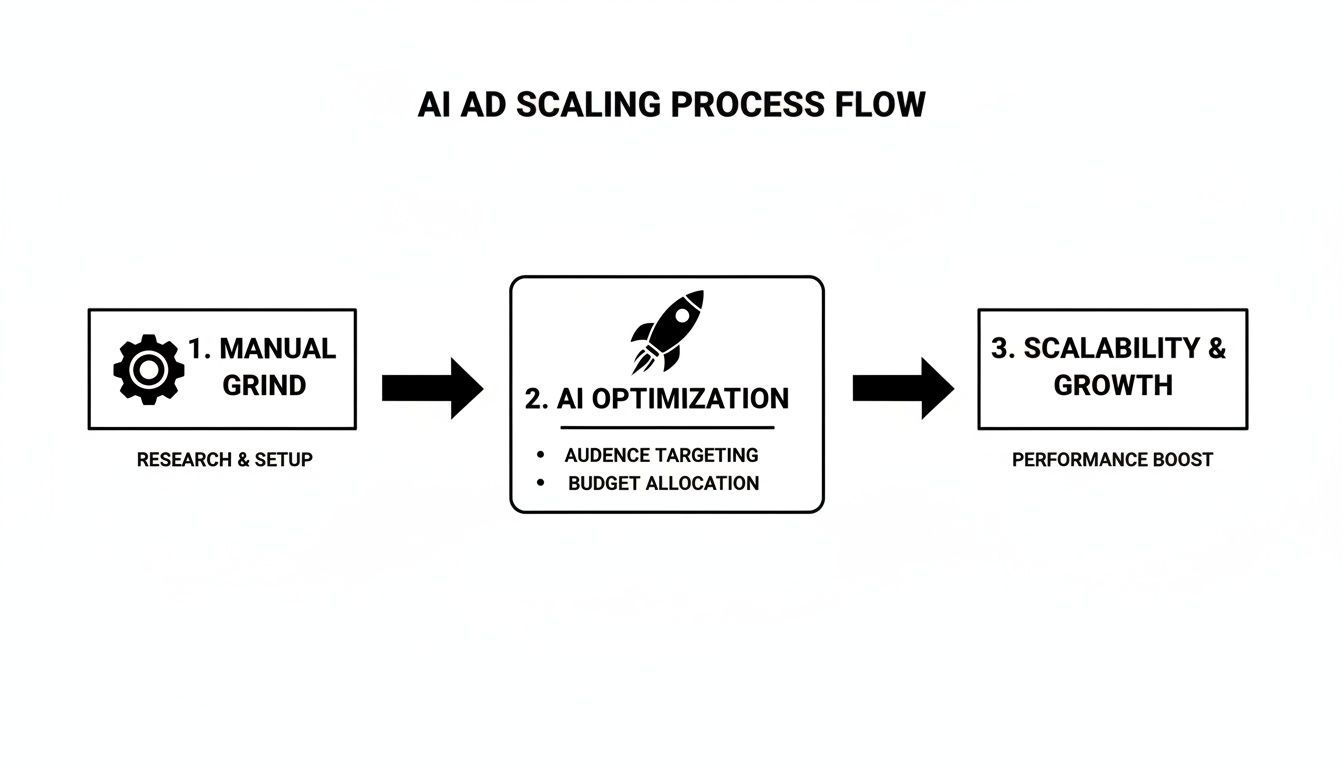
The big picture here is that AI doesn't just make old tasks faster. It unlocks a completely new, more powerful way to grow.
AI tools are now doing the heavy lifting, freeing up agency teams to focus on high-level strategy instead of getting bogged down in the weeds of execution. Just look at the numbers. In 2023, Meta's own Advantage+ Shopping Campaigns produced a 17% lower cost per acquisition (CPA) and a 32% higher return on ad spend (ROAS) compared to manual campaigns. We're seeing agencies launch 5x more video ad sets every week simply by letting AI generate the creative variations for them.
This isn't about replacing talented people; it's about amplifying their strategic impact. AI automates the repetitive tasks, freeing up creatives to focus on big ideas and media buyers to become campaign architects who oversee the system.
This new playbook is how agencies are hitting levels of scale and efficiency that were unthinkable a few years ago. They can test more ideas, learn from the data faster, and ultimately drive much better ROI for their clients.
For a clearer picture, let's contrast the two approaches.
Traditional vs AI-Powered Agency Workflow
This table shows the night-and-day difference between the old, manual grind and the new, AI-driven workflow.
| Process Stage | Traditional Agency Method (Manual) | AI-Powered Agency Method (Automated) |
|---|---|---|
| Creative Ideation | Hours of brainstorming, subject to creative block. | AI generates hundreds of angles and hooks based on top-performing ads. |
| Video Production | Weeks of scripting, shooting, and editing for a few concepts. | Generates dozens of video variants from text prompts in minutes. |
| Audience Targeting | Manually building and testing interest-based or lookalike audiences. | AI finds and optimizes for high-value audience segments automatically. |
| Campaign Launch | Manually setting up campaigns, ad sets, and ads one by one. | Launches hundreds of A/B tests across multiple variables with a few clicks. |
| Performance Analysis | Pulling reports and analyzing data retrospectively. | Real-time analysis and predictive insights to inform budget shifts. |
| Optimization | Manually pausing ads, adjusting bids, and reallocating budget. | AI-driven systems automate budget allocation and kill underperforming ads. |
As you can see, the AI-powered model doesn't just improve each step—it completely redefines what’s possible in terms of speed and scale.
Agencies looking to build out their own AI-powered tech stack often start with platforms designed specifically for this new reality, like LunaBloomAI's platform, which helps automate many of these processes. Integrating tools that can generate video ads directly from a simple text prompt is a game-changer for production timelines. You can learn more about how AI-powered text-to-video models are making this a reality for teams of all sizes.
Automating Creative Production at Scale
If you've been in the agency world for any length of time, you know the single biggest headache for scaling Facebook video ads has always been the creative bottleneck. It used to be a monumental effort. Launching just a few video variations meant weeks of back-and-forth between scriptwriters, designers, and video editors. That entire slow, expensive process is exactly what AI is built to tear down.
Today, we can whip up dozens of high-performing, UGC-style video ad variations for a client in a single afternoon. That’s a job that not long ago would have tied up an entire production team.
This isn’t about robots taking over the creative department. Far from it. It's about amplifying your best ideas. The core strategy, the big idea—that’s still driven by human insight. But all the tedious, repetitive execution? That gets handed off to AI. This frees up your team to test more angles, hooks, and formats than was ever humanly possible, which dramatically stacks the odds in your favor of finding that one breakout ad.
From Script To Video In Minutes
The whole workflow has been flipped on its head. Instead of staring at a blinking cursor on a blank page, one of our creatives can feed an AI tool a simple product description, a target audience, and the campaign goal. The AI spits back multiple script options almost instantly, each hitting a different emotional trigger or value prop.
Let's say we're launching a new skincare product. In seconds, the AI might give us:
- A classic problem-solution script that zeroes in on clearing up acne.
- A relatable testimonial-style script from the perspective of a raving fan.
- An educational script that breaks down the science behind the key ingredients.
Once we pick a direction, the same platform can turn that script into a finished video. It sources stock footage, generates custom scenes, and even lays down a surprisingly natural-sounding voiceover. A single approved concept can become five distinct, test-ready video ads in less than an hour.
The game-changer here is iteration speed. When you see an ad starting to fatigue, you don't have to schedule a new shoot. You just tell the AI to generate new versions of the winning creative with different hooks or visuals. It keeps performance up and costs way down.
Nail Brand Consistency with a Single Click
One of the biggest risks of scaling creative production the old way was brand dilution. You’d have different editors and designers interpreting brand guidelines in slightly different ways, and suddenly your campaigns would look like a mess.
AI fixes this with what's often called a brand kit. We upload a client's logos, color palettes, and fonts one time. From then on, every single video the AI generates automatically has those brand assets baked in. It ensures that even when we’re pumping out dozens of variations, the brand’s identity stays locked in and consistent. That’s a level of quality control that’s almost impossible to get manually at this kind of speed.
Generate Endless Variations to Beat Creative Fatigue
Creative fatigue is the silent killer of otherwise great Facebook campaigns. An ad can absolutely crush it in week one, only to have its ROAS tank by week three because people are just sick of seeing it. The old-school solution was to go back to the drawing board and make a whole new ad. AI gives us a much smarter way to work.
We now use AI to create micro-variations of our top-performing ads. This can be as simple as:
- Swapping the first three seconds for a new, scroll-stopping hook.
- Changing the background music to create a different vibe.
- Tweaking the call-to-action text or button color.
- Re-editing scenes into a new sequence to tell the story differently.
These small tweaks are often all it takes to make the ad feel fresh again to both the algorithm and your audience. You can extend the life of a winning campaign for weeks, sometimes even months. The ability to create high-quality, authentic-looking videos is especially powerful. If you’re looking to scale this specific type of creative, you can learn more about how to generate powerful AI UGC ads that really connect with people.
Smart Repurposing for Every Placement
We all know an ad built for the Facebook Feed is going to bomb as an Instagram Reel. Every placement has its own rules, dimensions, and best practices. Manually chopping up a single video for three or four different placements is mind-numbingly tedious work.
AI tools now handle this for us. With one click, we can take a winning 16:9 video and instantly get a 9:16 vertical version for Reels, a 1:1 square for the feed, and a 4:5 version for other spots. The AI is smart enough to reframe the action, add things like auto-captions where needed, and make sure the final video is actually optimized for that platform. This lets us maximize our reach and performance without tying up our creative team with boring, repetitive edits.
Mastering Audience Targeting with AI
Let's be honest, the old ways of scaling ads by painstakingly layering interests and demographics are dead. We used to spend hours trying to build the "perfect" customer profile, but those days are over. AI has completely flipped the script on audience targeting, and agencies that haven't adapted are being left behind.
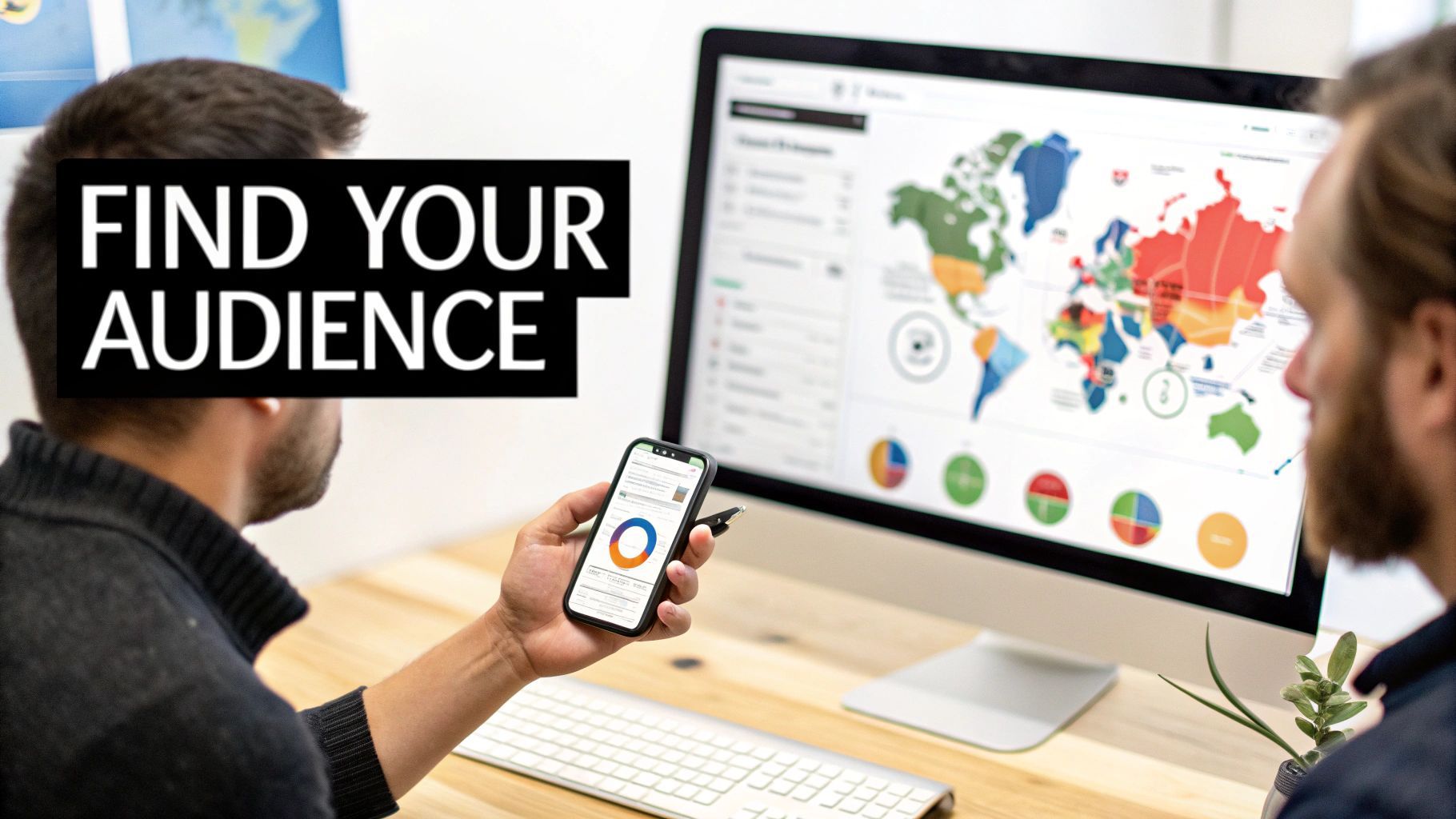
The strategic shift is massive. Instead of telling the platform who to target, we now tell it our goal and let its AI find the right people. Our job has evolved from being an audience builder to a data strategist. We're no longer pulling levers; we're feeding the machine.
Platforms like Meta Advantage+ are the new reality. They crunch trillions of real-time signals—user behavior, on-platform actions, off-platform data—to pinpoint people with the highest probability of converting. It’s a move away from static demographics toward dynamic, real-time purchase intent.
Fueling the Algorithm with High-Quality Data
For these AI systems to really work their magic, they need fuel. And that fuel is high-quality data. This is exactly why a properly set up Conversions API (CAPI) is non-negotiable for any serious agency today. The Meta Pixel is great for browser-side events, but CAPI gives you a direct, server-side line to Meta.
This direct connection bypasses all the usual headaches like ad blockers and browser privacy updates, giving the AI a much cleaner, more complete picture of the customer journey.
Better data leads to smarter decisions. Think about the signals you can send:
- Lead Quality: Don't just tell Meta a lead was generated. Tell it when that lead was qualified by your sales team.
- Customer Lifetime Value (LTV): Show the AI which customers come back for more or upgrade their subscriptions.
- Offline Conversions: Connect the dots between a video ad and an in-store purchase or a phone order.
When you feed the algorithm this kind of rich data, it stops optimizing for vanity metrics like clicks and starts optimizing for what actually matters: business value. It learns to find more people who look like your best customers, not just any customer.
The goal is no longer to build the perfect audience from scratch. The new goal is to provide the AI with the clearest possible signal of what a successful outcome looks like, and then let it find the audience for you. This approach consistently leads to higher ROAS.
The Power of Dynamic Lookalike Audiences
Lookalike audiences were always powerful, but they were static. You'd upload a list, and Meta would find a fixed group of similar users. AI makes this concept dynamic and constantly self-improving.
Advantage+ lookalikes, for instance, don't just find a set group of people and call it a day. The underlying model is always learning. It refines the audience in real-time based on who is actually converting from your ads. If the algorithm uncovers a new, unexpected pocket of users responding well to your videos, it automatically shifts the budget their way.
This self-correcting mechanism is a core reason why AI is so effective for scaling. Your campaigns are always hunting for the most profitable segments without you having to manually intervene 24/7.
While the old manual targeting options still exist, the AI in Advantage+ campaigns treats them as starting suggestions, not strict boundaries. It has the freedom to explore opportunities well beyond your initial inputs to find conversions.
And this is just the beginning. By the end of 2026, Meta's vision is for fully AI-automated ads. An agency could simply provide a business URL, and the AI would handle everything from creative and copy to targeting and optimization. We're already seeing the foundation for this with tools like Advantage+, which have delivered a 22% boost in ROAS compared to manual campaigns. To see where this is all headed, you can read more about Meta's roadmap for AI advertising.
Putting Your Ads to the Test with AI
Every top-tier Facebook ad campaign is built on a foundation of relentless testing. For years, this meant a media buyer painstakingly setting up a few A/B tests—maybe swapping out a headline or pitting two video creatives against each other. It was slow and limited.
AI completely shatters those old limitations. We can now build automated testing frameworks that operate at a scale that was pure fantasy just a few years ago.
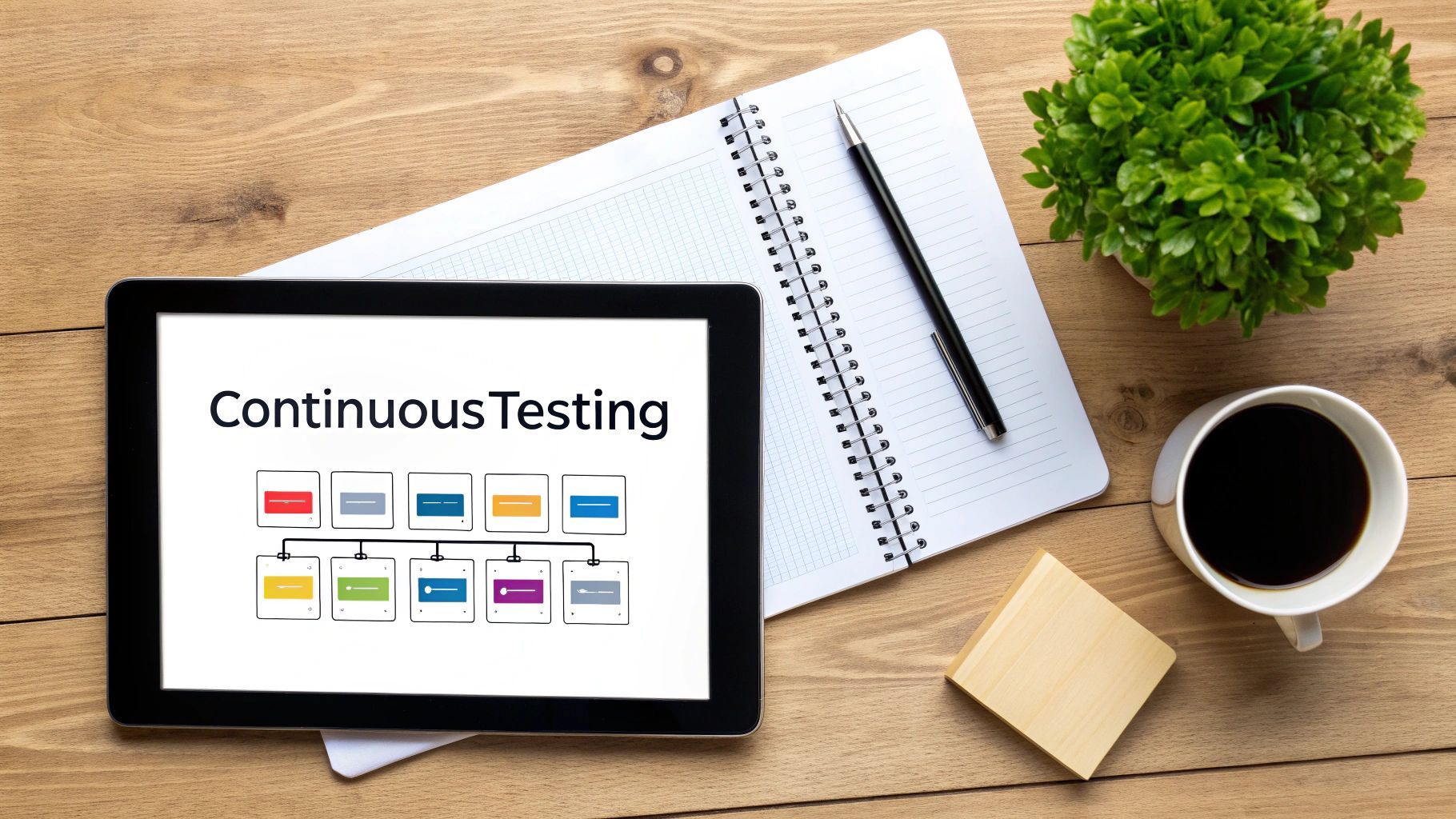
Instead of testing a handful of variables, you can now test dozens at the same time. Imagine testing five different video hooks, four calls-to-action, three unique ad copy variations, and two different background music tracks—all at once. Trying to manage that manually would be an absolute nightmare of ad sets and budget spreadsheets. With the right AI tools, it becomes a smooth, automated workflow.
This really requires a shift in mindset. We're no longer hunting for a single "winner" ad to run into the ground. The new goal is to create a continuous optimization loop, where the data from one test immediately informs the next creative sprint.
Automated Testing and Smart Budgeting
The real magic kicks in when AI platforms start managing the budget allocation for you in real time. It's essentially one massive, hands-off multivariate test. You feed the system all your creative ingredients—the video clips, the headlines, the captions—and the AI does the heavy lifting.
The process starts by showing different combinations of these assets to small segments of your audience. As soon as performance data trickles in, the system intelligently shifts more budget to the combinations that are hitting your goals, whether that's the lowest CPA or the highest ROAS. Any combinations that aren't cutting it are automatically throttled back or shut off completely.
This ensures your ad spend is always being put to its best use, focused on the creative combinations most likely to succeed. It takes human bias and guesswork out of the picture, letting pure data call the shots. For agencies juggling multiple clients, this level of automation is a lifesaver, freeing up countless hours that would have been spent buried in reports and manually tweaking budgets.
The core idea here is speed to insight. An AI-driven framework can pinpoint winning creative elements in just a few days—a process that used to take weeks of manual A/B testing. That acceleration gives you a massive competitive edge.
Building Your AI-Powered Testing Plan
To get the most out of AI-driven testing, you need a plan. This isn't about just throwing random ideas at the wall to see what sticks. It’s about methodically breaking down your creative to figure out exactly which parts are driving performance.
Your plan should focus on isolating variables across every stage of the viewer's journey.
Key Variables to Test with AI:
- The Hook (First 3 Seconds): This is non-negotiable. Test different opening scenes, bold on-screen text, or unexpected audio to find what actually stops the scroll. It's arguably the most critical element of any video ad.
- The Core Creative Angle: Pit your value propositions against each other. For instance, run a video focused on "convenience" against one that highlights "luxury" and see which message truly connects with your audience.
- Captions and On-Screen Text: Play with different lengths, styles, and tones. You might be surprised when a short, punchy line completely outperforms a longer, more descriptive paragraph.
- Calls-to-Action (CTAs): Don't just test the button text ("Shop Now" vs. "Learn More"). Test the verbal CTA within the video itself or the text overlay on the final frame to see what truly motivates a click.
- Thumbnails and End Cards: Where they apply, testing different static images for your thumbnail can have a surprisingly big impact on your click-through rates.
When you load all these creative assets into a smart platform, you're doing more than just finding one winning ad. You're uncovering the DNA of a winning ad. The AI might reveal that a specific hook paired with a particular CTA consistently crushes all other combinations, no matter what the core video is. That single insight is gold, and it can shape every ad you make from that point forward.
This is where a good AI ad generator becomes an essential part of your toolkit, letting you rapidly produce new variations based on these data-backed findings.
Analyzing Performance And Proving ROI With AI
Data is the lifeblood of any campaign, but let's be honest—it’s easy to get lost in a sea of spreadsheets and vanity metrics. For agencies scaling Facebook video ads, the real work isn't just pulling numbers; it's turning those numbers into a story that proves undeniable value to your clients. This is where AI stops being a creative tool and becomes your strategic co-pilot.
AI-powered analytics platforms are built to find the signal in the noise. They crunch massive amounts of data at a speed no human team could match, uncovering hidden patterns and performance drivers that you might otherwise miss. Instead of just telling you what happened, these systems start to explain why.
Imagine an AI flagging a performance dip in your best video ad at 3 PM on a Wednesday. It doesn't just stop there. It can cross-reference that dip with competitor bid activity, audience saturation, and even social sentiment to give you a probable cause. That’s the kind of insight that turns you from a report-puller into a strategic advisor.
Moving Beyond Surface-Level Metrics
Your clients don't really care about a high Click-Through Rate (CTR) if it isn’t ringing the cash register. Proving ROI is all about drawing a straight line from ad spend to real business outcomes. AI sharpens that line by shifting the conversation from flimsy metrics to solid, business-focused indicators.
This means digging deeper into the funnel.
- Predicting Customer Lifetime Value (LTV): AI models can look at new customers and forecast their long-term value. This lets you optimize for high-value acquisitions, not just the cheapest initial conversion.
- Running Incremental Lift Analysis: Did your video ad actually cause that sale, or was the customer going to buy anyway? AI-driven incrementality testing measures the true impact of your campaigns, answering a question clients are always asking.
- Breaking Down Creative Elements: These tools can dissect hundreds of your video ads to pinpoint exactly which elements—a specific hook, a certain voiceover, a particular visual style—are driving the most conversions.
This level of detail changes everything. A single insight—like discovering that videos with user-generated content in the first three seconds drive a 25% higher add-to-cart rate—can redefine your entire creative strategy for the next quarter.
This is how you start having more meaningful conversations with clients, showing them precisely how their investment is paying off. The data backs this up, too. We’re seeing agencies that properly integrate AI report average conversion rates of 9.2%. On top of that, vertical videos with audio are getting a 12% performance lift, all fueled by the machine learning from Meta’s Pixel and Conversions API. If you want to benchmark yourself, it's worth checking out the latest Facebook ads performance statistics to see how the landscape is shifting.
To help clients see the difference, it's helpful to frame the conversation around what truly matters. We've moved away from just reporting on clicks and impressions and now focus on metrics that directly tie to revenue and growth.
Key Metrics For AI-Powered Campaign Analysis
| Traditional Metric | AI-Powered Insight Metric | Why It Matters More |
|---|---|---|
| Click-Through Rate (CTR) | Creative Element Win Rate | Shows which specific part of an ad (hook, CTA, etc.) is driving action, not just that people clicked. |
| Cost Per Acquisition (CPA) | Predicted Customer Lifetime Value (LTV) | Optimizes for long-term profitable customers, not just cheap one-time sales. |
| Impressions / Reach | Incremental Lift | Measures the true causal impact of your ads, proving they generated sales that wouldn't have happened otherwise. |
| Video Views | Audience Saturation Forecast | Predicts when a creative will fatigue, allowing you to proactively refresh ads before performance tanks. |
This shift in focus moves the discussion from ad performance to business performance, which is exactly where you want it to be.
From Reactive Reporting To Predictive Forecasting
The ultimate goal here is to stop looking in the rearview mirror and start seeing what's on the road ahead. The most advanced AI platforms don’t just analyze the past; they use predictive modeling to forecast future campaign outcomes. This is what allows you, as an agency, to make proactive, data-backed decisions.
For example, a predictive model might warn you that your top-performing video ad is on track to hit creative fatigue in the next 10 days. It sees the early warning signs in declining engagement and audience saturation. That's a critical heads-up, giving you time to get fresh creative in the mix before performance falls off a cliff.
This kind of forecasting changes how you manage budgets, de-risk ad spend, and keep the momentum going. You stop reacting to problems and start anticipating opportunities—a far more powerful way to operate. Proving ROI is no longer about a monthly report; it becomes a continuous, forward-looking strategic partnership.
Common Questions on Using AI for Facebook Ads
Diving into AI-driven workflows always kicks up a lot of questions. I see it all the time with agency owners and performance marketers—they see the potential, but the "how" feels a bit fuzzy.
Let's cut through the noise. Here are the most common questions I hear, with straight-to-the-point answers to help you get past those initial hurdles and start seeing a real impact. This isn't about a massive, overnight overhaul. It's about making smart, targeted changes that build momentum and deliver wins right away.
What Is the First Step My Agency Should Take to Start Using AI?
Start with creative. It's the single biggest lever you can pull for performance, and it’s almost always the biggest time suck. Your first move should be adopting an AI creative tool to generate variations of your current top-performing ads.
This gives you an immediate, measurable impact without blowing up your entire process. You can start by testing simple but powerful changes.
- New hooks: Use an AI tool to brainstorm and create five new opening scenes for a video that’s already working.
- Scene shuffles: Re-edit the body of an ad to see if a different sequence hits harder.
- Voiceover variations: Generate a few different voice styles—maybe one energetic, one conversational—and test which one connects best.
Once your team gets comfortable with producing creative this way and sees the results for themselves, the next steps feel natural. From there, you can lean into things like Meta's Advantage+ features for audience targeting and start building a more automated testing process. It's all about a phased approach that builds confidence and minimizes disruption.
How Do I Convince Clients to Invest in AI Tools and Strategies?
Lead with business outcomes, not the tech itself. Clients care about a lower Cost Per Acquisition (CPA), a higher Return On Ad Spend (ROAS), and getting campaigns live faster. "AI" can sound like a buzzword, but numbers are impossible to ignore.
Build a clear business case with specific data. Tell them that AI-driven campaigns have shown a 17% lower CPA on average. Frame it as a competitive edge that gets them better results, faster, while their competitors are still doing everything by hand.
Explain that AI lets your agency test more creative angles at a much higher velocity. This actually de-risks their ad spend. You're no longer guessing—you're finding what works faster and doubling down on proven winners.
A pilot project is your best friend here. Carve out a small piece of their budget for an AI-powered test campaign. Run it head-to-head against a manually managed campaign and let the data tell the story. It makes the value crystal clear.
Will AI Replace My Media Buyers and Creative Team?
No. AI is an amplifier, not a replacement. Think of it as a tool that automates the tedious, soul-crushing tasks, freeing up your team to focus on the high-level strategy where human creativity is irreplaceable. Their roles just get better.
Your media buyers will shift from manually tweaking bids all day to becoming campaign architects. They’ll be the ones overseeing the AI, interpreting the data, and making the big-picture calls on budget and scaling. They evolve from technicians into strategists.
Likewise, your creative team can finally get off the hamster wheel of resizing videos and making endless minor tweaks. Instead, they can pour that energy into developing core concepts, brainstorming breakthrough ideas, and digging into performance data to figure out what to create next.
AI handles the "how," so your people can own the "what" and the "why." It doesn't make your team obsolete; it makes them (and your agency) far more valuable.
Ready to stop the creative grind and start scaling your ads effortlessly? ShortGenius is the AI ad generation platform that helps you produce high-performing video ads in minutes, not weeks. Generate endless variations for testing, keep your campaigns fresh, and drive better results for your clients. Start creating with ShortGenius today