How Agencies Use AI to Scale Facebook Video Ads

Discover how agencies use AI to scale Facebook video ads. Learn the strategies for AI-driven creative, automated targeting, and budget optimization.
If you're finding it tough to scale your Facebook video ad campaigns, you're not alone. In today's crowded market, the old ways just don't cut it. The secret isn't just throwing more money at the problem—it's about adopting a smarter, AI-powered system. Top-tier agencies have cracked the code, using a powerful feedback loop of AI creative tools, automated campaign management, and predictive analytics to manage huge ad spends with incredible efficiency and get far better results.
The Modern Agency's Playbook for Facebook Video Ads
Forget the days of manual, painstaking tweaks to your Facebook campaigns. That old playbook is obsolete. Today's most successful agencies know that scaling video ads isn't about having the biggest creative team; it's about having the most intelligent systems. Their new strategy is built from the ground up with artificial intelligence woven into every single step of the advertising process, completely changing how they work and what they deliver for clients.
This is a massive shift in thinking. Instead of guessing which video will resonate, agencies now use AI to spit out hundreds of creative variations and let the algorithms find the winners. Rather than manually fiddling with bids and budgets, they lean on platforms like Meta's Advantage+ to optimize in real-time. This levels the playing field, allowing smaller, more agile teams to outmaneuver giants by focusing on strategy instead of getting lost in the weeds of tactical execution.
The Key AI Levers for Scaling
At its heart, this new approach is about integrating AI across three critical areas. A deep understanding of how to apply AI for social media marketing is the foundation for making this work. Agencies that get this right find that scaling becomes almost second nature.
Here’s where they focus:
- Automated Creative Production: Using generative AI to write scripts, produce voiceovers, and even generate video assets. This allows them to pump out a huge volume of diverse ad creatives, which is essential for staving off ad fatigue.
- Intelligent Campaign Management: Trusting machine learning platforms like Advantage+ to handle the heavy lifting of targeting, bidding, and budget allocation. These systems are brilliant at finding conversion opportunities that a human would likely overlook.
- Predictive Performance Analysis: Leaning on AI analytics tools to see where a campaign is headed, spot performance trends early, and get solid, data-backed advice on where to shift the budget for maximum impact.
To put it simply, here’s a breakdown of how these components work together to drive scale.
Core AI Levers for Scaling Facebook Video Ads
| AI Component | Function | Impact on Scaling |
|---|---|---|
| Generative Creative | AI writes scripts, creates voiceovers, and generates video assets. | Enables high-volume, diverse ad production to constantly test and refresh creative. |
| Automated Management | Machine learning platforms handle targeting, bidding, and budget allocation. | Optimizes spend in real-time, uncovering hidden conversion opportunities 24/7. |
| Predictive Analytics | AI tools forecast campaign outcomes and identify performance trends. | Allows for smarter budget reallocation and proactive strategy adjustments. |
Mastering these three levers is what separates the agencies that struggle from the ones that scale effortlessly.
By truly embracing an AI-first model, agencies aren't just getting more efficient—they're rewriting the rules of what it costs to scale. The ability to test more ideas faster, spend money more intelligently, and predict outcomes with greater accuracy is what separates a modern, high-growth agency from the pack. This guide is your look inside their playbook.
Creating Endless Video Variations on Autopilot
Let’s be honest: the biggest headache in scaling Facebook video ads has always been the creative bottleneck. Just keeping up with ad fatigue is a full-time job, let alone producing enough fresh video variations to properly test new angles and find what really works. This is where smart agencies are using AI to completely flip the script, transforming creative production from a constant grind into a powerful, automated growth engine.
The workflow today looks nothing like it did a few years ago. Forget drawn-out brainstorming meetings and manual scriptwriting. Now, agencies feed AI tools top-performing ads from their niche, and in return, get dozens of potent hooks and script ideas. This becomes the raw material for a high-volume production sprint.
What’s so powerful about this first step is that it’s baked in data from the very beginning. The AI isn't just taking a wild guess; it's identifying the subtle patterns in language, pacing, and structure that have already been proven to stop the scroll and hold attention on Facebook and Instagram.
From Script to Screen in Minutes
With a batch of promising scripts in hand, the real magic begins. These scripts are plugged directly into AI video generation platforms, which do all the heavy lifting. We're talking about tools that can automatically pull relevant stock footage, generate entirely new AI scenes, or even create authentic-looking user-generated content (UGC) videos without ever hiring an actor. Many agencies now turn to specialized AI-powered UGC video creation tools to make this happen seamlessly.
Think about it in practice. An agency working with a skincare brand can take a single script and instantly spin up multiple ads:
- Version A: A clean, aesthetic ad showing off the product’s benefits with a polished, AI-generated voiceover.
- Version B: An AI-generated testimonial that looks and sounds like a genuine customer review, adding instant social proof.
- Version C: A punchy, problem-solution video that shows the product in action.
Each of these can be created with different visuals, unique voiceovers, and various background tracks in a tiny fraction of the time a human editor would need. A process that used to take days—or even weeks—is now condensed into hours, if not minutes.
The Power of Iterative AI Testing
The real competitive advantage here is the ability to create endless variations for A/B testing. With AI, swapping out a single element across ten or twenty videos to see what moves the needle is no big deal. This kind of granular testing used to be way too expensive and time-consuming to be practical.
Here are a few common variables that AI makes incredibly easy to test:
- Hooks: Test 5 different opening lines for the same video to pinpoint which one most effectively stops users in their tracks.
- Calls-to-Action (CTAs): Generate variations with different end-card text or voiceover CTAs. Think "Shop Now" versus "Learn More."
- Visual Styles: Pit a version with slick animated text overlays against another with raw, unedited footage to see what resonates with your audience.
- Voiceovers: Try a male voice against a female voice, or an upbeat, energetic tone versus a calm, authoritative one.
This is how agencies are truly scaling with AI. They've stopped hunting for a single "perfect" ad. Instead, they’re building an automated system that constantly generates, tests, and identifies winning components to assemble into high-performing campaigns.
This new workflow completely changes the creative team's job. They're no longer stuck in the weeds of manual production. They become strategists, guiding the AI, analyzing the performance data, and doubling down on the creative elements that are proven to deliver results. For agencies wanting to build this kind of efficiency, an AI ad generation platform is an absolute game-changer for pumping out testable creatives at scale.
This approach doesn't just save a massive amount of time. It leads to smarter, data-backed creative decisions, allowing agencies to maintain a constant flow of fresh ad content that keeps campaigns running at peak performance.
Let the Algorithm Drive: Scaling with Meta Advantage+
If your agency is still living in the world of manual ad set creation and hyper-granular audience targeting, you're leaving performance on the table. Period. The agencies that are truly winning at scale have moved on from that hands-on approach and embraced Meta’s most powerful AI engine: Advantage+ campaigns. This isn't just another feature; it’s a complete shift in campaign management, moving from gut feelings to machine-learning precision.
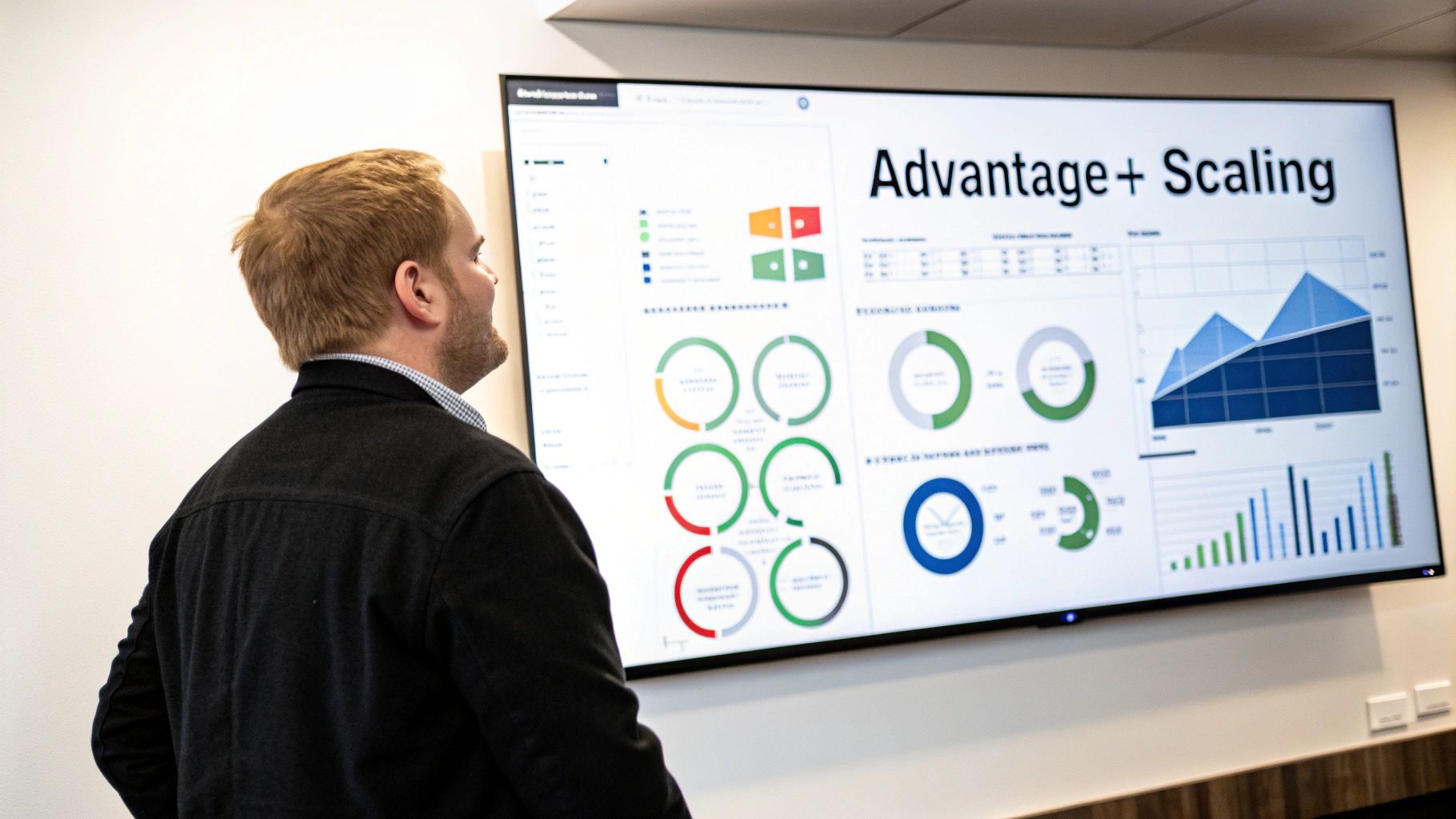
At its core, an Advantage+ campaign simplifies the entire setup. You feed it your best video creative, set a budget, and define your goal (like conversions or leads). From there, Meta's AI takes the wheel. It intelligently spreads your budget across placements like Reels, Stories, and the main Feed, while simultaneously finding the best people to show your ads to. This all happens in real-time, with the system learning and optimizing 24/7—something no human team could ever match.
Swap Granular Targeting for Broad, Rich Signals
One of the biggest mental hurdles for media buyers is letting go of the need to control every single targeting parameter. The old way meant painstakingly building specific interest audiences or super-narrow lookalikes. The new, far more effective strategy? Give the Advantage+ algorithm a rich dataset to learn from, then get out of the way and let it find pockets of conversions you’d never uncover on your own.
Here's a common workflow top agencies are using right now:
- Stack Your Best Audiences: Instead of creating a dozen different ad sets for each lookalike, "stack" multiple high-value lookalikes into a single Advantage+ campaign. For example, you might combine a 1% Lookalike of past purchasers, a 2% Lookalike of your email list, and a 5% Lookalike of website visitors.
- Give the AI a Strong Foundation: This stacking method gives the algorithm a massive, high-intent starting point. It’s not just analyzing one narrow group; it's finding the common threads between all your best customer profiles to build a picture of who to find next.
- Let the AI Explore: With this broad but high-quality input, the AI has the freedom to look beyond your initial lookalike pools. It uses that data as a guidepost, then expands its reach to find entirely new segments that are likely to convert, often surprising even the most seasoned media buyers.
This approach completely changes the game for how agencies use AI to scale Facebook video ads. The focus shifts away from endless A/B testing of audiences and toward a model where you feed the machine the best possible data and let it handle the heavy lifting of finding your next customer.
The philosophy behind Advantage+ is simple but powerful: trust the algorithm. When you feed it great creative and broad, intent-driven audience signals, you're empowering Meta's machine learning to find efficiencies and conversion paths that are invisible to the human eye. It’s about guiding the AI, not micromanaging it.
The Inevitable March Toward Full Automation
Make no mistake, the industry is moving decisively in this direction. Agencies are using Meta's Advantage+ campaigns to automate everything from targeting to creative delivery, and it's only getting more powerful. Soon, these AI-driven campaigns will support up to 50 ads per ad set—a huge jump from previous limits. This lets agencies run campaigns that are almost completely automated, freeing them from constant manual check-ins.
Meta is signaling that this is the new standard. In fact, legacy Automated Ads are scheduled to be phased out in 2026, pushing every advertiser toward this AI-first model. For video ads, especially on Reels, this level of automation is unlocking incredible reach. You can learn more about the future of Meta's AI automation and its impact on Facebook ads to see what's coming.
This shift frees up an agency’s most valuable resource: its people. Instead of spending hours in Ads Manager tweaking bids, strategists can focus on what truly moves the needle—developing killer creative, analyzing high-level performance trends, and planning the next big campaign. It's just a smarter, more scalable way to operate.
Mastering AI-Powered Bidding and Budget Optimization
Taking an ad account from a few thousand a month to a multi-million dollar budget isn't just about having more money to spend. It's about being incredibly smart with every single dollar. For any agency serious about growth, the days of manually tweaking bids and budgets are long gone. The real key to scaling profitably is letting AI manage the money, freeing you up to focus on strategy.
This is where AI-driven bidding becomes your most powerful financial lever. Instead of guessing what a user is worth, these systems make thousands of tiny decisions every second. They look at everything—a user's past behavior, the time of day, their device—to predict the odds of a conversion and bid the perfect amount in real-time.
Let AI Handle the Bidding Math
Automated bidding strategies like Target Cost Per Action (CPA) and Target Return on Ad Spend (ROAS) are the engines of modern budget management. These aren't just simple if-then rules; they're complex machine learning models that get smarter with every dollar your campaign spends.
Picture an e-commerce agency with a client who needs a 4x ROAS, no exceptions. Instead of painstakingly setting manual bids and crossing their fingers, the agency just tells Meta's AI the goal. From there, the algorithm takes the wheel, bidding aggressively for users it thinks will make a big purchase and pulling back for window shoppers. This takes a massive amount of risk out of the scaling process.
The Shift to Predictive Budgeting
On top of Meta's built-in tools, many top-tier agencies are using third-party AI platforms for another layer of financial foresight. These tools can forecast campaign performance with a startling degree of accuracy. What if you could know beforehand which ad sets were about to blow through your budget without hitting their goals?
That's precisely how agencies use AI to scale Facebook video ads without burning cash. These platforms can:
- Forecast Performance: Give you a solid prediction of future CPA and ROAS based on real-time and historical data.
- Spot Reallocation Opportunities: Flag the ad sets that are dragging you down and suggest moving that budget to your proven winners.
- Automate Budget Shifts: Some tools can even be set to automatically pause weak ads and push more spend to the top performers based on rules you define.
This forward-thinking approach gives agencies an edge that just wasn't possible a few years ago. We've seen teams achieve up to 28% greater cost efficiency simply by preventing wasted spend before it happens.
Building AI-Driven Conversion Models
A core tactic agencies use to scale Facebook video ads with AI is leaning heavily on automated bidding strategies like Target CPA and Target ROAS. This isn't a niche strategy anymore—it's been adopted by 84% of advertisers and is becoming the standard. These tools are especially effective for short-form video formats like Reels, which are dominating social feeds.
By building conversion models that analyze past performance, agencies can forecast results and scale ROI effectively. You can dig deeper into the trends in Facebook video marketing to see just how big this shift is.
This kind of intelligent financial management is what lets an agency confidently tell a client, "We can double your spend next month and hold your target ROAS." It's not a guess; it's a projection backed by powerful AI.
By handing off the moment-to-moment financial tinkering to an AI, agency teams are freed from the tactical weeds. Your role shifts from being a button-pusher to a strategic director, focused on feeding the AI great creative and setting the right high-level goals. This is the new playbook for managing large-scale video ad budgets.
Finding Your Best Customers with AI Audience Discovery
The old way of targeting ads on Facebook is officially dead. With third-party cookies on their way out, painstakingly building audiences based on static interests just doesn't cut it anymore. Smart agencies have thrown out that playbook and are now letting AI do the heavy lifting to find new, high-value customer segments. The job is no longer about guessing who your audience is; it’s about feeding the machine the right clues so it can find them for you.
At the heart of this shift is Meta's own recommendation engine, an incredibly powerful AI that learns from billions of user interactions every single day. Every like, share, and video view acts as a signal, training the algorithm to understand what people actually want with scary accuracy.
For agencies, this means we can stop wasting hours trying to nail down hyper-specific interest lists that often miss the mark anyway. The new focus is all about giving Meta’s AI the right starting data and then letting it run.
Let Meta's AI and Your Own Data Do the Work
Meta's recommendation engine is what makes modern audience discovery possible. It’s the reason your feed feels so personalized, and it’s a massive advantage for advertisers. The results speak for themselves: AI recommendations have already led to a 15% increase in Reels watch time and a 7% boost in overall time spent on Facebook. With 140 billion Reels played daily, the AI is constantly learning from a torrent of fresh data. You can dig deeper into these Facebook ad trends on Wordstream.
Top agencies know this and have made video creative their number one priority. It's simple: when people are glued to your videos, the algorithm gets better data on what they like, which feeds right back into more precise targeting for your ads.
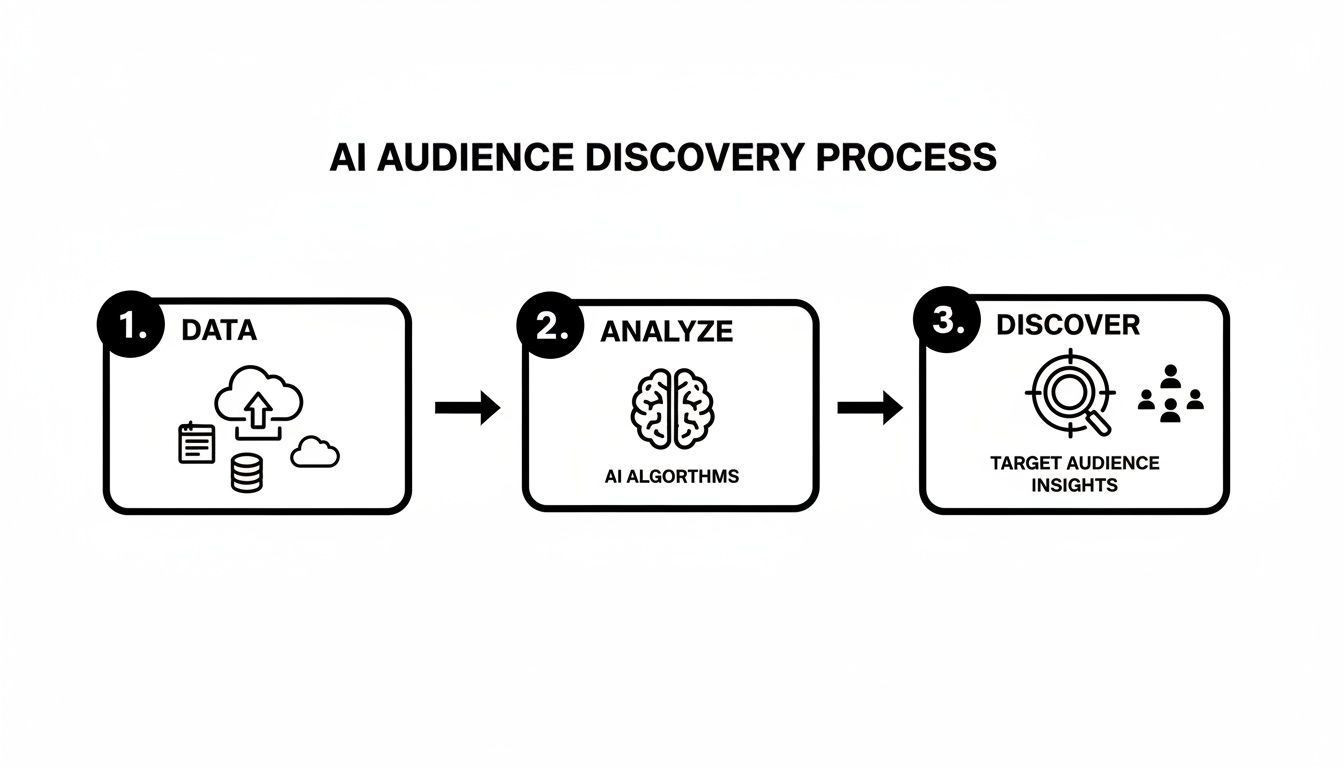
The workflow itself is surprisingly straightforward but powerful. Instead of starting with broad, generic interests, you kick things off by uploading your own first-party data. This is your secret weapon.
- Customer Lists: Your list of past buyers is pure gold. It gives the AI a crystal-clear picture of what a converted customer looks like.
- Email Subscribers: These are people who have already raised their hand and shown interest, making them a fantastic high-intent signal for the algorithm.
- High-Value Website Visitors: Using your pixel, you can create an audience of people who have viewed key pages, added items to their cart, or spent a lot of time on your site.
Once you feed the AI this seed data, it gets to work. It crunches thousands of data points to find users who share similar traits and behaviors but are currently outside your network. This is how you unearth those hidden-gem customer segments you'd never find on your own.
Uncovering Hidden Audiences with Advantage+
This entire AI-powered discovery process is baked right into Meta's Advantage+ campaigns. When you give an Advantage+ campaign a strong signal—like a stacked lookalike audience built from your best customer list—you're doing more than just reaching clones of your existing buyers. You're giving the AI a launchpad to explore and discover entirely new pockets of potential customers.
The real game-changer is shifting your mindset from telling Facebook who to target to showing the AI what a great customer looks like. From there, you trust its machine learning to find more of them, often in places you would have never thought to look.
This is a massive strategic pivot and is central to how agencies use AI to scale Facebook video ads today. The process is less about endless manual adjustments and more about smart, strategic data input. Your agency's role shifts from being an "audience architect" to being a guide for a powerful discovery engine. This not only drives better performance but also frees up your team to focus on what humans do best: creating killer video content that gives the AI the best possible fuel to work with.
Building an AI-Driven Agency Workflow
If you want to truly scale Facebook video ads with AI, you can't just bolt on a few new tools. It requires a fundamental shift in how your agency operates. The old way—endless manual tweaks and poring over spreadsheets—is simply too slow to keep up. The agencies winning right now are the ones rebuilding their entire workflow with AI at the very center.
This new approach changes what your team actually does. The day-to-day focus shifts from getting lost in the weeds of campaign management to providing high-level, strategic direction. This has given rise to a new, critical role: the AI Campaign Strategist.
This person isn't manually adjusting bids or swapping out ad copy. Their job is to steer the ship. They feed the AI the right creative, interpret its performance data, and make the big-picture calls that align the automated system with the client's business objectives.
The Three-Phase AI Workflow
To make this practical, we've seen agencies adopt a simple but powerful three-phase workflow. Think of it as a repeatable playbook that keeps everyone on the same page and ensures you're getting the most out of your tech.
-
Phase 1: The Creative Sprint. This is all about volume and variety. The team uses AI tools to churn out hundreds of video ad variations. We're talking different hooks, unique visuals, multiple calls-to-action—everything you can think of. The objective is to create a massive pool of diverse creative for the algorithm to test.
-
Phase 2: The AI Testing Ground. All those creative assets get launched into a broad Meta Advantage+ campaign. This campaign essentially becomes a live sandbox. Instead of you guessing what works, you let Meta's AI do the heavy lifting, identifying the top-performing ads based on real-time user engagement and conversion data.
-
Phase 3: Strategic Scaling. After letting the test run for about 3-5 days, the winners become clear. The AI has shown you what resonates. At this point, the strategist steps in, pauses all the underperformers, and consolidates the entire budget behind the handful of ads that the AI has proven to work. Then, it's time to scale hard.
This cycle is the core of modern, AI-powered media buying: gather data, let the AI analyze it, and then act decisively on the insights.
When you structure your agency this way, you're not replacing people with technology. You’re freeing up your sharpest minds to focus on strategy, which is where they create the most value, while letting the machines handle the tactical, repetitive work they were built for.
Common Questions About AI in Facebook Ads
When agencies start exploring an AI-first approach to advertising, a lot of practical questions pop up. It's totally normal. Everyone wants to know what to expect and how to navigate the inevitable bumps in the road. Let's walk through some of the most common concerns I hear from agency owners.
How Much Control Do We Really Give Up?
This is usually the first question, and it's a big one. The idea of handing over budget and targeting decisions to an algorithm can be unnerving, especially when you've built your reputation on meticulous manual campaign management. When agencies learn how agencies use ai to scale facebook video ads, they often worry about losing that hands-on control.
But here’s how you should reframe it: you're not giving up control, you're just changing what you control.
Instead of getting bogged down in the weeds of bids and placements, your team's energy shifts to a much higher-level, strategic role. You focus on feeding the AI the best possible inputs—the killer creative, the high-quality customer lists, the right campaign objectives like a specific Target ROAS. The AI just handles the tactical busywork faster and more effectively than any human ever could. Your job becomes guiding the machine, not pulling all the tiny levers yourself.
Can AI Really Be Creative?
I get this a lot from creative directors, and the skepticism is understandable. Can a machine truly come up with a compelling video ad? The short answer is no, not entirely. But that's the wrong way to look at it.
AI isn’t here to replace human ingenuity; it’s here to become an incredibly powerful creative partner. Think of it as a super-assistant. It can spit out dozens of script hooks in seconds, brainstorm visual concepts based on what's already working, and generate endless variations of an ad for testing.
The real magic happens with human-AI collaboration. Your creative team brings the core concept and the strategic vision. The AI then handles the high-volume, repetitive work required to test and find winning combinations at scale.
This frees up your best creative minds from the grind of making 15 slightly different versions of the same ad, letting them focus on the next big, game-changing idea.
Is It Expensive to Implement AI Tools?
Cost is always a concern, particularly for smaller, leaner agencies. The good news is that the AI tool landscape is becoming more accessible every day. Many of the most powerful features are now baked right into platforms like Meta Ads Manager for free.
For more specialized third-party tools, you have to think in terms of ROI, which is often surprisingly fast.
For instance, an AI video generator might seem like another monthly expense. But if that tool saves your team 40 hours of production time in its first month and helps you land on a winning creative that doubles a client's return on ad spend, it has paid for itself many times over. My advice is to start small. Pick one or two tools that solve a major bottleneck, prove their value, and then build out your AI stack from there.
Ready to automate your creative production and scale your video ads effortlessly? ShortGenius is an AI ad generation platform that helps you produce high-performing video ads in minutes, not days. Generate scripts, UGC-style scenes, and endless variations to find what works best. Start creating with ShortGenius today!