faceless youtube channel: Grow fast with AI content

Learn how to run a faceless youtube channel with smart niche picks, AI content, SEO tactics, and monetization - no face needed.
Ever wondered how some YouTube channels get millions of views without anyone ever showing their face? A faceless YouTube channel is exactly that—a content-first approach where the creator stays completely behind the scenes. The whole idea is to make your content the star of the show, using a smart mix of voiceovers, stock footage, animations, or screen recordings to build a loyal audience, all while keeping your privacy intact.
The Blueprint for a Successful Faceless Channel

The thought of building a huge YouTube following without ever pointing a camera at yourself might seem a little strange at first. But in reality, it’s become one of the most effective and accessible ways to build a business on the platform. This isn't just a strategy for introverts; it's a deliberate choice that disconnects the brand from a single person, which opens up some incredible doors for growth and efficiency.
Success here is all about shifting the focus from the creator's personality to the raw value of the content. You're not relying on charm to carry a video. Instead, you're leaning on powerful storytelling, sharp visuals, and crystal-clear audio. It’s solid proof that you don't need to be an "influencer" to make a real impact—or a real income.
Why Are So Many Creators Going Faceless?
The appeal goes way beyond just wanting to stay anonymous. For a lot of people, it's about building a sustainable content operation that doesn't demand their physical presence. It just makes the whole process easier to scale. You can bring on scriptwriters, voice actors, and video editors to create content 24/7. In effect, you're building a media company, not just a personal channel.
Just think about the practical advantages:
- Zero "On-Camera" Pressure: You can forget about being camera-ready. No more worrying about lighting, what you're wearing, or how you look. All that energy goes directly into the quality of the final product.
- Built for Scale: A faceless channel is a system waiting to happen. Once you dial in your workflow, you can hire a team to run the playbook, letting you manage multiple channels at once without burning out.
- Total Privacy: You get to share your knowledge and build a community without giving up your personal life. This shields you from the intense public scrutiny that often comes with being a well-known creator.
The core idea is simple but incredibly powerful: When the content is the celebrity, your production process becomes an assembly line for value. You're not building a personal brand; you're building a content engine.
Before diving in, it helps to understand the key components that make these channels work. I've broken them down into a simple table to give you a quick overview.
Core Pillars of a Profitable Faceless Channel
A quick overview of the essential components for building and scaling your faceless YouTube channel.
| Pillar | Key Objective | Example Tactic |
|---|---|---|
| Niche Selection | Find a high-demand, low-competition topic you can dominate. | Target "evergreen" search terms like "how to invest for beginners" instead of chasing trends. |
| Content System | Create a repeatable workflow for producing high-quality videos efficiently. | Use AI tools for script outlines and a fixed template for video editing to speed up production. |
| SEO & Discovery | Optimize videos so YouTube's algorithm promotes them to the right audience. | Craft keyword-rich titles and descriptions; design thumbnails with high-contrast colors and bold text. |
| Monetization Strategy | Build multiple income streams beyond just YouTube ad revenue. | Promote affiliate products, sell digital courses, or create a paid membership community. |
Getting these four pillars right is the difference between a channel that fizzles out and one that becomes a sustainable, profitable business.
It's a Proven Business Model
If you have any doubts about whether this can actually make money, just look at the numbers. Faceless channels aren't just a fun side project; they're legitimate, high-earning media businesses. Creators in niches like finance, history documentaries, guided meditation, and software tutorials are pulling in serious income without ever showing their faces.
The financial potential is incredible. We're talking about solo creators who have built entire portfolios of faceless channels that generate six-figure incomes every month. For example, one well-known creator runs three separate channels—one on documentaries, another on the food industry, and a third on legal drama—that together bring in around $250,000 per month. That kind of success comes from leveraging multiple revenue streams, not just ads. You can find more details about these kinds of faceless channel monetization strategies on UNKOA.
It’s clear that with the right strategy, a faceless YouTube channel is one of the most lucrative ventures you can start online today.
Finding Your Profitable Faceless Niche
Choosing your niche is the single most important decision you'll make for your faceless YouTube channel. So much of the advice out there is to just "follow your passion," but that's a quick way to end up in a crowded market fighting for scraps.
Real success happens when you find that sweet spot where genuine audience demand, strong earning potential, and your own interest all overlap. This isn't just about picking a topic; it’s about identifying a specific audience and the problems you can solve for them. Think less about a massive category like "history" and more about something laser-focused, like "the logistics of ancient battles." That’s how you stand out.
Moving Beyond the Obvious Ideas
Let’s be honest, most new creators jump on the same handful of niches—motivational quotes, luxury lifestyle videos, or rain sounds—and then wonder why they can't get any traction. They're oversaturated. To find a truly profitable niche, you have to dig a little deeper.
Your goal should be to find topics with a high RPM (Revenue Per Mille). This just means advertisers are willing to pay more to get in front of that specific audience.
Instead of the usual suspects, think about these high-potential areas:
- Deep-Dive Documentaries: Channels like ColdFusion are a perfect example. They tell incredible stories about tech and business using nothing but stock footage, slick animations, and a great narrative voice.
- Hyper-Specific Software Tutorials: Don't just make "Excel tips" videos. Get specific. "Automating financial reports for small businesses using Zapier and Google Sheets" targets a professional audience with a real problem, making your content incredibly valuable.
- Guided Meditations and Affirmations: This is a perfect faceless format. The entire experience is auditory, so you can pair a soothing voice with simple, calming visuals like abstract animations or peaceful landscapes.
The real secret to a great niche is finding an audience that is already searching for answers, solutions, or deep entertainment. You don't have to invent demand. You just have to find it and serve it better than anyone else.
When you do this, you’re creating videos people are actively looking for. This gives the YouTube algorithm crystal-clear signals about who to show your content to.
Analyze Your Competitors to Find the Gaps
Got a few ideas? Great. Now it’s time to do some recon. Your mission is to analyze the competition, but not to copy them. You're looking for what they aren't doing. That's where you'll find your opening.
Just head over to YouTube's search bar and start typing in your potential keywords. Pull up the top-ranking videos and start asking some critical questions:
- What are people asking in the comments? Unanswered questions are pure gold. If viewers are constantly asking for a deeper explanation or a follow-up video, you've just found a clear content gap.
- How could the visuals be better? Maybe the top videos use cheesy stock footage or have terrible audio. You can get an immediate advantage simply by upping your production value.
- Is there a unique angle they're all missing? If every finance channel is talking about picking stocks, maybe you can create a channel all about the psychology of spending and saving. It’s a fresh take on a proven topic.
This process isn't about ripping off what works. It's about using other channels as market research to pinpoint what viewers are craving but not getting. Then you can build your entire content strategy around filling those gaps and becoming the go-to resource.
The Power of Anonymity
The faceless model isn't some new-age gimmick; it's a proven business model. History is filled with channels that prove a strong brand and valuable content are far more important than seeing a creator's face.
Take Dream, for example, who blew up in the gaming world and amassed 32.6 million subscribers while remaining anonymous for years. Or look at a content giant like 5-Minute Crafts, which has reached an incredible 81 million subscribers with simple DIY videos. They are undeniable proof that you don't need to be on camera to build a massive, loyal audience. You can discover more insights on successful faceless channels at Beatoven.ai.
Here’s the final test: your niche should excite you enough that you could sit down right now and brainstorm at least 50 video ideas. If you can't, it might not have the long-term legs to sustain a channel. The right choice will feel less like a job and more like a fascinating world you can't wait to explore—with a clear path to profitability.
Using AI Tools and Smart Production Workflows
Let's be honest, building a successful faceless YouTube channel used to be a grind. It meant either having a big team or spending a fortune on gear. Not anymore. Today, the secret isn't a bigger budget; it's a smarter system. Modern AI tools have completely flipped the script, letting a single person create a content assembly line that can outpace much larger operations.
This streamlined workflow is your unfair advantage. It lets you go from a spark of an idea to a polished, ready-to-publish video in a surprisingly short amount of time, all without sacrificing quality. It’s like having a dedicated writer, a voice artist, and a video editor on call 24/7.
The AI-Powered Content Assembly Line
The modern production process breaks down video creation into simple, manageable stages, with AI lending a hand at every turn. This isn't about letting a robot take over your channel. It's about letting technology handle the boring, repetitive tasks so you can stay focused on the creative vision.
This approach changes everything. Instead of getting lost in the technical weeds of editing software or audio mixing, you get to be the director. You guide the AI tools to bring your ideas to life. This systematic method is the key to pumping out content consistently without burning yourself out.
Before you even hit record, though, you need a solid niche. This is where it all starts.
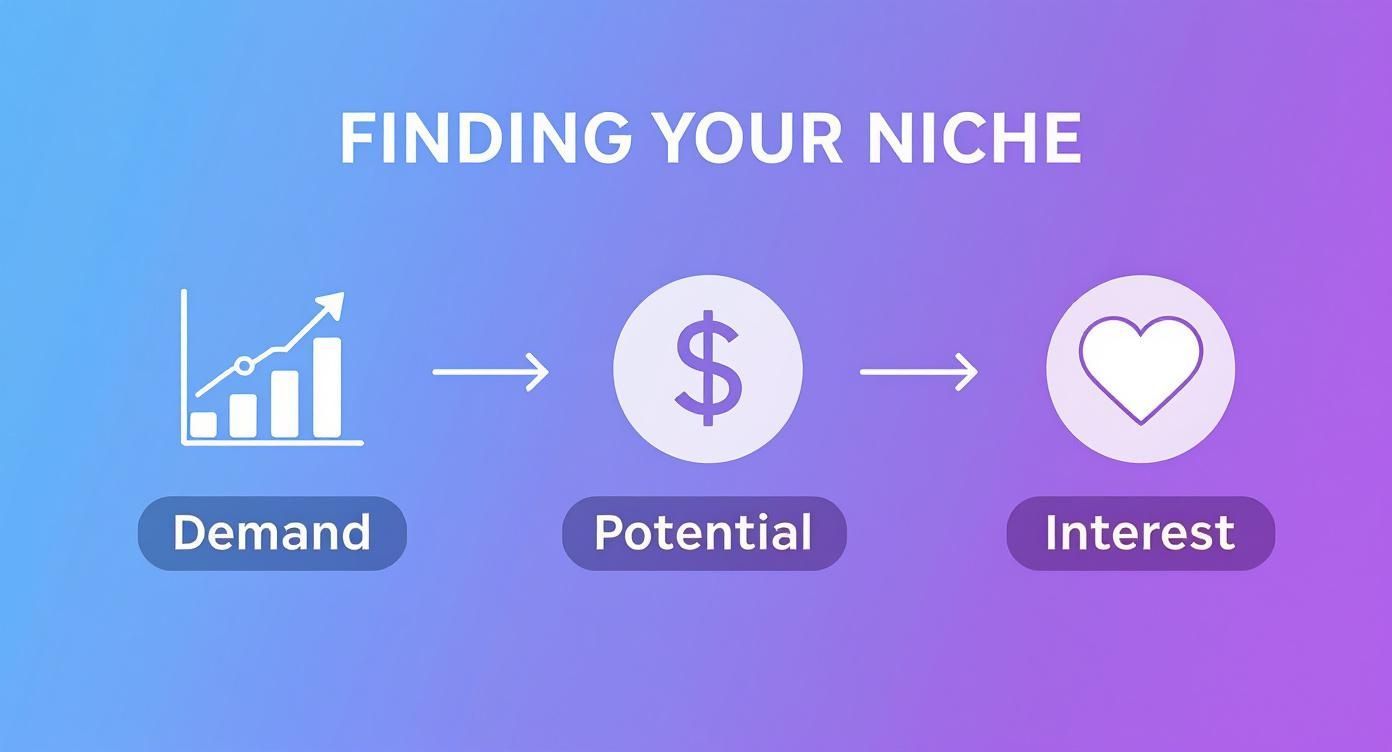
As you can see, a great niche sits at the sweet spot between audience demand, how much you can earn, and what you’re genuinely interested in. Nailing this first is non-negotiable.
Sourcing Your Visuals And Audio
For a faceless channel, your visuals carry all the weight. You've got two main options here: grabbing clips from high-quality stock footage libraries (think Pexels or Storyblocks) or using AI to generate images and videos from scratch. Stock footage is dependable and quick, making it a great choice for documentaries or news-style videos.
AI generators, however, are where you can get really creative. They can craft unique visuals that perfectly match the mood of your script in a way stock libraries just can't. If you're creating visuals without showing your face, knowing How to Turn Photo Into Video The Right Way is a foundational skill, and AI can make that process so much smoother.
Your audio is just as crucial. You could record your own voiceover, but AI text-to-speech (TTS) has gotten scarily good. These tools can spit out clean, professional-sounding narration in minutes, saving you hours of recording, re-recording, and editing.
The real game-changer with an AI workflow is scalability. You can produce five high-quality videos in the time it once took to make a single one. That gives you a massive leg up on consistency, which is everything for channel growth.
A Unified Workflow In Action
Trying to stitch all these different tools together—a scriptwriter here, a voice generator there, a video editor somewhere else—can get messy. That’s where all-in-one platforms come into play. A tool like https://shortgenius.com, for example, pulls the entire workflow into a single, clean dashboard.
Here’s what that looks like in practice:
- AI Scripting: You feed the AI a topic, and it writes a script that’s structured to keep viewers hooked.
- Voiceover Generation: With one click, that script becomes a natural-sounding voiceover in whatever style or language you need.
- Visual Assembly: The platform then automatically finds or generates relevant visuals—stock clips, AI images, you name it—and syncs them perfectly to the narration.
- Editing and Branding: From there, you can quickly add subtitles, drop in your logo and brand colors, and make any final tweaks before hitting publish.
This integrated system is what makes running a faceless YouTube channel not just possible, but incredibly efficient for a solo creator today.
Choosing Your Voice AI vs Human Narrators
One of the first big calls you'll have to make is your voice. Do you go with AI or hire a human? There's no wrong answer here; it really comes down to your budget, timeline, and the vibe you're going for.
An AI voice gives you incredible speed and is super affordable, which is perfect if you plan on producing a high volume of videos. On the other hand, a real person can bring an emotional depth and unique personality that AI still struggles to replicate. This can be a huge deal in niches built on storytelling, like true crime or history.
To help you figure out what's best for your channel, here's a quick breakdown.
Choosing Your Voice AI vs Human Narrators
| Feature | AI Voice Generators | Human Voiceover Artists |
|---|---|---|
| Speed | Instantaneous generation | Days or even weeks of turnaround time |
| Cost | A low monthly subscription | Can be a high per-project fee |
| Consistency | The exact same tone and pace, every time | Can vary slightly between recording sessions |
| Emotional Range | Decent, but can sometimes sound generic | Excellent—can convey deep, nuanced emotion |
At the end of the day, a smart, AI-assisted workflow gives you the power to compete with anyone. It proves that a great idea and an efficient system are far more valuable than a massive production budget.
Getting Your Faceless Videos Seen: A Guide to YouTube SEO
https://www.youtube.com/embed/wZonRKXyvzI
Let's be honest: creating a great video is just the starting line. If your audience can't find it, all that hard work might as well be invisible. This is where a solid understanding of YouTube SEO becomes your secret weapon for growth, making sure the algorithm puts your content in front of the right people.
For a faceless channel, good SEO isn't just important—it's everything. You don't have a charismatic host to pull viewers in, so your titles, thumbnails, and descriptions have to do all the talking. Think of them as your digital handshake, grabbing a potential viewer's attention and convincing them to click in a crowded feed.
Crafting Titles That Get Clicks
Your video title is your single most important piece of SEO real estate. A truly effective title has to pull double duty: it needs the right keywords for the YouTube algorithm while also creating a spark of curiosity for a human. Just jamming keywords together like "Finance Tips Investing Stocks Beginners" is a fast track to nowhere.
Instead, you have to frame your keywords within a title that promises a specific result or teases a compelling story. A much better angle would be something like, "5 Simple Investing Rules I Wish I Knew Sooner (Beginner's Guide)." This title still hits the "investing for beginners" keyword, but it also creates intrigue and promises real, actionable advice.
Think of your titles like a magazine headline. Use numbers, powerful words, and even brackets to make them pop. Numbers are especially powerful because they signal a clear, easy-to-follow format—perfect for the kind of educational content that thrives on faceless channels.
Designing Thumbnails That Demand Attention
Your thumbnail is the other half of your one-two punch. I see so many channels make the mistake of creating thumbnails that are cluttered, impossible to read on a phone, or just plain boring. Since you aren't putting your face on the screen, your graphic design has to be on point.
A good thumbnail tells a visual story that complements your title. It should use high-contrast colors, big, bold text, and have a single, clear focal point. If you're making a video about the "History of Ancient Rome," a generic photo of the Colosseum isn't going to cut it. A much stronger thumbnail might feature a dramatic illustration of a Roman soldier with bold text like "THEIR BIGGEST MISTAKE."
A great thumbnail doesn't just show what the video is about; it creates an information gap. It makes the viewer think, "What mistake? I need to know," compelling them to click to find the answer. This is the key to a high click-through rate (CTR).
Writing Descriptions That Feed the Algorithm
So many creators treat the video description like an afterthought, but it's a goldmine for SEO. The first 2-3 sentences are critical because they show up above the "Show more" link. This opening needs to summarize the video's value and naturally work in your main keywords.
Don't stop there, though. Use the rest of the description to give YouTube all the context it needs. Here’s what I always include:
- A Detailed Summary: Go deeper with a few paragraphs about the video's topic. This is the perfect place to sprinkle in secondary keywords and related phrases that tell the algorithm exactly what your content is about.
- Timestamps: For any video over a few minutes, timestamps are a must. They make for a better viewer experience and can even help your video show up with "key moments" in Google search results, giving you a visibility boost.
- Helpful Links: Always link to your social media, other relevant videos on your channel, or any affiliate products you mention. This keeps viewers engaged with your brand and content.
Building a Community Without Showing Your Face
At the end of the day, YouTube’s algorithm loves videos that get people talking. Building a community around a faceless channel takes a bit more deliberate effort, but it's absolutely crucial for long-term success. You have to actively encourage interaction to send those strong engagement signals to YouTube.
One of the simplest tricks is to pin a thoughtful or funny comment. It's a great way to reward a viewer and often sparks even more replies. I also make it a point to heart and reply to as many comments as I can, especially within the first few hours after a video goes live.
And don't sleep on the Community tab! Once you unlock it, use it to post polls, quizzes, and behind-the-scenes updates. Asking your audience what video they want to see next is a fantastic way to get content ideas while also making your subscribers feel like they're part of the channel's journey. That kind of loyalty is priceless.
Monetizing Beyond Basic Ad Revenue

Getting into the YouTube Partner Program is a massive win, no doubt about it. Seeing that first AdSense payment hit your account is a huge milestone. But if you stop there, you're leaving a ton of money on the table.
Relying on ad revenue alone is a risky game. It's like building your entire business on a single pillar that can wobble with any algorithm shift or change in ad rates. The most successful creators I know have learned to build a much more stable foundation by diversifying their income. When one stream has a slow month, the others keep the business running smoothly.
Harnessing the Power of Affiliate Marketing
One of the most seamless ways to start earning more is with affiliate marketing. It’s a pretty simple concept: you recommend products or services you genuinely use and believe in, and you get a small commission when someone makes a purchase through your unique link.
The key to making this work without sounding like a sleazy salesperson is authenticity. Only promote things that actually make sense for your audience and your niche. For instance, if you run a faceless channel that teaches video editing, it’s a no-brainer to drop an affiliate link for the software you use in your description. Your viewers get a direct path to the tool you’re demonstrating, and you earn a commission at no extra cost to them. It's a true win-win.
Here are a few ways this can look in practice:
- Software and Tools: A graphic design channel could link to Canva Pro or Adobe Creative Cloud.
- Physical Products: A channel that does animated book summaries can have Amazon affiliate links for every book they cover.
- Services: A personal finance channel might partner with a popular budgeting app or an investment platform.
The whole game has changed for faceless channels. With better tools, growth is faster than ever, and the income potential is staggering. I've seen channels in the geography niche pull in 17 million views on a single Short. It's proof that if you pick the right topic and nail the quality, the audience is there. Some creators are even scaling this model to run dozens of profitable channels at once.
Creating and Selling Your Own Digital Products
Affiliate marketing is great, but creating your own products? That's where you get full control and much higher profit margins. This is all about packaging your knowledge into a resource that your audience can buy directly from you.
Think about it—no inventory, no shipping, just pure profit once you’ve created the product. This move also solidifies your status as an expert in your niche and builds a much stronger connection with your most dedicated fans. Of course, this raises the big question of just how much money you can make on YouTube when you start layering these strategies.
The best digital products solve a specific problem for your audience. They should feel like the logical next step for someone who loves the free value you already provide.
Let’s say you run a faceless history channel. You could easily package your research into a beautifully designed e-book called "The 10 Most Misunderstood Events in World History," going even deeper than your videos do.
Or imagine a finance channel that helps millennials get their budgets in order. A perfect product would be a custom-built budget spreadsheet template. At the end of each video, you could give a quick demo of how it works, offering a tangible solution to the exact problem your content is built around. It’s a natural, helpful way to transition from free content to a paid product that genuinely serves your viewer.
Got Questions About Faceless Channels? Let's Clear Things Up.
Jumping into the world of faceless YouTube channels is exciting, but let's be real—it also brings up a ton of questions. It’s completely normal to wonder about the money, the potential roadblocks, and what it really takes to succeed. I'll give you some straight-up answers to the concerns I hear most often from new creators.
A common worry I see is whether YouTube penalizes channels that don't show a face. The short answer? Nope. What the algorithm cares about is quality and viewer satisfaction. A well-produced, genuinely helpful faceless video will always crush a low-effort vlog, face or no face.
"Can I Actually Get Monetized Using AI Voices?"
Yes, you absolutely can. This is probably the biggest myth holding people back right now. YouTube's monetization policies care about the value you add, not the specific tools you use. As long as your videos are original and well-made, using an AI voice is perfectly fine for the YouTube Partner Program.
The line in the sand is what YouTube calls "low-effort" or "reused" content. If you just slap some random stock clips over a robotic, unedited AI script, you’re asking for trouble.
But if you’re putting in the work by:
- Writing unique, well-researched scripts that actually teach or entertain someone.
- Editing your visuals with purpose, making sure they match the narration and tell a story.
- Creating a polished final product with good pacing, sound, and graphics.
…then an AI voice is just another production tool, like using background music. It won't stand in your way.
"How Long Does It Take to Make Real Money?"
This is the million-dollar question, isn't it? The honest-to-goodness answer is: it depends. But looking at the growth patterns of countless channels, we can sketch out a pretty realistic timeline.
For most creators who post consistently (think one or two videos a week), hitting the initial monetization goal of 1,000 subscribers and 4,000 watch hours usually takes somewhere between 3 to 6 months.
Getting to a more substantial income, like your first $1,000 month from ad revenue, often takes between 6 to 12 months. Of course, this can happen much faster if you're in a high-RPM niche like personal finance, software, or tech, where advertisers pay top dollar for eyeballs.
Keep this in mind: YouTube growth is rarely a straight line. It's a snowball. It starts small and slow, but once it gains momentum, it can grow exponentially. Your first 100 subscribers will feel harder to get than the next 1,000.
"What Are the Biggest Mistakes New Creators Make?"
So many new creators stumble over the same few hurdles, and almost all of them are preventable. The biggest one I see is picking a generic niche without any unique spin. Trying to launch another "motivational quotes" channel today is a brutal uphill battle because the space is completely flooded.
Another classic mistake is choosing quantity over quality. The old "post every single day" advice is dead. It's far, far better to publish one fantastic video a week than seven mediocre ones that nobody watches.
Here are a few other common tripwires:
- Ignoring Thumbnails and Titles: I see it all the time. Someone spends 10 hours editing a video and then slaps a thumbnail together in five minutes. Your thumbnail and title are your sales pitch—they deserve just as much effort as the video itself.
- Quitting Too Early: Your first 10-20 videos will probably feel like shouting into the void. This is the "great filter" where most people give up, often right before things are about to take off.
- Putting All Your Eggs in the AdSense Basket: Relying only on ad revenue is a risky game. The smartest creators plan for other income streams like affiliate marketing, digital products, or sponsorships from day one.
Steering clear of these traps will put you on a much faster track to building a faceless channel that actually goes somewhere.
Ready to build your content assembly line? ShortGenius brings every part of faceless video creation together—from AI scripting and lifelike voiceovers to automated editing and scheduling. Stop juggling a dozen different tools and start producing high-quality content, faster.