Your Guide to Faceless YouTube Automation Success

Launch a profitable channel with our guide to faceless YouTube automation. Learn to use AI tools for content, voiceovers, and scaling your income.
Ever dreamed of a YouTube channel that pulls in revenue without you ever having to step in front of a camera? It’s not a pipe dream. This is the reality of faceless YouTube automation, a strategy where creators use AI and slick workflows to build content empires behind the scenes. It’s a game of process over personality, and it opens the door to massive scale.
The Reality of Automated YouTube Channels
The idea of a hands-off content machine might sound too good to be true, but it's a legitimate and fast-growing business model. And it's not just about the money. In an era of constant oversharing, the appeal of privacy is huge. You can build a significant online asset without ever becoming a public figure.
This entire model hinges on systemizing every part of content creation. Instead of one person juggling everything, the work is broken down into small, repeatable tasks—scriptwriting, voiceovers, video editing, thumbnail design—that can be easily automated or handed off to someone else.
The Power of Scalable Content
The true magic of faceless automation is scalability. When you, the creator, are no longer the bottleneck, your production limits vanish. You're not tied to a camera or a microphone, which means you can run multiple channels across completely different niches all at once.
Think about the possibilities. A channel that you never appear in could explode to 1.82 million subscribers and hit 188 million total views by October 2025. This isn't just a fantasy number; it's the kind of growth possible when you get the system right. I've seen channels master this by outsourcing everything from the script to the final upload, effectively creating a passive income stream. You can find plenty of examples of successful automation strategies that show just how powerful this can be.
This isn't just about making more videos. It's about building a diverse portfolio of digital assets, spreading your risk, and creating multiple, independent streams of income.
Core Stages of Faceless YouTube Automation
To get this right, you need to understand the fundamental stages of building one of these automated channels. Think of it as an assembly line for content.
This table breaks down the key phases, the main objective for each, and the types of tools you'll rely on.
| Stage | Primary Goal | Essential Tools |
|---|---|---|
| Niche & Ideation | Find a high-demand, low-competition topic that doesn't need a personality. | Keyword research tools, trend analysis software (e.g., TubeBuddy), brainstorming AI. |
| Content Production | Generate scripts, voiceovers, and video assets efficiently and consistently. | AI scriptwriters, text-to-speech (TTS) voice generators, stock footage libraries. |
| Assembly & Polish | Edit all components into a polished, engaging final video with a compelling thumbnail. | Video editing software (e.g., CapCut), AI video editors, graphic design tools (e.g., Canva). |
| Publish & Optimize | Schedule content, optimize titles/tags for search, and manage the channel's output. | YouTube Studio, scheduling tools, SEO optimization plugins. |
| Scale & Monetize | Analyze performance data to improve the system and diversify income streams. | YouTube Analytics, affiliate marketing platforms, digital product hosts. |
Each stage builds on the last, creating a repeatable workflow that can eventually run almost entirely without your direct day-to-day involvement.
The goal isn't just to make videos; it's to build a self-sustaining content engine. Every decision, from niche selection to the tools you use, should be made with scalability and efficiency in mind.
Think of yourself as the architect of a factory. You design the assembly line (your content workflow), bring in the machinery (AI tools and software), and manage the operation to ensure quality and output. Your role shifts from being the talent to being the CEO of your own media business.
Finding a Niche That Actually Makes Money
This is it. This is the single decision that will make or break your entire faceless YouTube operation. Forget the cliché advice to "follow your passion." We're here to build a business, and that means following the data and, more importantly, the money.
Your mission is to find a sweet spot: a topic people are searching for, advertisers are paying top dollar to get in front of, and that you can create content for almost entirely on autopilot.
Too many people see a popular gaming channel and think, "I can do that." They dive into a market so crowded their videos never see the light of day. The smart money is on niches with a high CPM (Cost Per Mille). That’s the magic number representing how much advertisers shell out for every 1,000 views on your videos.
Niches like personal finance, real estate, software tutorials, and even niche health topics consistently command high CPMs. Why? Because the audience is there with a problem to solve or a specific need, making them incredibly valuable to companies selling solutions. A video breaking down stock market strategies will earn multiples more per view than one showing funny cat compilations. It’s just a different ballgame.
So, What Makes a Niche "Automation-Friendly"?
Not every topic works for this model. You need something where the information itself is the star, not the person presenting it. If the channel relies on a charismatic host, it’s not for us.
Here are a few categories I’ve seen work exceptionally well time and time again:
- Historical Deep Dives: Think compelling stories about ancient civilizations or forgotten battles. This stuff is perfect for AI narration, stock footage, and simple animations.
- Guided Meditations & Ambient Sounds: These are all about the audio and visual mood. You can easily generate soothing voiceovers and pair them with relaxing stock video loops.
- "Top 10" Lists: This is a classic for a reason. "Top 10 Most Luxurious Private Jets" or "Top 10 Mind-Blowing AI Tools." The formula is simple, repeatable, and lends itself perfectly to automation.
- Software Walkthroughs: Screen recordings with a clear voiceover are gold. They solve a very specific problem for a viewer and don't require you to ever show your face.
The secret sauce for all of these is evergreen potential. A great video on the life of Nikola Tesla will be just as relevant in five years as it is today. You're not just making a video; you're building a library of digital assets that can earn you money while you sleep.
How to Know if an Idea is a Winner
Okay, you have a few ideas bouncing around. Now it's time to put them to the test before you invest a single second in creating content. Don't guess—validate.
Start with Google Trends. It's a quick and dirty way to see if interest in your topic is growing, dying, or flatlining. A nice, steady upward trend is exactly what you want to see.
Next, you need to go directly to the source: YouTube. This is your reconnaissance mission. Search for your niche keywords, but here’s the pro move: filter the results by "View count" and set the date range to "This Month." Now, scroll and look for videos with a surprisingly high number of views from channels with a low subscriber count.
This is the signal you’re looking for. When a small channel pulls in massive views, it proves the topic is the star. It tells you that audience interest is so high that you don't need a huge, established brand to get a piece of the action.
Jot down a list of these channels. What are they doing right? Look at their thumbnails, their titles, how they structure their videos. Just as important, where are they falling short? Maybe their AI voiceover sounds clunky or their editing is lazy. Those are the gaps where your higher-quality automated content can swoop in and dominate. This isn't about copying; it's about finding a proven formula and then executing it better than anyone else.
Building Your AI-Powered Content Machine
Alright, you've locked in a profitable niche. Now for the fun part: building the engine that will power your entire channel. This is the heart of your faceless YouTube automation strategy, where we bring together the right AI tools to turn a simple idea into a polished, binge-worthy video. The goal here is to create a repeatable workflow that’s fast, consistent, and—most importantly—requires minimal hands-on effort from you.
Modern AI video platforms have become absolute game-changers. Instead of fumbling with separate tools for scripts, voiceovers, and visuals, you can now do it all under one roof. This integration is the secret sauce to truly scaling your operation.
From Script to Screen with AI
Every great video starts with a compelling script. AI scriptwriters are fantastic for getting the ball rolling, quickly generating structured outlines and solid first drafts. Just feed it a video title or a quick concept, and it will spit out a script with a clear beginning, middle, and end.
But don't just copy and paste. The raw AI output often sounds a bit… robotic. Your role is to be the editor, the human touch. Go in and add conversational language, drop in some surprising facts, and make sure the pacing feels right. A script that sounds like a real person wrote it is what keeps viewers hooked.
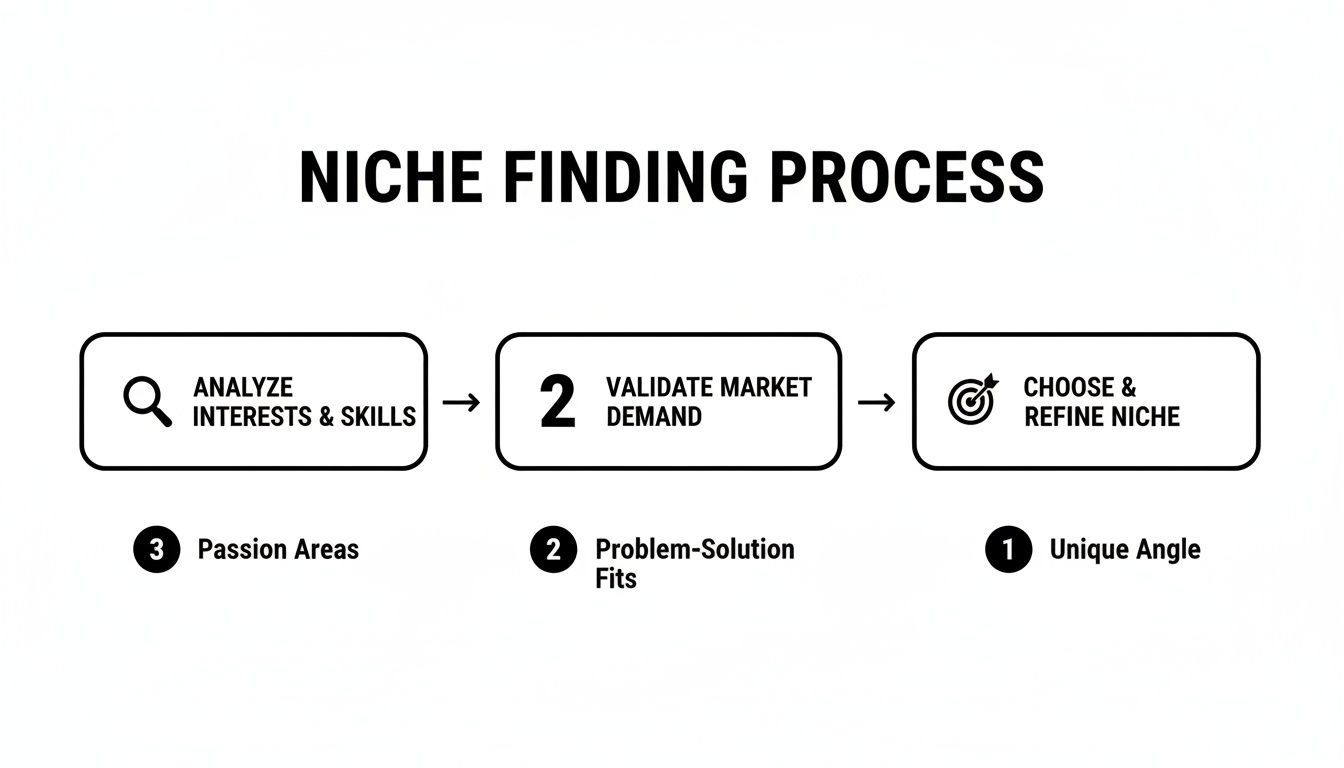
This is the process we’re building on—the strategic groundwork laid in the niche selection phase is what makes this content production stage so effective.
Generating Lifelike Narration
With your script polished, it's time for the voiceover. AI text-to-speech (TTS) has come a long way. Seriously, forget the monotone, robotic voices of the past. Today’s best AI voice generators offer a huge range of natural-sounding voices, letting you tweak the tone, speed, and emotion.
You can pick a voice that perfectly fits your channel's vibe—maybe something authoritative for a finance channel, or calm and soothing for guided meditations. The quality is so good now that most viewers won't even realize they're listening to an AI. Since you’re relying on AI, your audio quality has to be flawless. This ultimate guide to removing background noise from audio is a great resource for getting that professional studio sound.
Sourcing and Assembling Visuals
Now that the audio is ready, you need visuals to tell the story. This is where faceless channels have a massive advantage—no cameras, no studios, no problem. Your visual toolkit will mostly consist of:
- Stock Footage Libraries: Sites like Pexels, Pixabay, and Storyblocks are goldmines of high-quality video clips that are free or affordable.
- AI Image Generators: Need a unique image for a thumbnail or a specific scene? AI can create it for you from a simple text prompt.
- Simple Animations: Using basic text animations or kinetic typography is a simple but effective way to keep your viewers’ eyes moving and engaged.
The trick is to match your visuals to what's being said in the script. If the narration is about ancient Rome, you better be showing clips of the Colosseum. Talking about a new iPhone? Use sleek, modern product shots. Many integrated AI video platforms can even scan your script and automatically pull relevant stock footage, which can save you countless hours of digging. You can see how to turn your text prompts into complete videos with these powerful, all-in-one systems.
A rookie mistake I see all the time is using the same generic stock clips over and over. Mix it up! Use different camera angles, cut between wide shots and close-ups, and keep your scenes short and punchy to hold onto that precious viewer attention.
Unifying the Workflow
The real magic happens when you bring all these pieces together into a single, unified workflow. This is what I mean by a "content machine."
A platform like ShortGenius, for example, lets you do everything in one place. You can generate a script, choose an AI voice, let the system automatically find and sync relevant video clips, and then assemble the whole thing on one timeline.
This completely removes the headache of exporting and importing files between a dozen different apps. Once your video is assembled, you can apply your channel’s branding—like custom fonts, colors, and logos—with a single click. Boom. Consistent, professional-looking content every single time.
By setting up this AI-powered assembly line, you’re turning video creation from a time-sucking chore into a streamlined, scalable process. This efficiency isn't just a nice-to-have; it's the absolute foundation of a successful faceless YouTube automation business.
Fine-Tuning Your Publishing and Growth Engine

Creating a great video is only half the battle. If nobody finds it, all that work was for nothing. Your publishing process is where the real growth begins—it’s the engine that drives discovery and tells the YouTube algorithm your channel means business. This is the moment you turn a finished video file into an asset that can actually be found.
Your approach to publishing can’t just be a last-minute thought. It needs to be a systematic, data-driven process that covers everything from video SEO to a rock-solid upload schedule. Automating these steps gives every single video you produce the best possible shot at success right out of the gate.
Mastering Video SEO With AI
Before you even think about hitting "publish," you have to clearly tell YouTube what your video is about. This means optimizing your title, description, and tags with the exact keywords your target audience is typing into the search bar. Trying to do this by hand is just a time-consuming guessing game.
AI tools, on the other hand, can scan the top-ranking videos in your niche and instantly spit out a list of high-impact keywords. They can then spin up compelling, keyword-rich titles and detailed descriptions that grab the attention of both the algorithm and actual humans. For instance, instead of a bland title like "History of Rome," an AI might suggest something far more clickable like "The Rise and Fall of the Roman Empire: A 10-Minute Deep Dive."
Don't forget that video transcripts are a goldmine for SEO, giving YouTube’s algorithm a word-for-word script of your content to crawl and understand. For anyone serious about maximizing reach, it's even worth looking into building a YouTube transcript AI to get an extra edge.
Designing Thumbnails That Demand Clicks
Let's be clear: your thumbnail is the single most important piece of marketing for your video. Think of it as a digital billboard competing for eyeballs on a very crowded homepage. A fantastic thumbnail sparks curiosity and sets expectations, which directly impacts your click-through rate (CTR)—a metric the YouTube algorithm is obsessed with.
But creating custom thumbnails for every video can quickly become a massive bottleneck in your production line. This is where AI image generators become an absolute game-changer for any automated channel.
Don't underestimate the power of a single image. I’ve seen channels double their viewership overnight simply by A/B testing and improving their thumbnail designs. A 2% increase in CTR can be the difference between a video that fizzles out and one that goes viral.
With AI tools, you can generate dozens of unique, high-quality thumbnail concepts in minutes. You can play with different styles, color palettes, and layouts without needing a lick of graphic design experience. A history channel, for example, could generate a dramatic, photorealistic image of a battle that you'd never find on a stock photo site. You can get a sense of the incredible power of transforming simple text into stunning images and see how it can make your visuals impossible to ignore.
Building a Consistent Upload Schedule
On YouTube, consistency is currency. Publishing videos on a regular, predictable schedule does two things: it signals to the algorithm that your channel is active and reliable, and it trains your audience to come back for more. This is how you build a loyal following.
Manually uploading and optimizing every video at the perfect time is a recipe for burnout and mistakes. This is what scheduling tools were made for.
The smartest strategy is to batch-produce your content. Carve out a block of time to create a week’s—or even a month’s—worth of videos all at once.
- Scripting: Dedicate a few hours to generating and polishing all your scripts.
- Voiceovers: Knock out all the audio tracks in a single session.
- Video Assembly: Edit all the videos and create their matching thumbnails.
Once your batch is ready to go, use a scheduling tool to upload everything and set your publishing dates and times. This hands-off system ensures your content engine keeps running like clockwork, even when you're busy with other things. It's this automated consistency that truly scales your channel from a side hustle into a self-sustaining business.
7. Diversifying Your Income Beyond AdSense
Getting into the YouTube Partner Program and seeing that first AdSense payment is a massive win. But honestly, that's just the starting line. The faceless channels that pull in serious, life-changing money don't just lean on ad revenue. They build multiple streams of income right from the get-go.
Thinking like a business owner, not just a content creator, is the key. Relying only on YouTube ads is risky. One algorithm shift can slash your views, ad rates can dip seasonally, or a policy strike could put your entire income on hold.
Diversifying is your safety net. It turns your channel from a simple content pipeline into a real, resilient business.
The Power of Affiliate Marketing
For most faceless channels, affiliate marketing is the easiest and most natural next step. The idea is simple: you recommend products or services you actually use and trust. When someone clicks your unique link and makes a purchase, you get a cut.
This works perfectly for the faceless model because it’s all about providing value, not showing your personality.
For example, if your channel teaches people how to use a specific software, it's a no-brainer to become an affiliate for that tool. Run a channel about ancient Rome? You could partner with an audiobook service like Audible to recommend history books. The secret here is relevance. Pushing random products just because the commission is high will shatter the trust you've built with your audience.
When your recommendations feel like a genuine extension of your content, your viewers won't even see them as ads—they'll see them as helpful resources.
Creating and Selling Digital Products
This is where you can truly take control of your earnings and see the highest profit margins. With affiliate marketing, you get a small piece of the pie. When you sell your own digital products, you keep almost all of it.
This is the move that elevates your channel from a media property to a direct-to-consumer brand. The options are endless and can be perfectly tailored to your niche:
- E-books or Guides: A channel on personal finance could sell a comprehensive guide like "The Beginner's Guide to Crypto Investing."
- Templates: If you teach video editing, you could sell a pack of custom motion graphic templates and presets.
- Checklists or Worksheets: A meditation and wellness channel might offer a printable "30-Day Mindfulness Challenge" journal.
The best part? You build it once, and you can sell it forever. It's the ultimate scalable income stream for a faceless YouTube automation system.
Building your own digital product is a direct path to higher profits. Instead of earning a 5% commission, you can earn a 95% margin. It requires more upfront effort but delivers exponentially greater returns over the long term.
Securing Sponsorships and Brand Deals
It's a common myth that you need to be on camera to land sponsorships. Brands care about one thing above all else: access to a targeted, engaged audience. If your channel has a dedicated viewership in a specific niche, you're a goldmine for the right companies.
Think about it: a channel about camping gear with 50,000 highly engaged subscribers is way more valuable to an outdoor brand than a generic vlogger with 200,000 followers who are only casually interested.
To get on their radar, create a professional media kit. This should showcase your channel's audience demographics, key engagement stats like average view duration, and what your viewers are interested in.
These deals often go beyond a simple shout-out. You could create dedicated review videos or weave a brand's message into a multi-part series. For brands looking for authentic content, you can even offer to produce AI UGC ads for them, using your unique video style to showcase their products.
Faceless Channel Monetization Models
To help you decide where to start, here's a quick comparison of the most common monetization strategies for faceless channels.
| Monetization Method | Income Potential | Setup Effort | Scalability |
|---|---|---|---|
| YouTube AdSense | Low to High | Low | High |
| Affiliate Marketing | Medium to High | Low to Medium | High |
| Digital Products | High | High | Very High |
| Sponsorships | Medium to Very High | Medium | Medium |
Each of these models has its place in a well-rounded strategy. Starting with AdSense and affiliate marketing is a great foundation, but adding digital products and sponsorships is what truly unlocks your channel's earning potential.
By layering AdSense with these other powerful income streams, you’re not just making videos—you’re building a profitable, long-lasting business engine.
Got Questions About YouTube Automation? Let's Clear Things Up.
Diving into faceless YouTube channels is exciting, but it's smart to come armed with a few questions. I've been in this space a while, and I see the same concerns pop up again and again. Let's tackle them head-on so you can build your content engine on a solid foundation.
A lot of people start by asking if this whole model is even allowed. The short answer is yes, running a faceless, automated YouTube channel is completely within the rules. YouTube’s policies never say you have to show your face. What they really care about is the quality and originality of what you post. As long as your videos are valuable and stick to their terms of service, you're good to go.
Can I Actually Get Monetized with AI Voices and Stock Footage?
This is the big one, isn't it? And again, the answer is a definite yes, but there's a huge catch. YouTube's monetization policies are designed to filter out low-effort, "reused content." If your plan is to just download someone else's video, throw a robotic AI voice over it, and hit publish, your channel will get rejected. I've seen it happen.
The magic word here is transformation. Your process, even if automated, has to add real, original value. This means your videos must have:
- A unique script and narrative: Your commentary needs to bring a fresh perspective or new information to the table.
- Purposeful editing: The way you weave together stock clips, text, and graphics needs to tell a story, not just fill time.
- High-quality production: No excuses for muffled audio or blurry visuals.
When you use AI voices and stock footage to bring an original, well-written idea to life, YouTube views it as legitimate creation, not a cheap knockoff.
How Do I Handle Copyright and Legal Stuff?
Copyright is no joke on YouTube. Using automation doesn’t give you a free pass to ignore it. Grabbing copyrighted music, images, or video clips without the right license is the quickest path to a copyright strike, and enough of those will get your channel shut down for good.
You should always assume content is protected unless you have a clear license saying you can use it. Trying to argue "fair use" is a gamble; it's a complicated legal defense, not a magic shield. It's so much safer to just stick to licensed or royalty-free sources from the start.
This is exactly why your choice of tools and asset libraries matters so much. Stick with reputable stock footage sites like Pexels or Storyblocks and use a trusted music library like Epidemic Sound. These platforms give you clear licensing terms, which means you can scale your faceless YouTube automation channel without constantly looking over your shoulder.
Be Honest, How Much Time Does This Really Take?
While "automation" is in the name, this isn't a "set it and forget it" business from day one. You have to be realistic. Expect to put in a good amount of time upfront—researching your niche, building your content formula, and getting your first batch of videos produced and scheduled.
Once you have a well-oiled system, though, the time you spend drops off a cliff. I know successful channel owners who only spend a few hours a week on their channels. They're mostly focused on the big picture: analyzing what's working, brainstorming new video ideas, and looking for ways to grow. The "automation" is what frees you up to think like a strategist instead of just a content creator.
Ready to build your own content engine? ShortGenius gives you all the AI tools you need—from scriptwriting and voiceovers to video assembly and scheduling—in one powerful platform. Stop juggling different apps and start creating consistent, high-quality content in minutes. Build your automated channel with ShortGenius today!