Create Video Ads with AI A Performance Marketer's Guide

Learn to create video ads with AI that drive real results. This guide covers scripting, generation, testing, and optimization for high-performance campaigns.
If you want to create video ads with AI, the process is surprisingly straightforward with the right platform. Using a tool like ShortGenius, you can take simple text prompts and generate entire campaigns—complete with scripts, authentic-looking UGC-style scenes, and voiceovers.
You start by defining your ad's goal and plugging in some product details. From there, the AI gets to work, spitting out multiple creative variations in just minutes. It's a total workflow transformation, turning a process that used to take weeks into something you can knock out in an afternoon. This speed is a massive advantage for rapid A/B testing and scaling your content without needing a big production crew.
The New Era of AI Video Ad Creation
Welcome to the future of advertising—a future where you don't need a Hollywood budget or a month-long production schedule to create high-impact video ads. The arrival of generative AI has completely shaken up the creative industry, finally giving marketers a way to keep up with the endless demand for new content on platforms like TikTok and Instagram.
This technology directly solves one of the oldest problems in video production: it’s slow, it’s expensive, and you can’t possibly make enough variations to figure out what really works.
With the right AI tools, those barriers are gone. Think about it: you can generate entire ad campaigns, from the initial script to realistic user-generated content (UGC) style scenes, in the time it takes to brew a pot of coffee. That's the power of platforms designed to automate and simplify the entire creative workflow.
Why AI Is a Game Changer for Ad Creative
Let's be honest, traditional video ad creation is a long, painful process. It’s a linear slog of brainstorming, scripting, casting, shooting, editing, and post-production. Every single step requires specialized skills and a ton of time, which makes creating dozens of ad variations to test your audience's preferences a practical impossibility.
AI completely flips that model on its head. It introduces what I like to call creative agility at scale.
Instead of pouring all your resources into one polished video, you can generate ten different hooks, five different calls-to-action, and three distinct visual styles in less time than it takes to schedule a project kickoff meeting. This allows you to adopt a performance-driven mindset where real data—not just your gut feeling—guides your creative strategy.
This isn't some far-off future, either. The shift is happening right now. A recent report found that a staggering 22% of all video ad creative was built or touched by generative AI in the last year alone. And that number is expected to nearly double to 39% by 2026. It's a crystal-clear sign of where the entire industry is moving.
This innovation isn't just for mega-brands with deep pockets. To see how it's leveling the playing field, it's worth reading up on the rise of AI TV commercials for small businesses. High-quality video is finally becoming accessible to everyone.
Building Your AI Video Ad Campaign Blueprint
Jumping straight into an AI ad generator without a clear plan is a recipe for disaster. It’s like trying to build a house without a blueprint—you’ll get something, but it probably won’t be what you wanted, and it definitely won't be effective. Before you even think about writing a prompt, you need to lay the strategic groundwork. This is easily the most important step for creating AI video ads that actually perform.
We're not talking about some massive, 50-page strategy document here. It's about getting laser-focused on the inputs that will guide the AI toward your specific goal.
Your first move? Define one single, sharp objective. "More sales" is way too broad and won't get you anywhere. Are you trying to get email sign-ups for an upcoming webinar? Driving first-time purchases with a 20% off discount code? Or maybe you're focused on boosting app downloads? Each of these goals requires a completely different message, tone, and call-to-action.
Having a crystal-clear objective is your North Star. It ensures every creative decision you make serves a real purpose, which is what separates the campaigns that convert from the ones that just burn through your budget.
Know Your Audience Deeply
Once your objective is locked in, you have to get inside the head of who you're talking to. Building a detailed customer avatar is non-negotiable. Don't just stick to basic demographics; you need to dig deep into the psychographics—what are their real-world problems, frustrations, and biggest desires?
What keeps them up at night? What’s the one major problem your product solves that they are desperate for a solution to? For instance, instead of targeting "small business owners," get specific: "e-commerce founders struggling with high cart abandonment rates." That kind of detail gives your AI the rich context it needs to generate messaging that actually hits home.
Pro Tip: Your AI isn't a mind reader. The more detail you feed it about your audience, the better the final ad will be. Give it their exact pain points, their biggest aspirations, and even the specific language they use in customer reviews or on social media.
With your objective and audience defined, it's time to brainstorm the core creative elements. Think of these as the raw ingredients the AI will use to cook up your ad.
-
The Hook: How are you going to stop their scroll in the first three seconds? This could be a provocative question, a shocking statistic, or a super-relatable scenario that highlights a pain point.
-
The Unique Selling Proposition (USP): In one simple sentence, what makes you stand out? Is it your lightning-fast shipping, a one-of-a-kind ingredient, or an unbeatable money-back guarantee?
-
The Call-to-Action (CTA): What exact action do you want them to take next? Be direct and make it compelling. "Swipe Up to Get 20% Off" is infinitely better than a weak, generic "Learn More."
Think of this blueprint as the recipe for your ad campaign. By getting these key ingredients right upfront, you give the AI everything it needs to create a high-performing video ad that perfectly matches your brand and business goals. This bit of prep work is the real secret to getting the most out of AI in your advertising.
How to Generate Your First AI Video Ad
Alright, you've got your campaign blueprint. Now for the fun part: turning that strategy into an actual video ad. This is where the magic really happens, and you’ll see just how quickly you can go from an idea on a page to a video ready for publishing. When you use a platform like ShortGenius, the process feels less like technical video editing and more like brainstorming with a super-fast creative assistant.
The first move is to feed your core message and a few hook ideas into the system. Instead of agonizing over one perfect script, you can generate a handful of different versions in seconds. Let's say you're marketing a new skincare product. You could test a hook that hits a pain point ("Tired of hiding acne scars?") against one that leads with a benefit ("Get that glass skin glow in just one week"). The AI takes these starting points and builds them into full-fledged, thumb-stopping scripts.
This is the foundation. Getting this right makes creating a video ad that actually connects with people so much easier. The diagram below illustrates how your initial planning flows directly into the AI's generation process.
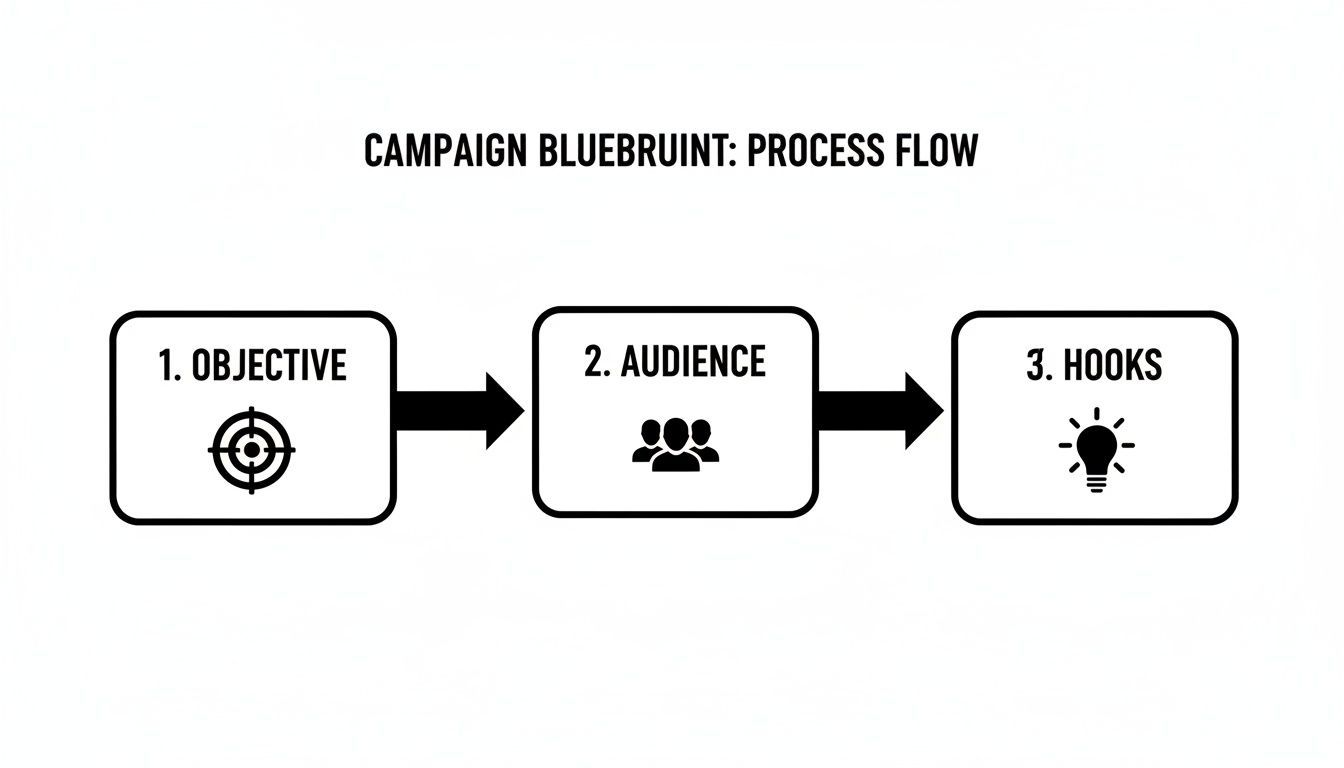
As you can see, a clear objective, a solid understanding of your audience, and a few compelling hooks are the essential ingredients the AI needs to do its best work.
To give you a clearer picture, here’s a quick breakdown of what this workflow looks like from start to finish.
AI Video Ad Generation Workflow
| Phase | Key Action | Example Input (Skincare Product) | AI Output |
|---|---|---|---|
| 1. Scripting | Provide core product info and audience pain points. | "Skincare serum for women 25-40 with acne scars. Hook: 'Tired of hiding your skin?'" | 3-5 complete video scripts with scene suggestions. |
| 2. Visuals | Describe scenes using text prompts. | "UGC-style clip of a woman smiling in her bathroom," "Close-up of serum texture." | A series of short video clips matching the descriptions. |
| 3. Audio | Choose a voice style and tone. | "Female voice, upbeat and friendly." | A natural-sounding voiceover synced to the script. |
| 4. Final Touches | Add captions and brand elements. | "Generate dynamic, on-screen captions. Add our logo at the end." | A fully-rendered video with timed captions and branding. |
This table shows just how you can translate simple, direct inputs into a polished final ad without touching a traditional video editor.
From Text Prompts to Visual Scenes
With your scripts locked in, it's time to create the visuals. Modern AI tools can generate surprisingly authentic-looking scenes from just a few words. Forget needing a camera crew or studio time—all you need is a clear idea of what you want to show.
For our skincare ad example, you might generate scenes by describing:
- A close-up shot of the serum's rich texture on a fingertip.
- A UGC-style clip of a smiling woman applying the product in a sunlit bathroom.
- A quick, satisfying product shot of the bottle on a clean, minimalist background.
The key here is specificity. The more detail you feed the AI, the better the visuals will turn out. This capability is a massive reason why video marketers are jumping on these tools. In fact, a staggering 75% are already using AI for content creation, with 54% using it specifically for video production. This whole trend is fueling a market expected to balloon from $716.8 million in 2025 to $2.56 billion by 2032, all driven by the relentless need for faster, more affordable video.
Adding Voice and Captions
A silent ad is an ignored ad. AI voiceover tech has gotten remarkably human-like, letting you pick from different tones, accents, and speeds to nail your brand’s voice. You can instantly generate an energetic, hyped-up voiceover for a TikTok ad or something more calm and trustworthy for an explainer video.
A non-negotiable for social media is captions. So many people watch with the sound off, so perfectly timed, easy-to-read captions are essential. Good AI platforms handle this automatically, generating and syncing them to ensure your message gets through, even in total silence.
To really get the most out of this process, it's worth exploring the best tools available, especially the most powerful AI video generators that can really simplify your creative workflow.
By pulling together AI-generated scripts, scenes, voiceovers, and captions, you can assemble a complete, high-quality ad in a tiny fraction of the time it would normally take. This process lets you go from a strategic plan to a finished video quickly, clearing the way for what really matters: testing, learning, and getting results.
Fine-Tuning Your AI Ads for Peak Performance
Getting that first video back from an AI generator is a great feeling. It’s like having a talented junior editor hand you a solid first cut—it has all the right pieces, but it’s not quite ready for the spotlight. The real performance gains come from what you do next. This is where your expertise turns a decent AI video into a scroll-stopping ad that actually converts.
I like to call this initial output the "Ugly Duckling Draft." It has potential, but it needs a strategic eye to make it shine.
The first thing I almost always do is trim the fat. Shave a few frames off the beginning of a scene, tighten the cut at the end. Every millisecond counts on social media, and snappy pacing is non-negotiable for holding a viewer's attention.
This is also the perfect moment to think about A/B testing. With a platform like ShortGenius, you can duplicate a video in seconds and swap out just one variable. For example, pit a direct, benefit-focused hook against a more mysterious, curiosity-piquing one. The data will tell you what grabs your audience in those crucial first three seconds.
Making Your Creative Fit Every Platform
One of the most tedious parts of video ad production has always been resizing and reformatting for different placements. A 9:16 ad for TikTok just looks wrong in a 1:1 Instagram feed, and neither is going to work for a 16:9 YouTube pre-roll ad. This used to mean hours of painstaking re-editing.
Thankfully, AI-powered tools have made this a non-issue.
You can now take a single master video and instantly repurpose it for any platform. With just a couple of clicks, your vertical ad is reframed into a perfect square or a cinematic horizontal video. The best part? It ensures your ad looks and feels native wherever it appears.
But it’s about more than just the aspect ratio. Each platform has its own culture. The voiceover for a TikTok ad might be super high-energy, while the one for a LinkedIn campaign could be more polished and authoritative. You can even apply different brand kits—logos, fonts, colors—to align with specific campaigns, all without ever starting over from a blank canvas.
The goal is creative consistency, not creative uniformity. A great ad feels like it was made for the platform it's on, even if it started from the same core video.
Using Dynamic Effects to Stop the Scroll
To cut through the noise of a crowded feed, you need some visual spice. This is another area where AI editing tools really pull their weight. Instead of wrestling with complex keyframes and effects panels, you can apply professionally designed effects with a single click.
Here are a few things I regularly add to make ads more dynamic:
- Scroll Stoppers: Think bold, animated text or a quick visual effect that flashes on screen right at the start. It’s a little jolt that snaps a user out of their mindless scrolling.
- Camera Movements: Even on a static shot, adding a subtle pan or a slow zoom can inject a surprising amount of energy and professionalism. It makes the ad feel less static and more alive.
- Unique Transitions: Forget basic crossfades. Using slick, custom-style transitions between scenes helps maintain momentum and guides the viewer's eye through your narrative.
These little touches are what separate a generic AI video from an ad that feels custom-built and high-budget. When you’re making video ads with AI, this final polish is where your marketing brain meets the machine's efficiency—and it’s what turns skips into clicks.
Scaling Ad Creative and Testing for Performance
The real magic of using AI to create video ads isn't just about speed—it's about the ability to test and learn on a scale that was pretty much impossible before. This is the point where you stop just making ads and start building a high-performance marketing engine. Forget betting your entire budget on one "perfect" video; now you can build a solid A/B testing framework without breaking a sweat.
In the past, getting just two or three different versions of an ad required a massive production effort. Today, you can spin up dozens of creative variations just by tweaking one element at a time. This is how you figure out what actually makes your audience stop scrolling and pay attention.
And it's not like your audience is in the dark. Recent data shows that 71% of Gen Z and Millennial consumers believe they've already seen AI-created ads. This isn't just a niche trend; it's happening as global digital video ad revenue is set to hit a staggering $191.4 billion in 2024, on its way to $223.5 billion by 2026. The platforms are all-in on this shift, and you can dive deeper into these AI ad spending trends in the full IAB report.
Building Your A/B Testing Matrix
Effective testing demands a structured plan. Don't just throw a bunch of random ads at the wall to see what sticks. Instead, create a testing matrix where each ad is a deliberate experiment. By isolating one variable per ad, you get clean, reliable data on what’s actually moving the needle.
So, where do you start? Focus on the elements that have the biggest impact:
- The Hook (First 3 Seconds): Pit a question-based hook against a bold, benefit-driven statement. Think "Struggling with productivity?" versus "Finish your to-do list by noon."
- The Voiceover: Does an upbeat, energetic voice convert better than a calm, authoritative one? AI lets you generate and test both in minutes.
- The Call-to-Action (CTA): Test a direct CTA like "Shop Now" against something softer, like "See How It Works." The difference can be surprising.
- A Key Visual Scene: Swap out a UGC-style clip for a clean, polished product demo. See which one your audience connects with more.
By methodically testing these components, you move from guessing what works to knowing what works. The data you gather becomes your playbook for all future campaigns.
Automating to Avoid Creative Fatigue
Once you've identified a few winning formulas, the next challenge is keeping your campaigns feeling fresh without living in the ad manager 24/7. This is where you can lean on more advanced workflows. For example, using a platform like ShortGenius, you can set up automated campaigns that push out new creative on a set schedule.
Imagine your system automatically swapping in a new hook every week or refreshing the background track on your top-performing ads. This simple process prevents your audience from seeing the same ad over and over again—a primary reason why ad performance drops off a cliff. This kind of automation is key to keeping your Return on Ad Spend (ROAS) high and fighting off the creative fatigue that can kill even the best campaigns. It's the smartest way to scale your efforts efficiently.
Common Questions About Creating Video Ads with AI
Jumping into any new tech always brings up a ton of questions. When it comes to making video ads with AI, I hear the same worries from performance marketers all the time: Is the quality any good? Will it feel fake? Is this actually going to save me time?
Let's get right into it and clear up some of the biggest concerns.
"Will an AI-Generated Ad Even Look Authentic?"
This is probably the number one question I get. Can an AI really create something that has that genuine, user-generated content (UGC) feel? Absolutely, but it’s all about what you feed it.
Garbage in, garbage out, right? If you give the AI a generic, corporate-sounding prompt, you’re going to get a generic, corporate-looking video. But if you get specific—I’m talking about real customer pain points, casual language in your script ideas, and descriptions of relatable, everyday scenes—the results can be shockingly convincing.
"How Do I Keep Everything On-Brand?"
Another huge concern is brand consistency. Nobody wants a bunch of AI ads that look like they came from a completely different company, clashing with your established visual identity. It’s a totally valid point.
This is exactly why you need to be picky about your tools. Look for a platform with a solid brand kit feature. The ability to upload your logos, lock in your exact brand colors, and set your specific fonts is non-negotiable. This one feature turns the AI from a random video generator into an extension of your creative team, making sure every single asset is perfectly on-brand.
"How Much Control Do I Really Have?"
This is the big one. Many marketers think using AI means handing over the keys and losing all creative control. That’s just not how it works.
Think of AI as your super-fast creative collaborator. It’s there to do the grunt work and give you a solid first draft in record time, but you’re still in the driver's seat.
You always have the final say on the things that matter most:
- The Strategy: You’re the one defining the campaign goal, the target audience, and the core message.
- The Script: Don’t like a line? Change it. Want to merge two different AI script ideas? Go for it. You can edit everything.
- The Visuals: You get to pick and choose every scene. You can trim them, swap them out, or regenerate them until they’re perfect.
- The Polish: All the final touches—the pacing, the transitions, the effects—are up to you.
The AI handles the tedious, time-consuming parts of production. That frees you up to focus on the high-level strategy and creative direction—the stuff that actually gets results. It's not about replacing your expertise; it's about making it go further.
Finally, everyone asks if it’s actually worth the money. When you break down the costs of a traditional video shoot—hiring a crew, finding a location, paying for actors and editors—the numbers speak for themselves.
For what you’d spend on a single traditionally-produced ad, you could generate and test hundreds of AI ad variations. That gives you a massively better shot at finding a true high-performing winner that scales.
Ready to stop guessing and start creating high-performing ads at scale? ShortGenius gives you the tools to go from idea to campaign in minutes. Generate scripts, scenes, and voiceovers to create video ads with AI that drive real results. Try ShortGenius today and see the difference.