Create ads with ai: A Practical Guide to Winning Social Campaigns

Learn a practical workflow to create ads with ai that boost results and spark ideas for TikTok and Instagram campaigns.
If you've been in marketing for a while, you know the old routine: long creative meetings, expensive video shoots, and a painful editing process. That whole model is getting a serious shake-up, thanks to AI.
So, how do marketers actually create ads with AI? It usually starts with a specialized platform that handles the entire workflow. You give the AI a simple prompt, maybe just a link to your product page, and then you guide it. From there, it can spit out scripts, create realistic UGC-style scenes, and even generate a bunch of different ad versions for you to test. It's a completely different way of working that's incredibly fast and much cheaper than the traditional route.
How AI Is Redefining Ad Creation for Modern Marketers
Welcome to the new world of ad creation. The days of slow, expensive production cycles are on their way out, replaced by a much faster, smarter workflow driven by artificial intelligence.
This isn't just about making things quicker; it's a fundamental shift in strategy. For performance marketers, especially those battling creative fatigue on platforms like TikTok, AI has become essential. The constant demand for new, engaging content just can't be met with the old, sluggish approach.
AI-powered tools are designed to solve these exact problems. They take on the heavy lifting—the brainstorming, the scripting, the visual creation—allowing you to go from a single idea to a dozen testable ad variations in a shockingly short amount of time.
Why Marketers Are Embracing AI Tools
It really boils down to three things: speed, cost, and the ability to test everything. Brands are now spinning up entire ad campaigns without needing huge creative teams or pricey production gear.
Here’s what’s winning people over:
- Massive Cost Reduction: You can skip the expensive camera equipment, actors, and long editing sessions.
- Unmatched Speed: Think about going from a product idea to a launch-ready ad campaign in a few hours, not a few weeks.
- Effortless Scalability: Need to find the perfect ad? Easily generate hundreds of creative variants to A/B test and find what truly works.
The numbers here are pretty telling. The AI in advertising market was already valued at USD 8.6 billion in 2023 and is expected to rocket to USD 81.6 billion by 2033. This isn't a niche trend; it’s a massive global shift, and you can see the full market analysis from Market.us for more details.
This is exactly why tools like ShortGenius exist. They give you the power to generate concepts, write scripts, and produce visuals all on your own, which is a huge competitive edge. To get a better sense of where this is all headed, it’s worth looking into how major players are integrating these ideas, like with the development of ChatGPT Ads.
From a Spark of an Idea to a Conversion-Ready Script
Every ad that actually works starts with a great concept. Before you even touch a visual, you need a killer idea and a hook that can stop someone mid-scroll in the first three seconds. This is the perfect place to bring in AI—not as a mindless content mill, but as your creative sparring partner.
Forget the blank page. Instead, you'll feed your AI tool a detailed creative brief. The old saying "garbage in, garbage out" has never been more true. Let's say a new DTC brand is launching a line of eco-friendly cleaning supplies. A tool like ShortGenius can take a simple prompt and run with it, but the quality of that prompt makes all the difference.
Pro Tip: Your creative brief should be specific. Include your target audience (e.g., eco-conscious millennials in urban areas), the campaign goal (e.g., drive first-time sales), key product benefits (e.g., plant-based ingredients, zero-plastic packaging), and the tone you're going for (e.g., witty and relatable).
This kind of detail is what helps the AI move past bland, generic suggestions and give you ad angles with real substance.
Brainstorming Hooks and Angles that Hit Home
Once you’ve provided a solid brief, the AI can spit out a bunch of different concepts for you to test. For our eco-friendly cleaning brand, it might come back with three distinct angles:
- The Problem/Solution Hook: Kick things off by showing the all-too-familiar frustration of using harsh, chemical-based cleaners that just don't work, then pivot to the satisfying "aha!" moment of using the new product.
- The "Wait, What?" Hook: A funny, off-the-wall script where someone uses the cleaner for a completely unexpected purpose, subtly highlighting how safe and versatile it is.
- The Mission-Driven Hook: An inspiring take that focuses on the bigger picture—the positive environmental impact customers make just by switching to a plastic-free alternative.
Each of these concepts taps into a different emotional driver: frustration, humor, or a sense of purpose. This is exactly what you want. Having this kind of strategic variety upfront is key to figuring out what your audience actually cares about. You let the AI do the heavy creative lifting, while you focus on the big-picture strategy.
This is how AI completely changes the game, turning a slow, manual creative process into a fast, iterative, and results-focused workflow.
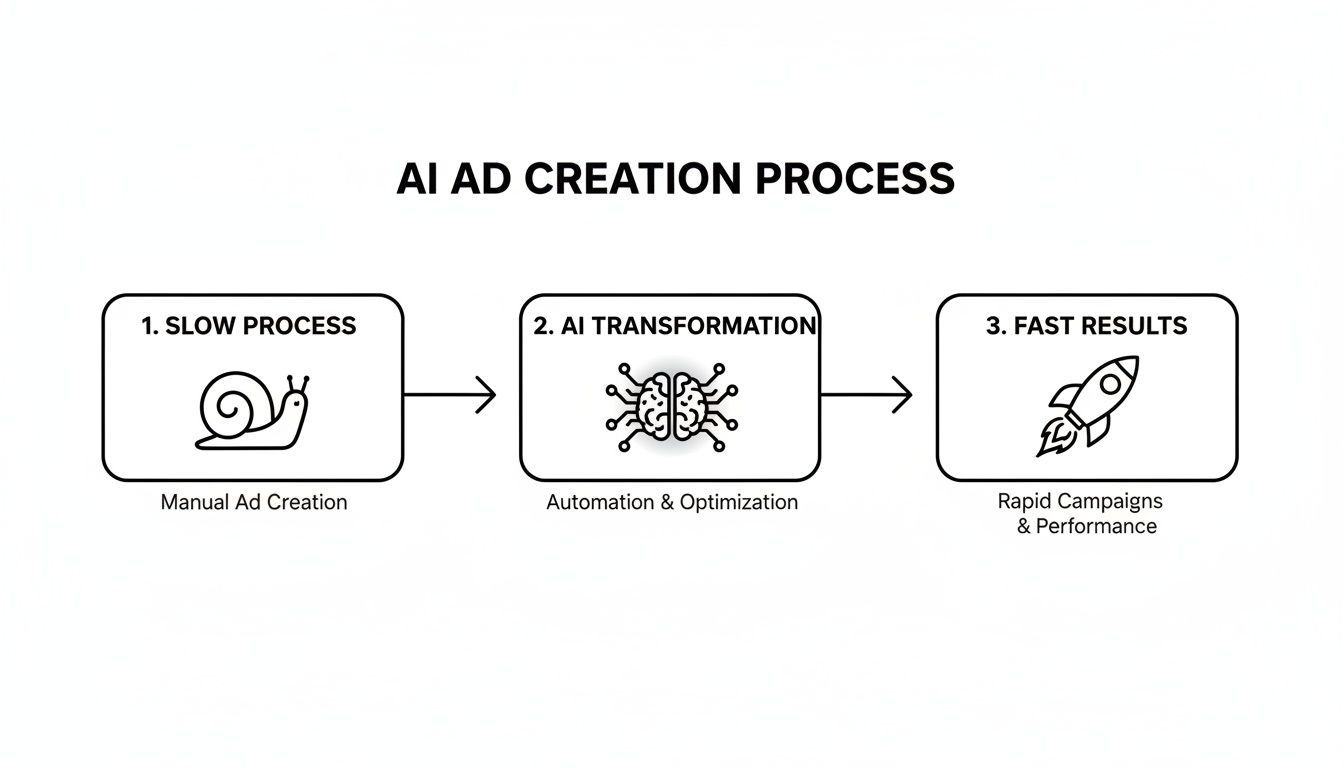
The real win here is the sheer speed. You can test more ideas, faster than ever before, which dramatically shortens the path to finding a winning ad.
Turning Winning Angles into Data-Backed Scripts
Okay, you've picked a few core angles you like. Now it's time to write the script. A truly good AI tool doesn't just hand you one script and call it a day; it gives you options.
Using a platform like ShortGenius, you can take one of your chosen angles and instantly get several script variations. Each one might have a slightly different hook, a rephrased call-to-action, or a faster pace.
For instance, sticking with the "Problem/Solution" angle, the AI could generate one script that opens with a direct question like, "Tired of your countertops smelling like a chemical factory?" and another that leads with a shocking statistic about chemicals in typical household cleaners.
This ability to spin up multiple script versions from a single idea is what really sets this workflow apart. You can build a whole library of creative to test without writing a single word yourself. This sets you up perfectly for a data-first campaign where you can quickly find the exact messaging that gets people to click.
Bringing Your Vision to Life with AI Production
So, you’ve nailed down a script that feels right. Now comes the part that trips up most marketers: turning those words into visuals that actually perform. The old way of thinking meant booking a studio, hiring actors, and spending a small fortune on a film crew.
Thankfully, that’s not the world we live in anymore. This is where AI really starts to shine, letting you create high-quality, authentic-looking ads without the massive overhead. The key is to stop thinking like you're making a Super Bowl commercial. The goal here is to create content that feels native to a social feed—think genuine UGC-style clips and clean product shots that don't scream "I'm an ad!"
This isn’t just some fringe trend, either. The numbers show this is the new standard. Generative AI use in business shot up from 33% in 2023 to a staggering 71% in 2024. That's more than double in a single year. Zooming in on video, 86% of ad executives are already using AI or have firm plans to.
The results speak for themselves. Marketers are saving about three hours on every piece of content and are seeing 40% boosts in productivity. For 64% of users, the cost savings are the biggest win. It's safe to say AI ad production has moved from "experimental" to "essential."
To understand just how different this approach is, let's compare the old way with the new AI-powered workflow.
AI-Powered Ad Production vs Traditional Workflow
| Stage | Traditional Workflow | AI-Powered Workflow (with ShortGenius) | Key Benefit |
|---|---|---|---|
| Concept & Scripting | Days of brainstorming, multiple revisions with a team. | AI generates 10+ ideas and scripts in minutes. | Speed & Volume |
| Filming & Production | Weeks of coordination, location scouting, hiring crew. | AI generates video scenes from text prompts instantly. | Cost & Flexibility |
| Asset Sourcing | Expensive stock footage licenses or custom shoots. | Access to AI-generated or royalty-free asset libraries. | Efficiency |
| Editing & Post-Production | Days or weeks with a professional editor and software. | AI handles editing, transitions, and effects in minutes. | Time-to-Market |
| Voiceover & Captions | Hire voice actors, manually transcribe and style captions. | AI generates voiceovers and auto-captions instantly. | Scalability |
| A/B Testing | Costly reshoots to create minor variations. | Create dozens of creative variants with a few clicks. | Performance Optimization |
The table makes it pretty clear. What used to take weeks and a hefty budget can now be accomplished in an afternoon, giving small teams and solo entrepreneurs the kind of creative firepower that was once reserved for huge agencies.
Generating Scenes from Simple Text Prompts
The magic of modern AI ad creation really comes down to text-to-video. With a tool like ShortGenius, you can literally just describe the scene you have in your head, and the AI will create it for you. This is a game-changer for getting those dynamic B-roll shots, establishing a location, or even creating short narrative clips that would be a pain to film yourself.
For instance, you could type in a prompt like, "A woman in her 20s happily unboxing a skincare product in a bright, modern bathroom." Seconds later, you'll have a realistic, UGC-style clip ready to go. You can get as specific as you want with lighting, camera angles, or the overall mood. It's like being a director, building your ad shot-by-shot without ever picking up a camera.
Breathing New Life into Your Existing Assets
You don't always need to create everything from scratch. Most businesses are sitting on a goldmine of existing assets—product photos, logos, maybe even some old video clips. AI is brilliant at taking what you already have and making it new again.
- Animate your static images. Got a great product shot? AI can add subtle motion to turn it into a short, eye-catching video.
- Build dynamic product demos. You can feed the AI several product images, and it can stitch them into a clean, seamless video that walks through key features.
- Swap out the background. Drop your product into a completely new environment without having to pay for a complicated photoshoot.
This ability to remix and repurpose your content is a huge time-saver. It lets you keep your ad creative fresh without having to go back to the drawing board every single time.
Adding Voice and Text to Maximize Impact
Let’s be honest: a silent video is only half an ad. The audio is just as crucial as the visuals. AI lets you generate incredibly natural-sounding voiceovers in pretty much any language or accent you can think of. This is perfect for reaching a global audience and ensuring your message is heard loud and clear.
A great ad is seen, heard, and understood. AI streamlines all three by generating visuals, adding a voice, and overlaying clear, stylized captions that grab attention even when the sound is off.
Speaking of captions, most modern tools like ShortGenius handle that for you automatically. This is non-negotiable, since so many people watch videos on social media with the sound off. You can even set up a brand kit to make sure your fonts, colors, and caption styles stay consistent, reinforcing your brand in every single ad. This complete package—visuals, voice, and text—is what really drives engagement.
Refining Your Ads for Peak Platform Performance
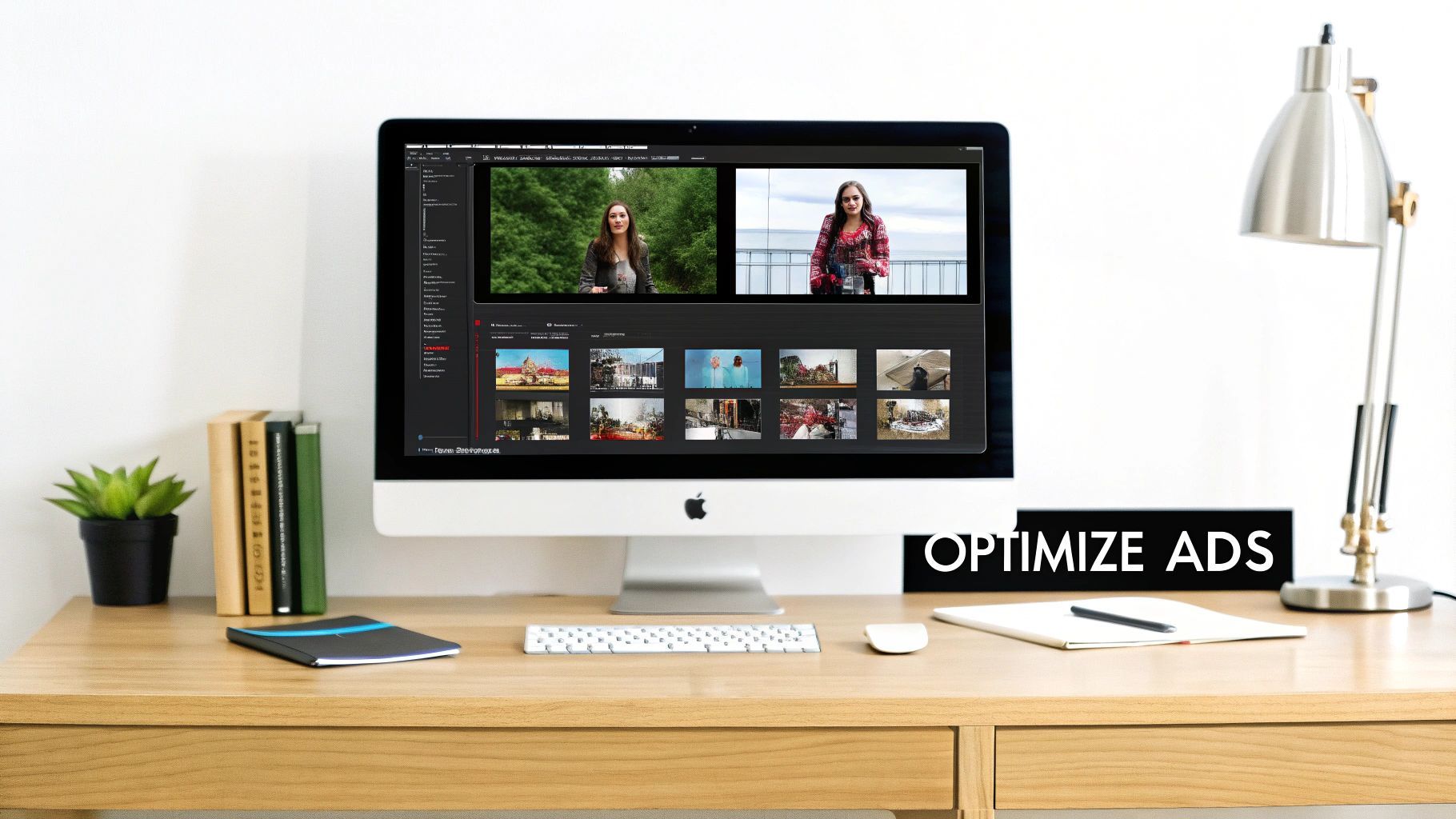
Getting that first version of your ad assembled is a great feeling, but the real magic happens in the editing and optimization phase. This is where you polish a good idea into a high-performing workhorse, fine-tuned for the platforms where your customers actually hang out.
The biggest win here with AI is pure speed. Forget the old-school, tedious process of manually re-editing a video for every single placement.
With the right tools, you can take your core video and instantly adapt it. One click can reformat a 16:9 YouTube ad into a 9:16 vertical video for TikTok or Instagram Reels. This single feature demolishes one of the biggest time-sucks in video production, making sure your ads always look and feel native to the feed.
And that native feel is non-negotiable. A video that looks great on a Facebook feed can stick out like a sore thumb on TikTok, and that tiny bit of friction is all it takes for someone to scroll right on by. AI handles these technical tweaks, freeing you up to focus on the creative.
Elevating Visuals from Standard to Unforgettable
If you truly want to create ads with AI that stop the scroll, you need to think beyond simple cuts and resizing. This is where you layer on specialized effects to really grab attention. Platforms like ShortGenius come loaded with visual enhancers designed specifically for that critical first 3-second window.
Think about how you can add a jolt of energy to an otherwise simple shot. You could apply things like:
- Scroll Stoppers: These are quick, attention-grabbing effects—think sudden glitches, snap zooms, or flashes that break a user's mindless scrolling pattern.
- Surreal Effects: What if your product floated in mid-air? Or a dreamlike filter was applied to a scene to create a bizarre but memorable visual?
- Camera Movements: AI can simulate professional camera work, adding subtle pans, tilts, or dolly zooms to static images. This gives them a much more polished, cinematic feel without needing an actual camera crew.
Using these effects, you can transform a basic product demo into a thumb-stopping visual experience. The goal is to make your ad so visually interesting that you earn a few extra seconds of watch time, giving your hook and core message a chance to stick.
A great ad isn't just seen; it's felt. AI-powered effects allow you to inject emotion and energy into your visuals, turning a passive viewing experience into an active one and significantly increasing the chances of engagement.
The Power of Rapid A/B Testing Variations
Maybe the most powerful advantage of this entire workflow is the ability to churn out tons of ad variations for A/B testing. In the past, testing a new hook or swapping out one scene meant sending notes to an editor and waiting hours—or days—for a new version. Now, it takes seconds.
From a single core ad, you can spin up a dozen different versions to test very specific ideas.
- Test different hooks: Does starting with a question get more clicks than a bold, declarative statement?
- Swap out scenes: Does a raw, UGC-style clip of a customer outperform a glossy, polished product shot?
- Change the voiceover: Is a male voice more authoritative for this audience, or does a female voice feel more relatable?
- Vary the call-to-action: Which gets better results: "Shop Now" or "Learn More"?
This is how you go from guessing what works to knowing what works, all based on cold, hard data. By constantly testing and iterating, you can systematically improve your results, lower your ad costs, and uncover the winning formulas that connect with your audience—all without having to go back to the drawing board every time.
Launching and Scaling Your AI-Powered Ad Campaigns
Now that you've got a batch of ad variations ready to go, it's time to get them out into the world. This is where we shift from creation to execution, turning that library of AI-generated assets into a machine that drives predictable growth.
The whole point here is to build a constant feedback loop. You're not just launching one "perfect" ad and crossing your fingers. Instead, you're deploying a whole portfolio of creative ideas, each one a mini-experiment. This is exactly what platforms like ShortGenius were designed for, letting you schedule out entire series of ads to keep your content from getting stale and hitting that wall of ad fatigue.
Figuring Out What Works (and Doing More of It)
Once your campaigns are live, your focus needs to switch completely to the data. It's one thing to make great ads, but you need to integrate them effectively within major platforms like Google's advertising ecosystem to get the best reach and results. To do that, you have to track the right numbers.
Here are the metrics I always keep a close eye on:
- Click-Through Rate (CTR): This is your first signal. It tells you if your hook and visuals are actually stopping the scroll. A low CTR is a huge red flag that your opening isn't grabbing attention.
- Cost Per Acquisition (CPA): How much are you actually paying for each new customer? For any campaign focused on sales or sign-ups, this is the number that really matters to your bottom line.
- Return on Ad Spend (ROAS): Simply put, for every dollar you spend, how many are you making back? This is the clearest, most direct measure of whether your ads are profitable.
By digging into the results of your A/B tests, you’ll start seeing patterns emerge almost immediately. You might find that ads with a funny voiceover get a 50% lower CPA, or that the UGC-style scenes are doubling your CTR. This is the secret to create ads with AI that don't just work, but get better and better over time.
This isn't just a niche strategy anymore; it's becoming the industry standard. Global spending on AI-powered advertising has ballooned to around 370 billion USD. The smartest marketers are now putting 35% of their digital budgets toward AI—that's five times more than their competitors. And it's working. Retail brands have seen efficiency jump by 20-40%.
Scaling the Winners Smartly
When an ad starts crushing it, the temptation is to just throw the entire budget behind it. That's a mistake. The smarter move is to use AI to understand why it's a winner and then multiply that success.
Your best-performing ad isn't the finish line. Think of it as the blueprint for your next round of creative development. It’s what you use to keep your campaigns running hot.
Break down the core pieces of your winning ad—the hook, the visual style, the call-to-action—and plug them back into a tool like ShortGenius to generate new versions. You can try swapping in a different product shot, testing a new voiceover, or just tweaking the first line.
This nimble process lets you constantly refresh your ads and scale your campaigns without having to go back to the drawing board every single time. It transforms your advertising from guesswork into a finely tuned, data-driven system.
Got Questions About Making Ads with AI?
Jumping into a new workflow always sparks a few questions. When it comes to using AI to create ads, I've found that most marketers are curious about the same things: quality, control, and how steep the learning curve really is. Let's tackle those head-on so you can feel good about making the shift.
One of the biggest hang-ups I hear is the fear that AI ads will just look… fake. It’s a totally valid concern. Authenticity is everything on social media, so the last thing you want is something that screams "robot-made."
Can AI-Generated Ads Actually Look Authentic?
Yes, absolutely. The latest AI platforms are designed specifically to create visuals and voiceovers that feel like genuine, user-generated content. We're way past the days of clunky, obviously AI videos. The real trick is in the details you provide upfront.
When you give the AI a solid creative brief and use features like brand kits to dial in your style, you're essentially coaching it to match your vibe. The result is content that blends right into a TikTok or Instagram feed, not something that sticks out for all the wrong reasons.
How Much Creative Control Do I Really Have?
You have complete creative control. A common myth is that using AI means giving up your creative vision. It’s better to think of it as having a ridiculously fast and efficient production assistant, not a new creative director calling the shots.
With a tool like ShortGenius, you’re still steering the ship at every stage:
- You approve the core idea and the script.
- You choose the visual style and pick the scenes.
- You make the final tweaks to the edit, captions, and effects.
The AI is just doing the heavy lifting—generating the assets—while you focus on strategy and creative direction. Don't like a scene it generated? Regenerate it with a click. It's that simple.
The real power of AI isn't about replacing your creativity; it's about amplifying it. It strips away the tedious technical work, freeing you up to focus entirely on the marketing strategy and the big idea behind the ad.
Is It Hard to Get Started Creating Ads with AI?
Not at all. The entire point of these platforms is to be intuitive, even if you’ve never touched a video editor in your life. All those technical roadblocks that used to make video production a headache are basically gone.
Most tools guide you through a simple workflow. You start with something basic, like your product link or a quick description, and the AI helps you the rest of the way. It generates scripts, finds visuals, and puts it all together, turning what used to be a complicated process into a series of easy choices.
How Does AI Make A/B Testing Better?
This is where AI becomes a massive advantage for performance marketers. It takes A/B testing from a slow, expensive headache to a fast, data-backed process. Instead of waiting days for a new creative, you can generate a dozen variations in minutes.
Once you have a solid ad, you can instantly test different hooks, try out new calls-to-action, or swap in different voiceovers. This makes it feasible to run huge creative tests, see what’s working almost immediately, and zero in on the exact elements that get your audience to click. The impact on campaign results can be huge.
Ready to see just how fast you can turn an idea into a winning ad? ShortGenius gives you everything you need to script, generate, and launch video ads that actually perform. Start creating for free at https://shortgenius.com.