8 Common Mistakes With AI Generated Video Ads to Avoid in 2026

Discover the top common mistakes with AI generated video ads and learn how to fix them for better performance. Boost your ROAS with actionable tips today.
AI video generation has revolutionized ad creation, allowing marketers to produce content at an unprecedented scale. Tools can spin up dozens of ad variations in minutes, promising endless creative testing and optimization. However, this speed often comes at a cost. Many teams fall into predictable traps, launching campaigns that are technically polished but strategically flawed, leading to wasted ad spend and disappointing results.
The problem isn't the AI—it's the strategy behind it. Simply generating a video is not enough to drive conversions. Without a solid creative foundation and a keen understanding of platform dynamics, these ads often fail to connect with audiences, capture attention, or compel action. Success requires blending the efficiency of automation with proven marketing principles. To maximize the impact of your AI-generated campaigns and address low conversion rates, a solid understanding of fundamental persuasive advertising techniques is essential for building a strategy that truly resonates.
This article breaks down the 8 most common mistakes with AI generated video ads we see crippling campaigns right now. We'll move beyond generic advice to give you a clear, actionable playbook for avoiding these pitfalls. For each mistake, we'll explain precisely why it hurts performance, provide concrete fixes with prompt examples, and offer checklists to ensure your next AI-powered campaign is your most profitable one yet. Let's dive into the specific errors that are holding your ads back and how you can fix them, starting today.
1. Ignoring Brand Consistency and Visual Identity
One of the most frequent and damaging common mistakes with AI generated video ads is sidelining brand consistency. This happens when marketers, excited by the speed of AI, generate numerous ad variations without enforcing a unified visual and tonal identity. The AI might create a technically perfect video, but if the colors, fonts, logo placement, and voiceover style are inconsistent from one ad to the next, it actively weakens your brand.
This inconsistency creates a disjointed customer experience. An audience seeing five different ads from your brand, each with a unique aesthetic, won't form a strong connection or recall your identity. It erodes trust and makes your marketing efforts feel fragmented and unprofessional, much like a construction project without a unified blueprint can lead to chaos. Learn more about how structured planning prevents costly errors by exploring Exayard's general contractor estimating software.

Why Brand Consistency is Non-Negotiable
In a crowded digital landscape, brand recognition is a powerful asset. Consistency builds a mental shortcut for consumers, helping them instantly identify your content. When every ad reinforces your brand's unique look and feel, you build familiarity and credibility. This cohesion is why major brands like Apple and Nike are instantly recognizable; their strict adherence to brand guidelines ensures every piece of content feels like part of a larger, trustworthy whole.
Actionable Fixes for Consistent AI Ads
Fortunately, maintaining your brand identity within AI workflows is straightforward with a proactive approach. Instead of fixing ads after generation, build your brand guidelines directly into the creation process.
- Upload a Brand Kit: Many advanced AI video platforms allow you to upload a "Brand Kit." This typically includes your official logos, a defined color palette (with hex codes), and specific font files. The AI will then use these assets as the default for all new projects.
- Create a Master Template: Before generating dozens of variations, create a single master template. Set your logo position, define the text overlay style, select a consistent voiceover tone (e.g., "friendly and energetic"), and establish the background music style. Use this template as the starting point for every ad.
- Establish Voice and Tone Guidelines: Don't just focus on visuals. Create a simple document outlining your brand's voice. Is it witty, authoritative, empathetic, or formal? Use these keywords in your prompts when generating scripts or selecting AI voiceovers to ensure the messaging aligns with your brand personality.
- Perform a Pre-Launch Audit: Before a campaign goes live, quickly review all video variations side-by-side. Check for consistency in logos, colors, fonts, call-to-action styling, and overall tone. This final check catches any deviations the AI might have introduced.
2. Poor Script Quality and Weak Hooks in the First 3 Seconds
Another of the most critical common mistakes with AI generated video ads is overlooking the script, particularly the first three seconds. Marketers often trust the AI to generate a functional script, but these default outputs frequently lack the "thumb-stopping" power needed to capture attention on fast-paced platforms like TikTok and Instagram. A polished video with stunning visuals is useless if the opening line is too generic to stop a user from scrolling past.
This failure to hook the viewer immediately results in wasted ad spend and dismal performance metrics. An e-commerce brand using a generic opener like "Discover our amazing new product" will lose to a competitor whose ad starts with "Stop buying moisturizers that don't actually work." The latter addresses a specific pain point and creates instant intrigue, proving that a strong, AI-assisted script is the foundation of a successful video ad, not an afterthought.

Why the First 3 Seconds Are Everything
In the modern attention economy, you have a vanishingly small window to make an impact. The hook is not just the beginning of your ad; in many cases, it's the entire ad for the majority of viewers. A powerful opening must either create a curiosity gap, present a shocking statistic, call out a specific audience, or state a bold, benefit-driven promise. Without this initial punch, the rest of your carefully crafted message goes unheard.
Actionable Fixes for Stronger AI Scripts
Instead of accepting generic AI outputs, guide the technology with strategic inputs to produce compelling, scroll-stopping hooks. This involves treating the AI as a creative partner rather than a simple script generator.
- Prompt with Pain Points and Emotions: Feed the AI specific details. Instead of "Write a script for our new productivity app," use a prompt like: "Write three 15-second video ad hooks for a productivity app targeting overwhelmed freelancers. Start by directly addressing the pain point of juggling multiple clients and missing deadlines. The desired emotion is relief."
- Leverage Hook Formulas: Instruct your AI to use proven copywriting formulas. Prompt it to generate openings based on patterns like: "Problem-Agitate-Solution," "Before-After-Bridge," or by asking a provocative question. For example: "Generate 5 hooks that ask a question related to disorganized project management."
- Incorporate Pattern Interrupts: The first few seconds should break the viewer's scrolling trance. Use your AI tool to generate visuals or text overlays that are unexpected. Prompt for "quick-cut editing," "a surprising sound effect," or "a bold, controversial statement on-screen" within the first two seconds.
- A/B Test Hooks Aggressively: Never rely on a single hook. Use AI to generate 5 to 10 different opening variations for the same video. Test them simultaneously in your ad campaign to identify which style resonates most with your audience, whether it's a statistic, a user testimonial, or a direct question.
3. Overusing AI-Generated Voiceovers Without Human Review
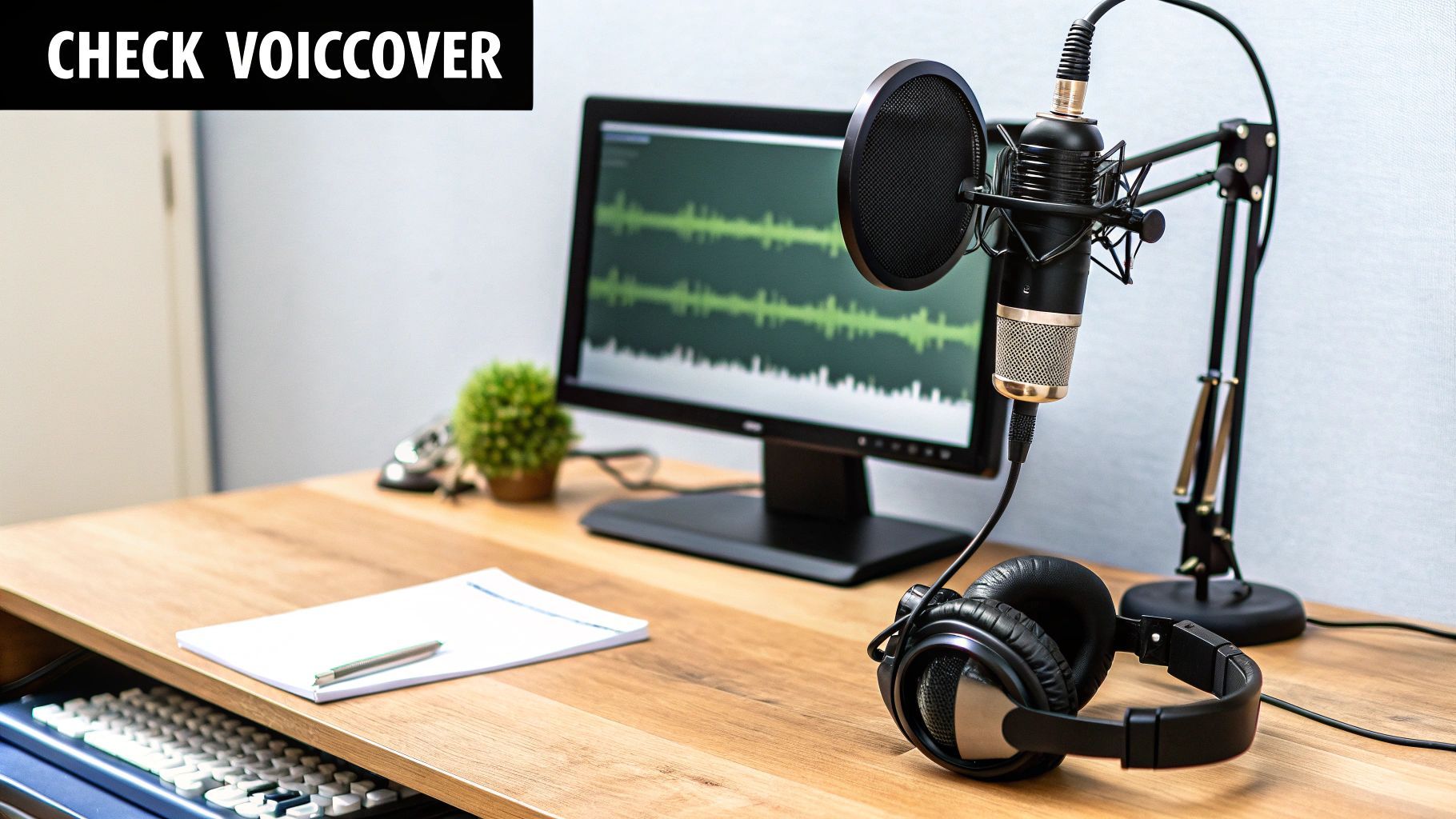
One of the most revealing common mistakes with AI generated video ads is deploying synthetic voiceovers without any human oversight. While AI voice technology has made incredible leaps, relying on the default output can lead to robotic, emotionally flat, or tonally inappropriate narration. This error is especially damaging when an AI mispronounces a brand name, technical term, or slogan, instantly shattering the ad's credibility and professionalism.
This oversight makes an ad feel cheap and untrustworthy. An audience listening to a B2B SaaS ad where the AI repeatedly mispronounces the product's name will question the company's attention to detail. Similarly, a fitness ad meant to inspire action falls flat when delivered in a monotone, lifeless voice, undermining the entire message. Authenticity, especially in user-generated content (UGC) style ads, is paramount, and a robotic voice creates an immediate disconnect.
Why Human Review of Voiceovers is Crucial
The human voice is an incredibly nuanced instrument for conveying emotion, trust, and personality. Even the best AI can struggle with the subtle inflections, pacing, and emphasis that make a message persuasive and authentic. When a voiceover sounds off, it distracts the viewer from the core message and the call to action. As TikTok creators and ad agencies like Wistia have demonstrated, authentic and emotionally resonant audio is directly linked to higher engagement and conversion rates.
Actionable Fixes for Better AI Voiceovers
Improving your AI-generated audio is about treating the voiceover as a critical creative element, not an afterthought. A few simple review steps can dramatically increase the quality and effectiveness of your ad's sound.
- Audit and Preview Every Generation: Never publish the first voiceover the AI produces. Always listen to the full audio track, checking for natural pacing, correct pronunciation of key terms, and appropriate emotional tone.
- Create a Pronunciation Guide: For brand names, acronyms, or industry-specific jargon, use the phonetic spelling features available in many AI tools. Create a simple guide (e.g., "Exayard" = "Egg-Zah-Yard") to ensure consistency across all ads.
- Match the Voice to the Audience: Don't just pick the default. If your target audience is Gen Z, select a more casual, conversational AI voice. For a corporate B2B ad, a more authoritative and polished tone would be appropriate. Test multiple voices to see which resonates best.
- Adjust Pacing and Emphasis: Most AI video platforms offer settings to control the speed, pitch, and pauses in a voiceover. Add a slight pause before a key benefit or slow down the delivery on the call to action to add emphasis and improve comprehension.
- Consider a Hybrid Approach: For high-stakes campaigns or UGC-style ads demanding maximum authenticity, use AI to generate the script but have a human record the voiceover. This combines the speed of AI writing with the irreplaceable nuance of a human voice.
4. Failing to Optimize Ad Length, Formatting, and Platform Algorithm Preferences
One of the most counterproductive common mistakes with AI generated video ads is creating a single "one-size-fits-all" video and deploying it across every social platform. This happens when creators, focused on the ease of generation, overlook the unique content consumption habits and algorithmic preferences of each channel. An AI can produce a brilliant 60-second horizontal ad, but when that same ad is forced onto a vertical-first platform like TikTok or Instagram Reels, it leads to poor engagement, incomplete message delivery, and wasted ad spend.
This failure to optimize creates a jarring user experience and signals to platform algorithms that your content isn't a good fit. An e-commerce brand posting a 90-second narrative ad on TikTok will see viewers drop off after 15 seconds, while a SaaS company's horizontal demo video on Instagram Reels will have its key UI elements awkwardly cropped. This is akin to an electrical project where wires are not cut to the correct length or gauge, leading to system failure; precise specifications are essential. You can learn more about how detailed specifications prevent project overruns by exploring Exayard's electrical estimating software.
Why Platform-Specific Optimization is Crucial
Each social media platform is a distinct ecosystem with its own audience expectations and content ranking signals. TikTok rewards fast-paced, authentic, user-generated-style content, while LinkedIn's algorithm favors polished, professional, and educational videos. Ignoring these nuances means you’re not just formatting incorrectly; you’re speaking the wrong creative language. Optimizing for length, aspect ratio, and tone dramatically increases the likelihood that your ad will be served to the right audience and perceived as native, high-value content rather than a disruptive, out-of-place advertisement.
Actionable Fixes for Platform-Optimized AI Ads
Adapting your AI-generated ads for each platform is a critical step that can be streamlined directly into your workflow. Instead of treating distribution as an afterthought, plan for multi-platform delivery from the start.
- Generate Length Variations Upfront: Prompt your AI tool to create multiple versions of your ad from the beginning. A good prompt would be: "Generate 15-second, 30-second, and 60-second video ad variations for this script." This gives you ready-to-deploy assets for different platforms and placements.
- Use Platform-Specific Prompts: Tailor your creative instructions to match the platform's native style. For example, use "Create a raw, authentic UGC-style video for TikTok" versus "Create a polished, professional brand video for a Facebook feed ad."
- Master the Aspect Ratios: Before generating, specify the correct format. The most common are 9:16 (for TikTok, Reels, Shorts), 1:1 (for Instagram/Facebook feeds), and 16:9 (for YouTube main feed, X). Ensure any text overlays or captions are positioned to be legible in every format.
- Prioritize the First Three Seconds: Regardless of the total length, structure your prompt to place the most compelling hook, value proposition, and brand identifier within the first three seconds. This captures attention before users have a chance to scroll away.
5. Neglecting Product Visibility and Demo Quality
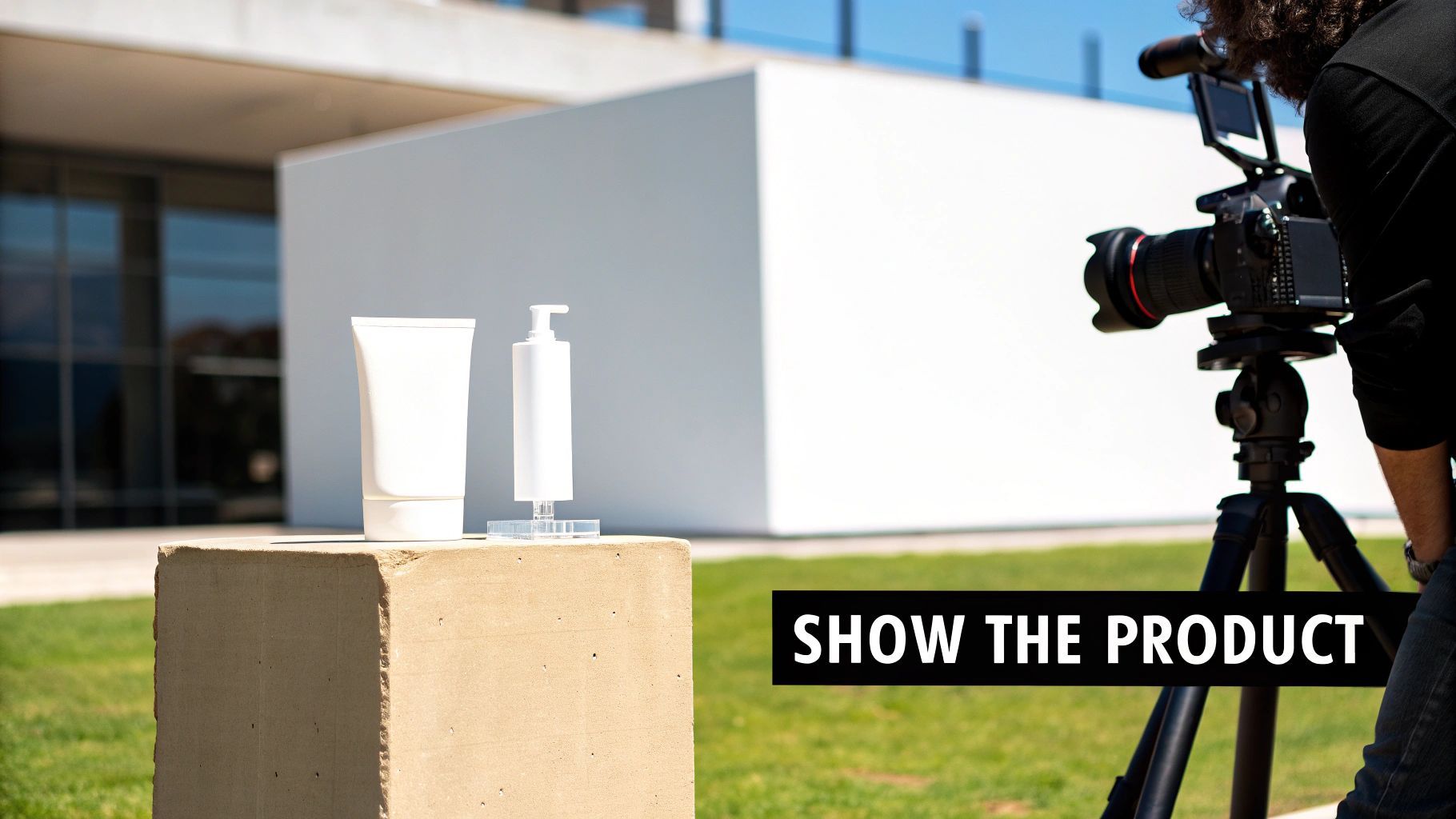
Among the most critical common mistakes with AI generated video ads is prioritizing flashy effects over clear product presentation. Marketers can get carried away with surreal transitions and dynamic AI-generated backgrounds, inadvertently obscuring the very product they're trying to sell. When a generated scene has poor lighting, distracting visual noise, or fails to show the product in a realistic use-case, it confuses the viewer and tanks conversion potential.
This mistake turns a promising ad into an abstract art piece. An e-commerce ad for a phone case that uses excessive particle effects to hide the product’s actual design is a wasted opportunity. Similarly, a SaaS demo showing a cluttered, unreadable dashboard fails to communicate value. This is akin to a contractor creating a beautiful 3D model of a building but failing to provide the detailed material list; the visual is nice, but it lacks the essential information needed to make a decision. You can discover more about how precise data leads to better outcomes by exploring Exayard's construction takeoff software.
Why Clear Demos Drive Conversions
Ultimately, a product ad exists to sell a product. Viewers need to see it clearly, understand its features, and envision how it will benefit them. A high-quality demonstration builds trust and answers key purchasing questions before they are even asked. Whether it's the texture of a cosmetic, the specific UI of a software tool, or the scale of a physical good, clarity is what transforms a viewer into a customer. A visually stunning ad that fails to clearly showcase the product is an expensive failure.
Actionable Fixes for Product-Focused AI Ads
To avoid this pitfall, make the product the hero of your video from the very start. Use AI as a tool to enhance the product's presentation, not to overshadow it.
- Make the Product the Visual Anchor: Start your prompt by defining the product's placement and importance. For example, use "A photorealistic shot of [our product] on a clean white surface, central in the frame" before adding stylistic instructions.
- Generate Multiple Angles and Views: Create a sequence of shots to provide a comprehensive view. Generate scenes for a "close-up on the product's texture," "the product held in a hand for scale," and "the product in a realistic home environment."
- Use AI for Feature Callouts: Instead of relying on distracting effects, use AI to generate clean text overlays or simple animated arrows that point to specific features as they are shown. Prompt the AI to "add a subtle text overlay saying 'Water-Resistant' next to the product."
- For SaaS, Focus on UI Clarity: When demonstrating software, use prompts that specify zooms and highlights. For instance, "Generate a screen recording that slowly zooms into the 'Analytics Dashboard' button, then highlights the 'Monthly Growth' chart with a glowing yellow box." This directs viewer attention effectively.
- Test Realistic vs. Stylized Scenes: Create two versions of your ad: one with realistic, well-lit environments and another with more surreal or abstract AI backgrounds. A/B test them to see which one delivers a better conversion rate for your specific product and audience.
6. Inconsistent Call-to-Action (CTA) Messaging and Placement
A critical entry among the common mistakes with AI generated video ads is overlooking the call-to-action (CTA). AI tools can produce stunning visuals, but they often default to generic CTAs like "Learn More," which dilutes the ad's purpose. This mistake manifests as weak, vague, or inconsistently placed CTAs that fail to create urgency or align with the specific campaign goal, directly damaging click-through and conversion rates.
This lack of strategic direction confuses the viewer. An e-commerce brand running a flash sale with a "Shop Now" button misses the urgency, while a SaaS company offering a free trial with a "Learn More" CTA creates unnecessary friction. Inconsistent placement, where the CTA appears in the middle of one ad and at the end of another, further fragments the user experience and weakens the campaign's overall impact.
Why Your CTA Dictates Success
The CTA is the single most important element for driving a desired action. It’s the bridge between viewer engagement and business results. A clear, compelling, and consistently placed CTA tells the audience exactly what to do next, removing ambiguity and motivating them to act immediately. As conversion rate optimization experts like Neil Patel have long emphasized, clarity and directness in your CTA are paramount for turning viewers into customers.
Actionable Fixes for High-Converting AI Ads
Integrating a strong CTA strategy into your AI workflow is essential for maximizing ROI. Instead of treating it as an afterthought, make it a core component of your video generation prompt and template.
- Define Your CTA Strategy Upfront: Before generating any ads, determine the precise action you want for each audience segment. Is it to "Start Your Free Trial," "Get 40% Off - Today Only," or "Reserve Your Spot"? Be specific.
- Use Benefit-Driven Language: Frame your CTA around the value the user will receive. Instead of a generic "Click Here," use an action-oriented phrase like "Get Your Free Guide" or "Claim My Discount."
- Match Urgency to the Offer: For limited-time offers, use scarcity-driven language in your prompts. Specify that the AI should include text overlays like "Offer Ends Tonight" or "Limited Stock Available" to drive immediate action.
- Standardize Placement and Styling: Create a master template where the CTA is always placed in the same spot, such as the final 5 seconds. Use your Brand Kit to ensure the CTA button's color, font, and animation are consistent across every single video variation.
- Reinforce the CTA: Don't rely solely on a visual button. Use your AI script generation prompts to include the call-to-action in the voiceover as well. A combination of visual text overlay and spoken audio significantly boosts comprehension and recall.
7. Insufficient Testing and Single-Variant Campaign Launches
One of the most significant yet common mistakes with AI generated video ads is launching a single ad variant and hoping for the best. AI's greatest strength is its ability to rapidly iterate and produce multiple creative options, but this advantage is completely lost when marketers generate one "perfect" video and push it live without testing. This approach is akin to a chef only ever cooking one dish for every customer; you miss out on valuable feedback and opportunities for improvement.
Failing to test different hooks, visuals, calls-to-action (CTAs), or voiceovers means you are guessing what resonates with your audience instead of letting data guide you. A startup launching a single product demo to a broad audience, for example, misses the chance to discover if a problem-focused hook would have performed ten times better. This oversight leads to wasted ad spend, lower conversion rates, and a stagnant creative strategy.
Why A/B Testing is Essential for AI Ads
The core principle of performance marketing, popularized by platforms like Facebook and Google, is systematic experimentation. AI tools supercharge this process, making it easier than ever to create the assets needed for robust testing. By launching multiple variations simultaneously, you can quickly identify which creative elements drive results, allowing you to double down on what works and cut underperforming ads early.
This data-driven approach transforms your marketing from a game of chance into a strategic process of continuous optimization. It allows you to understand your audience on a deeper level and consistently improve campaign performance. For comprehensive guidance on setting up effective ad tests, learn more about how to effectively test a Facebook ad to ensure your campaigns are data-driven.
Actionable Fixes for Effective AI Ad Testing
Leveraging AI for testing doesn't have to be complicated. By building a simple framework into your workflow, you can turn your campaigns into powerful learning engines.
- Define Your Variables: Before generating anything, decide what you want to test. Focus on high-impact variables like the first three seconds (the hook), the primary visual style, the CTA copy, or the background music. Limit it to 1-2 variables per test to get clear results.
- Generate Multiple Variants: Use your AI tool's batch generation features to create 5-10 variations based on your chosen variables. For example, prompt the AI to create five versions of an ad, each with a different opening line testing a unique customer pain point.
- Establish a Testing Hypothesis: Frame your test with a clear hypothesis, such as: "We believe a user-generated content (UGC) style visual will achieve a lower CPA than a polished, animated visual for our target audience." This clarifies the purpose of the test.
- Analyze and Iterate: Launch all variants simultaneously to a specific audience segment. After gathering enough data (e.g., 500 impressions per ad), pause the underperformers. Analyze the winning ads to identify common characteristics and use these insights as prompts for your next batch of AI-generated content.
8. Over-Reliance on AI Without Human Creative Strategy and Judgment
A significant and often overlooked pitfall is treating AI as a replacement for human strategy rather than an accelerator for it. This is one of the most critical common mistakes with AI generated video ads, occurring when teams use AI to generate high volumes of content without a guiding creative brief, market positioning, or narrative arc. The AI can produce endless variations, but without a strategic foundation, the output is a collection of disconnected tactics that fail to build a memorable brand or achieve long-term business goals.
This approach mistakes activity for progress. An e-commerce brand might generate 50 different product demos, but if none of them communicate what makes the brand unique, they are just adding to the noise. It’s like having a world-class orchestra without a conductor or a musical score; you get a cacophony of technically proficient sounds that lack harmony and purpose. True marketing impact comes from the fusion of strategic human insight with the executional power of AI.
Why Human Strategy is the Engine of AI Success
AI is brilliant at execution based on the instructions it's given, but it cannot invent a market position, understand audience psychology, or define a brand’s unique value proposition from scratch. These elements are born from human creativity, research, and strategic thinking. Legendary advertising minds like Dan Wieden built iconic brands by starting with a powerful, simple strategy first. Without this strategic direction, AI-generated ads become generic, easily forgettable, and fail to differentiate you from competitors who are likely using the same tools.
Actionable Fixes for Strategy-Led AI Production
Integrating human strategy into your AI workflow ensures that every video ad you create is not just a piece of content, but a deliberate step toward a larger business objective.
- Start with a Creative Brief: Before generating a single video, document your strategy. Define the target audience’s psychology, your competitive differentiation, the campaign’s primary objective, and the core message you want to convey.
- Develop Content Pillars: Establish 3-5 strategic narrative themes for your ads. For example, a skincare brand might use pillars like "The Science Behind Our Formula," "Customer Transformation Stories," and "Debunking Skincare Myths." This ensures variety while maintaining a coherent narrative.
- Use AI as an Execution Layer: Frame your prompts with strategic context. Instead of "create a video ad for our moisturizer," use a prompt like: "Generate a UGC-style video for our moisturizer based on our 'Customer Transformation' pillar. Target millennial women who feel overwhelmed by complex routines, positioning our product as the simple, effective solution."
- Maintain a Strategic Review Process: Your review process should go beyond technical quality. Appoint a brand strategist or marketing lead to evaluate if the AI-generated ads align with the established brand positioning and narrative. Ask: "Does this ad reinforce who we are and why we're different?"
8 Common AI-Generated Video Ad Mistakes Compared
| Item | Implementation Complexity 🔄 | Resource Requirements & Speed ⚡ | Expected Outcomes / Impact 📊 | Ideal Use Cases ⭐ | Key Advantages / Tips 💡 |
|---|---|---|---|---|---|
| Ignoring Brand Consistency and Visual Identity | Low–Moderate — easy to produce inconsistent variants; requires governance to fix | Low initially; moderate effort to create brand kits and enforce templates | Fragmented recognition, lower trust and ROAS; harder to scale creative | N/A as intentional strategy; useful for identifying creative gaps in testing | Upload brand kits, use master templates, audit before publish; enforce style presets |
| Poor Script Quality and Weak Hooks in the First 3 Seconds | Moderate — needs prompt engineering and creative writing oversight | Moderate — requires iterative testing of hooks and editorial input | High early drop-off, low engagement, higher CPV; strong hooks improve view duration 40–60% | Short-form platforms where scroll-stopping is critical (TikTok, Reels, Shorts) | Use proven "scroll stoppers," give detailed prompts, A/B test multiple hooks; prioritize curiosity/emotion |
| Overusing AI-Generated Voiceovers Without Human Review | Low — technically simple but risk-prone without review | Fast generation but needs human review for pacing/pronunciation; hybrid approach recommended | Perceived inauthenticity, mispronunciations, lower emotional resonance; possible negative PR | Rapid multilingual tests, scalable voice variants when human-reviewed | Always preview voiceovers, create pronunciation guides, match voice to persona, test human vs AI |
| Failing to Optimize Ad Length, Formatting, and Platform Algorithm Preferences | Moderate — requires platform knowledge and format adaptation | Moderate — trimming/resizing is quick with tools but needs analytics per platform | Poor platform performance, higher CPA, incomplete messaging; platform optimization can lift engagement 30–100% | Multi-platform campaigns needing tailored placements (TikTok, YouTube Shorts, Instagram) | Generate multiple lengths (15/30/60s), place hook in first 3s, use correct aspect ratios and captions |
| Neglecting Product Visibility and Demo Quality | Low–Moderate — needs attention to framing, lighting, and shot selection | Moderate — requires focused shoots/regeneration for clear close-ups and realistic lighting | Low conversion despite views; clear demos correlate with 2–3x higher conversion | E‑commerce and product demos, SaaS feature walkthroughs | Make product the visual anchor; use close-ups, size refs, before/after shots; test effects vs realism |
| Inconsistent Call-to-Action (CTA) Messaging and Placement | Low — easy to standardize but often overlooked | Low — templating CTAs is fast; testing variants is quick | Lower CTR and conversions; specific urgency-driven CTAs can boost CTR 30–50% | Time-sensitive offers, product launches, trial/signup campaigns | Define CTA strategy, standardize placement (e.g., last 5s), use benefit-driven and urgency language; A/B test CTAs |
| Insufficient Testing and Single-Variant Campaign Launches | Moderate — requires testing framework and discipline | Moderate–High — generate multiple variations and run parallel tests; tool support speeds process | Wasted spend, slower ROAS; systematic testing yields 2–3x better ROAS and faster optimization | Performance-driven campaigns and growth experiments | Create 3–10 variations, define metrics/hypotheses, run series-based tests, document and scale winners |
| Over-Reliance on AI Without Human Creative Strategy and Judgment | High — needs strategic briefing and human oversight | High — requires strategist time, creative briefs, and review cycles; AI for execution | Disconnected messaging, weak long-term brand impact; strategy-driven creative yields 2–4x ROI | Brand-building, differentiation, long-term narrative campaigns | Start with a creative brief, define content pillars, use AI as execution layer, maintain human strategic review |
Moving From AI Operator to AI Strategist
Navigating the landscape of AI-generated video ads can feel like learning a new language. As we've explored, the technology is powerful, but its potential is only unlocked when guided by sharp human insight. The journey from creating a single AI video to orchestrating a successful campaign requires a fundamental shift in mindset: you must evolve from a simple AI operator, focused on button-pushing and prompt entry, to a sophisticated AI strategist, focused on outcomes, audience connection, and brand integrity.
The most critical takeaway from this guide is that AI is a force multiplier, not a replacement for strategy. Each of the common mistakes with AI generated video ads we've covered, from ignoring brand identity to launching single-variant campaigns, stems from the same root cause: relinquishing creative control and strategic oversight to the machine. The goal is not to automate creativity out of existence but to automate the tedious, time-consuming production tasks so you can invest more of your energy into high-impact strategic decisions.
Your Strategic AI Workflow Checklist
To transition from operator to strategist, use the insights from this article to build a new, more intentional workflow. Audit your current process against this strategic framework:
- Brand First, AI Second: Do you start with a clearly defined brand kit and visual identity that the AI must adhere to? Or do you let the AI dictate the aesthetic, leading to off-brand visuals? A strategist ensures every frame, color, and font reinforces brand recall.
- Hook & Script Obsession: Are you treating the script as a mere input, or are you obsessively testing hooks, refining pacing, and ensuring the core message is crystal clear within the first three seconds? A strategist knows the ad is won or lost in that initial moment.
- Human-in-the-Loop Quality Control: Do you passively accept default AI voiceovers and unedited clips? A strategist actively listens, reviews, and refines these elements, ensuring the final output has a human touch that builds trust and avoids the uncanny valley.
- Platform-Native Mindset: Are you creating one-size-fits-all videos? A strategist understands that a winning TikTok ad has a different rhythm, format, and CTA placement than a YouTube Short or Instagram Reel. They use AI to adapt a core creative concept for each platform's unique algorithm and user expectations.
By consistently applying this strategic lens, you transform your relationship with the technology. AI stops being a magic box you hope will produce a winning ad and becomes a powerful extension of your own marketing expertise. You provide the "why" (the brand story, the audience insight, the campaign goal), and the AI delivers the "how" (the rapid video variations, the visual assets, the voiceover generation) with incredible speed and efficiency.
Ultimately, avoiding these common mistakes with AI generated video ads is about reclaiming your role as the creative director. The true power lies in the partnership between human intuition and machine execution. When you master this synergy, you don't just create ads faster; you create smarter, more resonant, and significantly more profitable campaigns that drive measurable business results and build a lasting brand.
Ready to put these strategies into action and avoid the pitfalls? ShortGenius is designed for marketers who want to move from operator to strategist, providing the tools to enforce brand consistency, rapidly test creative variations, and produce high-performing video ads at scale. Stop making common mistakes and start building winning campaigns by visiting ShortGenius today.