The CapCut Ban Navigating the Future of Video Creation

Is CapCut getting banned? Understand the global CapCut ban, its impact on creators, and how to protect your content with a clear, actionable plan.
So, you’re wondering if your favorite video editor is about to get banned. The simple answer is, it’s complicated—and it really depends on where you are in the world. There’s no single, worldwide CapCut ban in effect. Instead, we’re seeing a patchwork of different rules, with countries like India having already blocked the app, while the U.S. has a ticking clock that could pull it from app stores.
Understanding the Global CapCut Ban
The whole debate around a CapCut ban isn’t just noise; it’s a serious global issue tied to data privacy and national security. The real problem isn't about the app's features, but its owner: ByteDance, the same company behind TikTok.
Governments, especially in the West, are getting more and more nervous about apps owned by foreign companies and what happens to user data. This has created a fractured reality where CapCut works perfectly in one country but is completely off-limits in another.
Think of it this way: every time you edit a video, you're creating data. The big question governments are wrestling with is whether that data could potentially be accessed by foreign authorities, creating a security risk.
The Two Major Fronts
The pushback against CapCut isn't happening the same way everywhere. It’s really playing out in two distinct ways, each with massive implications for creators and brands who rely on the app.
- Outright Prohibition: This is the nuclear option. The app gets yanked from the Apple App Store and Google Play, and its servers are blocked. It becomes impossible to use without resorting to sketchy workarounds. This is already the case in a few places.
- Forced Divestiture or Ban: This is more of an ultimatum. The parent company is told to sell the app to a government-approved buyer by a specific deadline. If they don't, a full ban kicks in. The goal here is to cut the app's ties to its foreign ownership while letting it stay in business under new management.
This has thrown a huge wrench into the market. Despite its incredible success—we’re talking over a billion downloads and an estimated $100 million in revenue for 2023—the constant regulatory pressure has chipped away at user trust. India, for instance, permanently banned CapCut between 2020 and 2022 as part of a larger crackdown on over 300 apps. Now, the U.S. has given ByteDance a January 19, 2025, deadline to sell or face a ban. You can dive deeper into the global concerns and CapCut's status on Alibaba.com.
At the end of the day, the CapCut ban debate isn’t about video editing. It’s a geopolitical chess match over data security and who gets to control the digital tools we use every single day.
Getting a handle on this core conflict is the first step to staying ahead of any disruptions and making smart choices for your creative workflow.
CapCut Ban Status in Key Regions
To make sense of the current situation, it helps to see how different countries are handling the app. The table below offers a quick snapshot of where things stand.
| Region | Current Status | Primary Concern |
|---|---|---|
| United States | At Risk | A law requires ByteDance to sell by Jan 19, 2025, or face a ban. The main issue is national security and data privacy related to its Chinese ownership. |
| India | Banned | Permanently banned since 2020 amid geopolitical tensions, citing national security and data sovereignty threats. |
| European Union | Under Scrutiny | Operational but facing intense scrutiny under GDPR. Investigations into data transfer practices with China are ongoing. |
| United Kingdom | Operational | No ban in place, but lawmakers are closely watching the U.S. and E.U. actions. Concerns about data security persist. |
| Australia | Operational | The app is available, but the government has banned TikTok on federal devices, signaling potential future action for related apps. |
This table shows just how varied the response has been. While creators in some regions can continue as usual (for now), others have already been forced to find alternatives or are preparing for a potential shutdown.
The Timeline of Global Restrictions
The "CapCut ban" isn't a single event that happened overnight. It’s more like a series of dominoes falling, a chain reaction of policy decisions that have unfolded over several years and across different continents. Each government has its own reasons, mostly rooted in security and geopolitics, and understanding this progression is the key to seeing the bigger picture.
It all started with a swift, decisive move in India that completely caught the creative community off guard.
India Sets a Precedent
The real turning point in the global conversation around CapCut came in June 2020. India’s move wasn't just a warning shot; it was a full-blown ban that set a powerful precedent for other nations concerned about data sovereignty.
Following violent border clashes in the Galwan Valley, the Indian government acted fast. It banned CapCut, TikTok, and over 300 other Chinese-owned apps, citing threats to national security, user privacy, and potential surveillance. It was a complete shutdown—CapCut vanished from app stores, its websites were blocked, and millions of creators suddenly lost access, forcing them to scramble for alternatives. You can dig deeper into how this groundbreaking ban reshaped app regulations on tryhmesha.com.
India’s action proved that a government could, and would, pull a massively popular app from its digital ecosystem almost instantly.
This visual timeline breaks down the key moments, from India's initial action to the critical deadline now looming in the United States.
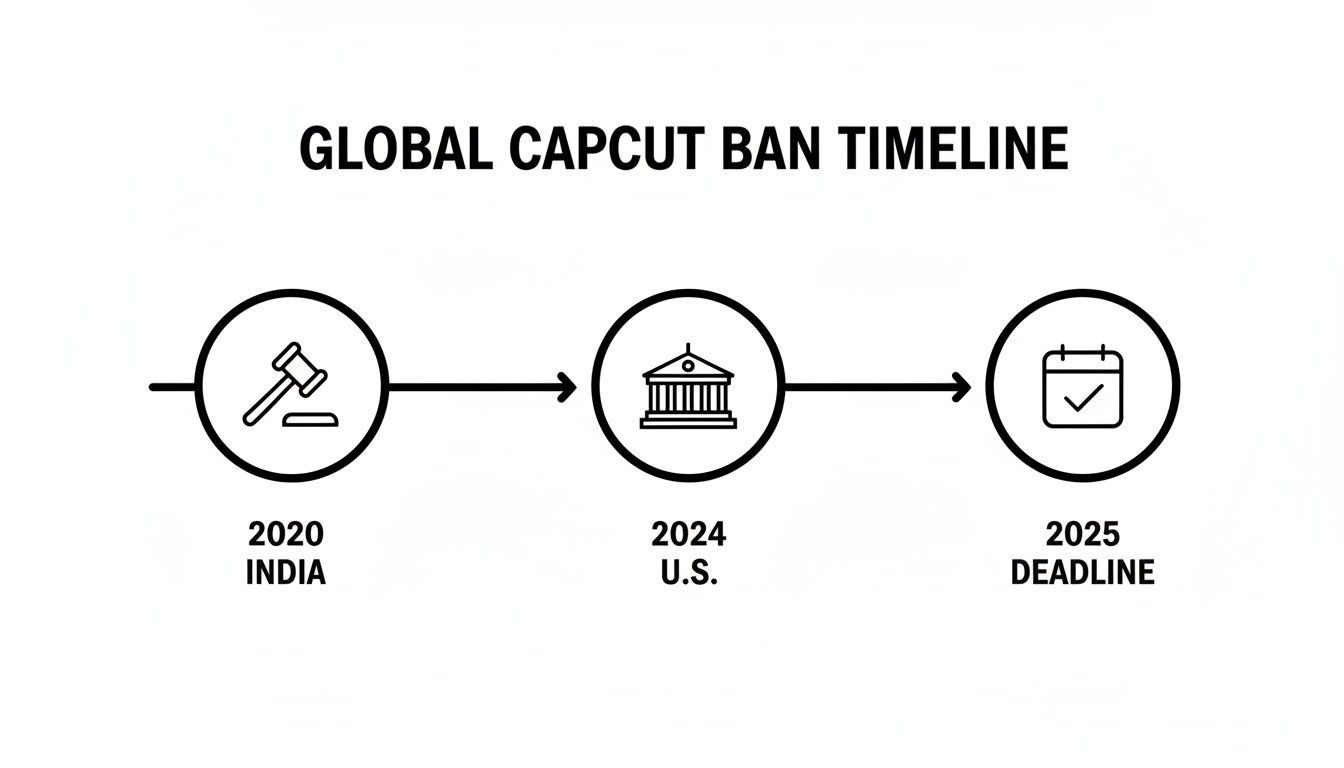
As you can see, what started in one country has escalated over several years, creating a growing cloud of uncertainty over the app's future.
The United States Responds
Following India’s lead, the conversation in the United States started heating up. For years, lawmakers had been voicing similar concerns about data security and CapCut’s ownership by ByteDance. That long-simmering debate finally boiled over into real legislative action in early 2024.
The U.S. government passed the Protecting Americans from Foreign Adversary Controlled Applications Act. This law wasn’t an immediate ban. Instead, it was an ultimatum: ByteDance must sell its U.S. operations to a buyer approved by the government, or face a total prohibition.
The legislation set a hard deadline of January 19, 2025. If a sale isn't finalized by then, the law requires Apple and Google to remove CapCut and TikTok from their U.S. app stores and forces internet service providers to stop hosting them.
This put a ticking clock on the app's survival in one of its biggest markets. The situation went from a "what if" scenario to a tangible business threat with a very specific end date.
The Ripple Effect in Other Nations
While India and the U.S. have been the most direct, other Western nations are taking a more cautious, "watch and see" approach. Their actions have created a more complicated, but still uncertain, environment for creators and brands.
- European Union: CapCut is still available, but it's under a microscope. Regulators are closely watching its data practices, especially how user information is transferred to China, to ensure it complies with the strict General Data Protection Regulation (GDPR).
- Canada & Australia: Both countries are following a similar path. While there’s no public ban on CapCut itself, they have forbidden TikTok on all government-issued devices. This is a clear signal of their concern about ByteDance-owned apps and hints that wider restrictions could be on the table down the line.
These moves, while not outright bans, add to a global atmosphere of regulatory pressure and distrust. The timeline shows a clear pattern: one country's policy decision sparks a debate and influences potential actions in another. This cascading effect is what puts the future of CapCut in question, making it critical for users to stay informed and start planning for what’s next.
Why Governments Are Wary of CapCut

To really get why a CapCut ban is even on the table, you have to look past the cool transitions and trendy templates. The heart of the issue for governments isn't video editing—it's about data, ownership, and national security. The entire controversy boils down to one key fact: CapCut's parent company is ByteDance, the same Chinese tech giant that owns TikTok.
That connection alone sets off alarm bells for regulators worldwide. The fundamental fear is that sensitive user data swept up by the app could end up in the hands of the Chinese government. This isn't just a hypothetical scenario; it's a worry grounded in real-world geopolitical tensions and specific national security laws that could force companies like ByteDance to hand over information.
Think of it like this: every app permission you grant is like a stamp in a digital passport, tracking your movements online. Governments are deeply concerned about who ultimately holds that passport and what they might do with all that accumulated data.
The Data CapCut Collects
When you hit "agree" on CapCut's terms of service, you're giving it the green light to collect a surprisingly broad swath of your information. While many media apps collect data, the context of ByteDance's ownership makes every single data point feel much more consequential.
And we're not just talking about the video clips you edit. The app gathers a whole host of personal and device information that, when pieced together, creates a remarkably detailed profile of you.
Here’s a quick look at what CapCut can collect:
- Personal Identifiers: Things like your name, date of birth, email address, and phone number.
- Location Data: The app can request access to your precise GPS data, painting a clear picture of your physical whereabouts.
- Device and Network Information: This includes your IP address, the type of phone you have, your operating system, and even your mobile carrier.
- Biometric Information: This is a big one. According to its privacy policy, CapCut can collect biometric identifiers from your content, such as faceprints and voiceprints.
This level of data collection is a major reason behind the push for a CapCut ban. The combination of personal details, location tracking, and especially biometric data creates a rich user profile that many security agencies find deeply unsettling.
The real risk isn't just about one person's data. It's about the potential for mass data collection that could be used for intelligence gathering, surveillance, or to influence public opinion on a massive scale.
National Security and Data Sovereignty
Stepping back from individual privacy, the much bigger picture for governments is data sovereignty. This is the principle that a country’s data should be subject to its own laws and protections. When millions of your citizens use an app owned by a company in a geopolitical rival's territory, that sovereignty is directly challenged.
The crux of the national security argument centers on China's 2017 National Intelligence Law. In simple terms, this law requires Chinese organizations and citizens to "support, assist and cooperate with the state intelligence work." For Western governments, this means there's a credible fear that no Chinese company can truly say "no" to a government request for data, no matter what its own privacy policy says.
This creates a serious conflict. CapCut might store user data in servers located in the U.S. and Singapore, but its parent company, ByteDance, is still under the jurisdiction of Chinese law. To regulators, this looks like a legal backdoor that could expose user data, making any promises of data security feel hollow. It’s this perceived vulnerability that keeps the idea of a CapCut ban alive as a potential safeguard for national interests.
How The Ban Actually Affects Creators And Brands
Forget the policy debates and the headlines for a second. The real question for anyone in the trenches creating content is: how does a CapCut ban mess up my actual day-to-day work? This isn't just a small bump in the road; it’s a major operational headache that hits solo creators and big brands in different, but equally painful, ways.
For an individual creator, CapCut is often the entire production engine. Think about it—what happens if you wake up one morning and it's gone? Years of saved projects, your go-to templates, and a workflow you’ve perfected could all disappear overnight. The muscle memory you've built from editing hundreds of videos suddenly becomes useless, kicking off a frustrating scramble to find and learn a new tool from scratch.
This isn't just some far-off possibility. The app's incredible growth, skyrocketing from 100 million users in 2019 to over 1 billion Android downloads by Q3 2024, has always been shadowed by this threat. With a looming U.S. ban deadline of January 19, 2025, the app's 200 million monthly active users are on notice. A ban would be a huge blow, especially for the 8.02% of users in the U.S. who helped make it the #1 app in the App Store.
The Hidden Costs For Brands And Agencies
For marketing agencies and brands, the stakes are even higher. The problem goes way beyond one person's workflow and creates a domino effect of logistical and financial nightmares that can throw entire campaigns off the rails.
A sudden ban would trigger a whole host of problems right away:
- Shattered Campaign Timelines: That video ad campaign you just launched? If the assets were made in CapCut, you can no longer edit or repurpose them. Your team is forced to either scrap the content entirely or rebuild it from the ground up in new software, leading to huge delays.
- Wasted Ad Spend: All the money you poured into campaigns using CapCut-edited videos is as good as gone if those assets are suddenly locked. With no way to tweak or update them, your return on investment tanks.
- Serious Security Risks: When employees get desperate, they might try to use VPNs or download unofficial APK files to keep using CapCut. This opens up your company's entire network to malware and major security breaches.
These issues are a logistical mess. Whole teams need to be retrained on new software, which isn't just about learning where the buttons are. It’s about building a new, efficient system for collaboration—a process that drains time, money, and patience.
Let's be real: relying on a tool with such an uncertain future is a direct threat to your business. The true cost of a CapCut ban isn't losing the app; it's the chaos it unleashes on your entire content production pipeline.
Workflow Breakdowns And Inconsistent Content
Maybe the most immediate and obvious hit is to your creative workflow. CapCut’s slick integration with TikTok and its dead-simple interface made it the undisputed king for a certain style of short-form video.
Take that tool away, and your content consistency goes right out the window. A brand’s signature style—those specific cuts, text effects, and a rhythm your audience recognizes—becomes nearly impossible to replicate on the fly. You'll likely see a clear drop in content quality and brand cohesion while your team fumbles around with unfamiliar software.
As creators figure out how to navigate a world without CapCut, they'll need to get smart about engagement on other platforms, which might mean looking into tools like a Tiktok Story Viewer. The shift isn't just about finding new software; it's about developing entirely new strategies to connect with your audience.
Ultimately, a CapCut ban forces you to take a hard look at your content toolkit. It's a wake-up call that you need a solid backup plan to keep your video production running no matter what happens in the world of tech policy. This isn't just about finding a replacement; it's about building a tougher, more secure creative operation. The brands that start preparing now are the ones that will keep publishing without missing a beat.
Your Game Plan for a Post-CapCut World

The chatter around a potential CapCut ban isn't just noise—it's a real risk to your entire content workflow. Instead of crossing your fingers and hoping for the best, you can use this moment to build a stronger, more secure creative process. Let's walk through a clear, step-by-step plan to protect your work and keep your publishing schedule on track, no matter what happens.
First thing's first: you need to get everything you've ever made out of the app. Now. A sudden ban could mean losing permanent access to your cloud projects, custom templates, and all that raw footage you've stored. Think of this as a digital evacuation—get your valuables to a safe place before the doors are locked for good. This is how you make sure years of hard work don't just disappear.
It’s like backing up your most important files before a hurricane is even on the radar. You don't wait for the storm to hit. By acting now, you're swapping last-minute panic for a calm, proactive strategy.
Audit and Export All Your Creative Assets
Before you jump to a new tool, you need to take inventory of what you have inside CapCut. This isn't just about grabbing your finished videos; it’s about saving the DNA of your content. A little organization here will save you a massive headache later.
To keep things from getting overwhelming, start by sorting your assets into three main buckets.
- Finished Videos: Download the final versions of every important video, both published and unpublished. Make sure you export them in the highest resolution possible and save them to a local hard drive or a trusted cloud service like Google Drive or Dropbox.
- Project Files and Templates: This part is critical. If the app lets you, export the actual project files. Even more importantly, grab any custom templates, brand kits (your specific fonts, colors, logos), and the effects or transitions you use all the time. Documenting these elements will make it so much easier to get your signature style up and running in a new editor.
- Raw Footage and Media: Don't forget your raw ingredients. Download every single raw clip, audio file, and graphic you've uploaded to the CapCut ecosystem. If you lose this media, you're starting from absolute scratch on any future remakes or updates.
Securing your assets is non-negotiable. If a CapCut ban goes into effect, you will almost certainly lose access to everything stored on their servers. Acting now is the only way to guarantee the safety of your creative work.
Finding Secure and Powerful Alternatives
Once your assets are safely tucked away, it's time to find a new home for your video creation. The goal isn't just to find a quick replacement, but to pick a platform that won't land you in this same boat again. You should be looking for tools that are transparent about their data practices and are headquartered in regions with solid privacy laws.
Your checklist should balance two things: robust security and killer features. After all, a tool is useless if it can't do what you need it to do.
Here’s what to look for when you're vetting new tools:
- Data Privacy Policies: Actually read the terms of service. Where is your data being stored? Who can see it? You want to see clear, easy-to-understand policies, not a wall of legal jargon.
- Geopolitical Stability: It's smart to choose software from companies based in countries with stable regulations and strong data protection laws, like the U.S. or EU nations.
- Feature Parity: Can the new tool actually do what CapCut did? Look for essentials like AI-powered editing, auto-captioning, brand kits, and easy ways to post to social media.
- Team Collaboration: If you're not a solo creator, make sure the platform is built for teams. You'll need things like shared asset libraries, multi-user access, and simple review-and-approval workflows.
Some creators are moving to all-in-one platforms like ShortGenius, which not only match CapCut's editing features but also bring scriptwriting, scheduling, and multi-channel publishing under one secure roof.
Feature Comparison CapCut vs. Secure Alternatives
To help you see the difference clearly, let's break down how CapCut stacks up against some of the more secure, next-generation platforms designed for professional creators and teams.
| Feature | CapCut | Secure AI Alternatives (like ShortGenius) |
|---|---|---|
| Primary Function | Mobile-first, trend-focused video editor | All-in-one content creation & distribution platform |
| Data Security | Ambiguous; data subject to Chinese laws | Transparent; hosted in US/EU with strict privacy controls |
| Team Collaboration | Limited, primarily single-user focused | Built-in workspaces, user roles, and approval flows |
| AI Capabilities | Strong on templates, effects, and captions | Advanced AI for scriptwriting, editing, and scheduling |
| Brand Management | Basic brand kit functionality | Centralized brand assets, fonts, and color palettes |
| Publishing | Exports video files for manual upload | Direct, multi-channel publishing and scheduling |
| Support | Community-based and limited direct support | Dedicated customer support and onboarding for teams |
While CapCut is great for quick, trendy videos, the table shows that secure alternatives are built with the needs of professional creators and businesses in mind, offering a much more robust and reliable foundation for your content operations.
Common Questions About the CapCut Ban
When a tool you rely on every day faces a potential ban, a lot of questions pop up. For creators and brands who've built their entire video strategy on CapCut, the uncertainty is a real problem. Let's cut through the noise and get you some straight answers to the biggest concerns.
Think of this as your practical guide to navigating what comes next.
Will I Lose My Videos if CapCut Is Banned?
Yes, that's a very real possibility. A full-blown ban would likely mean CapCut disappears from app stores and its servers get blocked. If that happens, any projects, drafts, and media you have stored in their cloud could be gone for good.
It's like having your work locked in a building, and suddenly the doors are sealed shut. That’s why you need to act now.
Get into the app and start exporting everything important—your finished videos, project files, and go-to templates. Save them to your computer or a cloud service you control, like Google Drive or Dropbox. Don't wait for the news to break; by then, it'll be too late to recover your hard work.
Can I Still Use CapCut with a VPN?
Technically, a VPN (Virtual Private Network) might seem like a clever workaround, but for any serious creator or business, it's a shaky and unreliable strategy. A VPN can spoof your location, but it doesn't solve the core issues a ban introduces.
For one, app stores can still block downloads and updates based on your account's region, no matter what your IP address says. More importantly, running your professional workflow through a VPN opens up a whole host of performance and security issues.
A VPN is like a temporary detour around a roadblock. It might get you through for a little while, but it’s not a permanent, reliable highway for your business. It can be slow, unstable, and open you up to security risks you wouldn't otherwise face.
Instead of patching together a short-term fix that could break at any moment, the much smarter move is to migrate to a platform built for long-term reliability and peace of mind.
What Makes a Video Editor a Safe Choice?
A truly "safe" alternative is one that respects your data, operates transparently, and isn't caught up in the geopolitical drama that’s putting CapCut at risk. When you're shopping for a new tool, you need to look past the fancy features and focus on the company's foundation.
Here are a few things to look for when vetting a new editor:
- Clear Privacy Policies: A trustworthy company has a privacy policy that’s easy to find and written in plain English. It should tell you exactly what data they collect and where it's stored.
- Strong Data Protection Laws: Look for tools based in countries with solid data protection laws, like the United States or EU member nations compliant with GDPR.
- Transparent Ownership: You should be able to easily find out who owns the company. This clarity removes any question marks about potential government influence.
A secure tool means you can create without worrying that your content, business data, or personal info is at risk.
How Does This Ban Affect Posting on TikTok?
While the CapCut ban and the potential TikTok ban are two different things, they're deeply connected since ByteDance owns both. If CapCut gets banned, the immediate hit to your TikTok workflow will be huge.
You'd lose the editor that's built to work seamlessly with TikTok. Suddenly, your creation process gets slower and clunkier, and keeping your signature style consistent becomes a major headache. Finding, learning, and getting good at a new editor takes time—time you don't have when you're trying to stay relevant.
This is exactly why an all-in-one platform is such a game-changer. By using a single, secure tool for everything from scripting and editing to scheduling and publishing, you keep your momentum. You can create content and push it to TikTok and all your other channels from one place, making sure your content engine keeps running no matter what.
Ready to secure your workflow and scale your content without worrying about bans? ShortGenius is the all-in-one AI video platform that helps you write, create, and publish high-quality videos in minutes. Join over 100,000 creators and teams who trust ShortGenius for reliable, fast, and multi-channel content production. Get started with ShortGenius today.