Build a Profitable Automated YouTube Channel That Runs Itself

Discover how to build a successful automated YouTube channel from scratch. Learn proven strategies for niche selection, content creation, and monetization.
Think of an automated YouTube channel less as a "set it and forget it" machine and more as a lean, intelligent media company. The most successful creators in this space aren't just making videos; they're building systems. They use AI-powered workflows to handle the heavy lifting—like scripting, voiceovers, and video assembly—so they can stay focused on the big picture: strategy and growth.
A Smarter Way to Create Content
Welcome to the new era of YouTube, where automation isn't just a buzzword—it's a fundamental shift in how content gets made. The old way involved one person grinding for hours, often days, to produce a single video. That model is quickly becoming unsustainable for creators who want to scale without burning out.
This modern approach isn’t about removing the human touch; it's about amplifying it.
The core idea is brilliantly simple: offload the repetitive, time-sucking tasks to specialized AI tools. This frees you up to act as a creative director or a producer, not just a line-level editor or writer. Your job becomes steering the ship—picking the right niche, analyzing what works, and planning your next move.
Here's a quick look at how the pieces fit together:
- AI-Generated Scripts: Creating engaging scripts from a simple idea or prompt.
- AI-Powered Voiceovers: Using text-to-speech for crisp, consistent narration.
- Automated Video Assembly: Pulling in stock footage, adding graphics, and piecing it all together.
- Systematic Scheduling: Keeping a steady flow of content going out to your audience.
Why This Is Happening Now
This model is exploding for two big reasons: YouTube's colossal audience and the incredible accessibility of AI tools. With 2.85 billion monthly active users, the platform's appetite for new content is insatiable. This creates a massive opportunity for anyone who can produce quality videos at scale.
We're seeing creators use tools like ShortGenius to build entire content pipelines without succumbing to the typical creator burnout. While there are over 869 million channels out there, only a tiny fraction are monetized, which shows just how much room there is to grow. You can find more stats on YouTube's scale and earnings potential over at Affinco.
The real magic of an automated channel is scalability. Once you build a system that works for one channel, you can duplicate that process across different niches. You're not just creating videos; you're building a portfolio of digital assets that generate income 24/7.
This guide is your blueprint for building an automated YouTube channel from scratch. We’ll walk through everything—finding a profitable niche, setting up your AI workflow, mastering the algorithm, and scaling your income well beyond AdSense.
Let's get started on building your content engine.
Finding a Niche That Actually Makes Money
Let's get one thing straight: the success of your automated YouTube channel is decided long before you ever hit "render." It all comes down to the niche you choose. A lot of people make the mistake of picking a passion project, but if you want to make real money, you have to treat this like a business from day one.
That means finding topics with a built-in audience and, more importantly, high monetization potential. We’re not just looking for what’s popular today, but what’s profitable and sustainable for an automated workflow. Think evergreen—topics that will still be relevant five years from now, letting your old videos pile up views and cash for a long, long time.
Identifying High-RPM Niches
On YouTube, not all views are created equal. The platform pays you based on a metric called RPM (Revenue Per Mille), which is simply how much you earn for every 1,000 video views. Niches that attract viewers with money to spend or who are actively researching a purchase will always have higher ad rates. It's just that simple.
Your job is to find a niche where advertisers are lining up to pay top dollar. Some of the most lucrative areas I've seen are:
- Personal Finance and Investing: This is the big one. Content on stocks, crypto, real estate, or even just budgeting pulls in an audience ready to spend or invest. Advertisers love them.
- Technology and Software Tutorials: If you can explain software, review the latest gadgets, or teach coding, you're golden. Tech companies will pay a premium to get their ads in front of your viewers.
- Health and Fitness: This is a classic evergreen category. Whether you're covering keto diets or home workout routines, the audience is massive and always looking for solutions.
- Historical Deep Dives: Channels that break down complex historical events or fascinating biographies can build an incredibly loyal following. This format is perfect for faceless, narrated content that’s easy to automate.
The real beauty here is that these niches lend themselves to repeatable content formats. A "Top 10 Historical Mysteries" video uses the exact same production blueprint as a "Top 10 Tech Gadgets" video. This makes creating templates for your AI workflow an absolute breeze.
Analyzing Competitors and Finding Your Angle
Got a few high-RPM niches in mind? Great. Now it's time to do some homework. Jump on YouTube and search for other automated channels in those spaces. If you see a lot of competition, don't get discouraged—that’s a good sign! It means there’s a proven market and money to be made.
Your goal isn't to reinvent the wheel, but to find the gaps. Ask yourself:
- What specific topics are they glossing over?
- Could I present this information in a cleaner, more engaging way?
- Is there a smaller, underserved sub-niche they're all ignoring?
For example, the "personal finance" niche is crowded. But you might notice that while everyone is talking about stocks, almost no one is making clear, simple videos on small business tax strategies. Boom. That's your opening. A unique angle is what will make your channel stand out from the endless sea of generic content.
The most successful automated channels I've seen don't just chase trends. They find a very specific, repeatable video format and absolutely own it. This creates a predictable experience that both viewers and the YouTube algorithm will reward.
A Look at High-Potential Niches
Choosing the right niche is a balancing act between what advertisers will pay for (RPM) and how easily you can scale content production. Some topics are far better suited for an AI-driven workflow than others. Below is a breakdown of popular categories to help you see where the sweet spots are.
High-Potential Niches For Automated Channels
| Niche Category | Example Channel Types | Estimated RPM Range | Automation Suitability |
|---|---|---|---|
| Finance & Investing | Stock analysis, crypto news, real estate tips, personal budgeting | $15 - $50+ | High: Data-driven content is perfect for AI scripting. Visuals can be stock footage and charts. |
| Technology | Gadget reviews, software tutorials, AI news, programming guides | $10 - $40 | High: Factual, step-by-step content is easy to generate. Screen recordings and stock clips work well. |
| History & Education | Historical events, biographies, science explainers, psychology facts | $8 - $25 | Very High: Narrative-style content is an AI strong suit. Relies on archival footage and voiceover. |
| Health & Fitness | Workout routines, nutrition tips, meditation guides, biohacking | $7 - $20 | Medium: Requires careful fact-checking, but formats are very repeatable. Stock footage is plentiful. |
| Luxury & Travel | Top 10 mansions, luxury product showcases, city guides | $10 - $30 | High: Listicle formats are simple to automate. Heavily reliant on high-quality stock video. |
| Mystery & Horror | Unsolved mysteries, true crime stories, paranormal tales | $5 - $15 | Very High: Storytelling is ideal for AI. Visuals can be abstract, using stock clips to build mood. |
As you can see, niches like Finance and History offer a powerful combination of high RPMs and high suitability for automation. These are often the best places to start because they give you the highest potential for a strong return on your time and investment.
Building a Replicable Content Strategy
Think of your content strategy as the blueprint for your automation factory. The goal is to develop a handful of video formats you can produce over and over again with slight variations. Consistency is king on YouTube—it tells the algorithm what your channel is about and gives viewers a reason to subscribe.
Here are a few formats that are practically built for automation:
| Format Type | Description | Why It Works for Automation |
|---|---|---|
| Listicles/Top 10s | Videos like "Top 10 Ancient Roman Inventions" or "5 Best Budgeting Apps." | Highly structured, making script generation a piece of cake. Sourcing B-roll for each point is simple. |
| Explainer Videos | Breaking down complex subjects like "How Does a Quantum Computer Work?" | Perfect for AI-generated scripts and voiceovers. Visuals can be handled with animations and stock clips. |
| Historical Narratives | Telling the story of a specific event, person, or era. | Follows a clear beginning, middle, and end that AI can script effectively. Visuals are easy to find in historical archives. |
| Productivity Hacks | Showcasing tips and tricks for getting more done at work or in life. | Simple concepts that can be illustrated with screen recordings, stock footage, and slick animated text. |
Once you have your formats locked in, you can use an AI tool like ChatGPT to brainstorm ideas at scale. For instance, you could feed it a prompt like, "Generate 50 video ideas for a historical deep-dive channel, using a listicle format focusing on forgotten battles."
Just like that, you can fill your content calendar for the next six months. This is how you turn niche selection from a wild guess into a calculated business decision.
Your AI-Powered Content Creation Workflow
Alright, you've locked in a profitable niche. Now for the fun part: building the engine that will run your automated YouTube channel. This is where we shift from planning to doing, creating a seamless production line from start to finish. The goal isn't to be a digital juggler, bouncing between a dozen different apps. It's about creating one unified workflow that turns a simple idea into a finished video with as little hands-on effort as possible.
Think of it as building a content factory. Every step, from the first word of the script to the final thumbnail design, is handled by a specialized AI tool, all working together. Let's walk through how this assembly line actually works.
From Prompt to Polished Script
Every good video starts with a solid script. For most creators, this is the biggest time suck. But with AI, the game completely changes. Using a large language model (LLM), you can generate a well-structured, engaging script from a single prompt in just a few minutes.
Let's say your channel is all about historical mysteries. Your prompt could be something like: "Write a 5-minute YouTube script about the mysterious disappearance of the Roanoke Colony. Make it a storytelling style, throw in three surprising facts, and end with a question for the audience."
The AI will spit out a full script—intro, body, conclusion, and all. It often even includes cues for visuals and pacing. It's not the final, polished product, but it's an incredible starting point that you can refine in seconds. This easily saves hours of research and writing on its own.
Generating Lifelike Voiceovers Instantly
Script in hand, you need a voice. Forget the robotic, monotone text-to-speech from years ago. Today's AI voice generators are shockingly realistic, offering a huge range of tones, accents, and emotional deliveries.
You just paste your script into the tool, pick a voice that fits your channel's vibe (maybe an authoritative tone for a finance channel or a calming one for meditation), and generate the entire audio track. It's that simple.
A huge advantage here is consistency. Using the same AI voice across all your videos builds a recognizable brand. Your channel develops a distinct, professional sound without you ever having to touch a microphone.
The process of picking a strong niche, as shown below, is what fuels this entire content workflow.
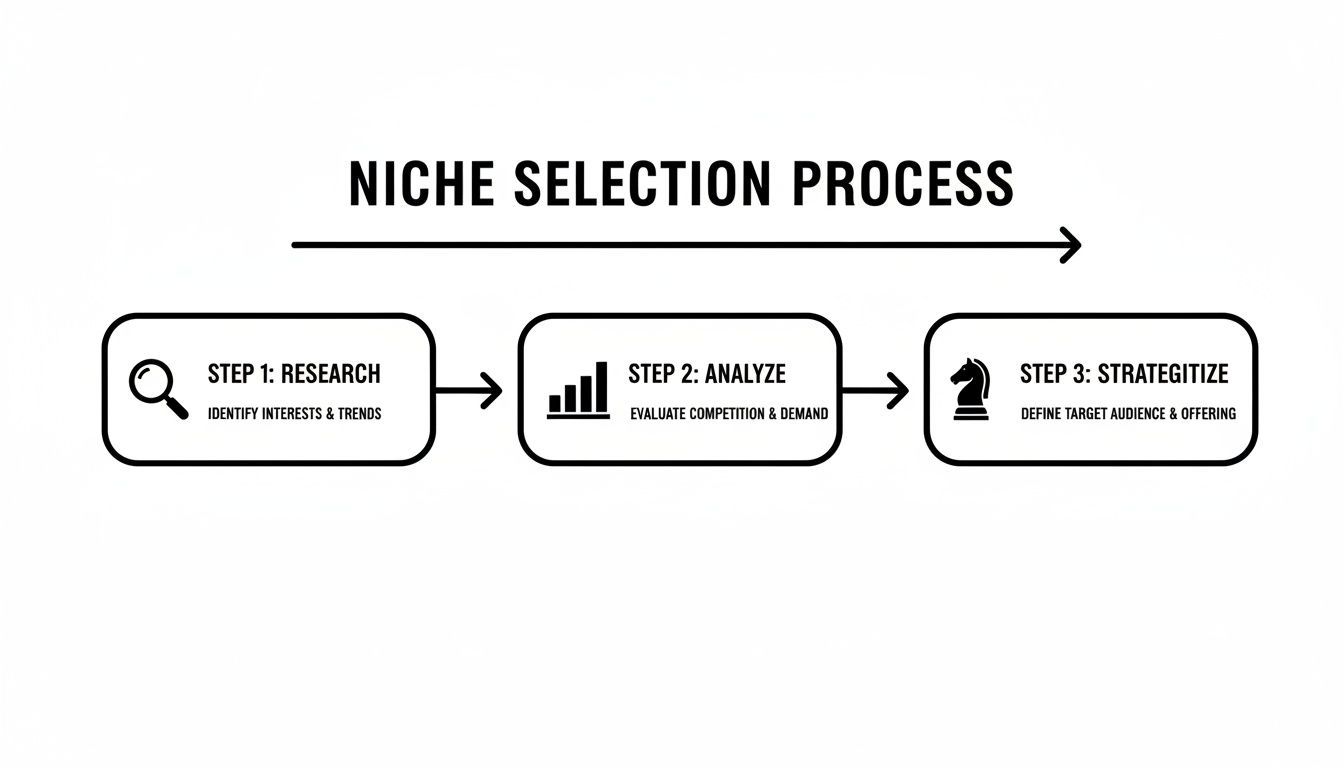
This just goes to show that a great workflow always starts with smart research and a clear strategy.
Assembling the Video with AI Magic
This is where the real speed comes in. AI video assembly tools take your script and voiceover and automatically piece together the entire video. Here's a quick look at how it works:
- Scene Creation: The AI reads your script line by line, then finds relevant, high-quality stock footage, images, or even AI-generated art to match what's being said.
- Text Overlays: It automatically adds animated text and captions to pop on screen, which is great for engagement and accessibility.
- Perfect Sync: The tool flawlessly syncs the visuals and text with the voiceover, ensuring the timing and pacing feel professional.
- Brand Application: You can set up a brand kit with your logo, fonts, and colors, and the AI will apply it to every video for a consistent look.
This process turns a simple text doc and an audio file into a dynamic, polished video way faster than you could ever do it with traditional editing software.
The sheer volume of content people watch makes this speed a massive advantage. For example, YouTube Shorts get a mind-boggling 200 billion daily views. For an automated channel, that format is pure gold because you can script, voice, and edit a short in just a few minutes flat.
Creating Click-Worthy Thumbnails with AI
Your thumbnail is everything. It's the billboard for your video, and it needs to grab attention immediately. AI thumbnail generators make this critical step way easier. Just give the tool your video title or a short description, and it will generate several design concepts for you to choose from.
These tools usually let you customize the designs, too. You can tweak colors, add your logo, or swap out images to create a thumbnail that’s both eye-catching and perfectly on-brand. A strong, consistent thumbnail style is what makes your videos pop in a crowded feed.
To make all of this truly efficient, you need a unified platform. A tool like ShortGenius, for instance, pulls all these pieces—scripting, voiceover, video assembly, and even scheduling—into a single dashboard. This integration is the secret sauce to a genuinely automated channel, cutting out the tedious work of moving files between different services. By keeping your workflow in one place, you can spend less time tinkering and more time creating.
Optimizing Your Videos for the YouTube Algorithm
Look, having a slick, automated content machine is a game-changer, but it's only half the battle. If nobody finds your videos, all that efficiency is for nothing. This is where you need to put on your strategist hat and learn how to make the YouTube algorithm work for you.
Think of it this way: your great content is the product, and your optimization strategy is the delivery truck. Without a good delivery system, your amazing product just sits on the shelf.
Get Smart with AI-Assisted Keyword Research
The entire foundation of YouTube SEO starts with knowing what real people are typing into that search bar. Guessing is a fast track to zero views. Luckily, AI tools can give you a massive leg up here, helping you uncover those high-traffic, low-competition keyword gems your audience is searching for right now.
Forget staring at a blank screen trying to brainstorm. You can prompt an AI to spit out hundreds of ideas. For a finance channel, you could ask, "Generate 50 YouTube video ideas for beginners learning about dividend stocks." Instantly, you have a list of topics with proven demand.
From there, you can use tools like TubeBuddy to validate those ideas. It will show you the search volume and, more importantly, the competition level right inside YouTube. This data-driven approach takes the emotion out of it and points you toward topics that actually have a shot at ranking.
The goal isn't just finding popular keywords; it's finding the right ones. A hyper-specific long-tail keyword like "best passive income strategies for college students" will pull in a far more dedicated viewer than a generic term like "make money online."
Write Titles and Descriptions That Actually Work
Once you've got your keywords, you have to strategically place them where it counts. Your video's title and description are the loudest signals you can send the algorithm about what your content is about.
-
Titles: Your title has two jobs: entice a human to click and inform the algorithm. Always try to get your main keyword near the front. Instead of "My Thoughts on the Newest Laptops," you'd go with "The Best Budget Laptops of 2024: A Complete Review." See the difference?
-
Descriptions: This is your chance to add some context. Those first couple of lines are gold because they show up in search results. Write a natural-sounding summary of the video, weaving in your primary and secondary keywords. It’s like a mini-blog post that gives both people and the algorithm a clear picture of what to expect.
-
Tags: Tags don't have the same pull they used to, but they still help YouTube categorize your video. Lead with your most important keyword, then add variations and related terms. Think like a searcher—what different phrases might someone use to find your video?
You can even automate this by creating a simple template for your descriptions. Pre-fill it with your social links, affiliate disclaimers, and placeholder spots for your keywords. It’s a small trick that saves a ton of time and keeps your branding consistent.
The Power of an Automated Publishing Schedule
Consistency is one of the most powerful signals you can send to YouTube. It tells the algorithm that your channel is active and reliable, which can earn you some serious brownie points in the recommendation engine. Planning and scheduling your content weeks—or even months—ahead is how the pros stay on top.
Many AI video creation platforms like ShortGenius build scheduling right into the workflow. Once your video is done, you can set it to go live on YouTube, TikTok, and Instagram all at once. This creates a steady drumbeat of content that keeps your channel alive without you needing to be there for every single upload.
For a deeper dive into strategies that really move the needle, check out these actionable YouTube channel growth tips to power up your automated schedule.
Use Your Analytics to Get Smarter
Your YouTube Analytics dashboard is your secret weapon. It’s the feedback loop that tells you exactly what’s working and what’s a dud. Don't just glance at the view count; you need to dig into the metrics that tell the real story.
Keep a close eye on these three numbers:
- Click-Through Rate (CTR): This shows how good your titles and thumbnails are at grabbing attention. If your CTR is consistently below 4%, it's a clear sign that your packaging needs a refresh.
- Audience Retention: How long are people actually watching? If you see a massive drop-off in the first 30 seconds, your hook isn't working. Period.
- Traffic Sources: Where are your views coming from? Seeing a lot of traffic from "Browse Features" is fantastic news—it means YouTube is actively recommending your content to new viewers.
Let this data guide your next move. If a certain video style has an amazing retention rate, make more of that. If your CTR is in the gutter, it's time to A/B test some new thumbnail designs. This constant cycle of publishing, analyzing, and tweaking is how you transform an automated channel into a legitimate growth engine.
Automated YouTube Channel SEO Checklist
To keep your optimization on track, it helps to have a checklist. Many of these SEO tasks can be streamlined or fully automated, ensuring you never miss an opportunity to maximize your video's reach. Here’s a quick rundown of what to focus on and how automation can help.
| SEO Task | Manual Approach | Automation Tool/Method | Impact on Growth |
|---|---|---|---|
| Keyword Research | Brainstorming, manually searching YouTube | AI idea generators, tools like TubeBuddy/VidIQ | High |
| Title Optimization | Writing titles from scratch for each video | AI copywriters, title-generating templates | High |
| Description Writing | Crafting unique descriptions every time | Pre-made templates, AI description generators | Medium |
| Tag Generation | Manually finding and adding relevant tags | Browser extensions, AI tag suggestion tools | Low-Medium |
| Thumbnail A/B Testing | Creating two versions and manually tracking CTR | Tools like ThumbnailTest for automated testing | High |
| Publishing Schedule | Manually uploading and publishing each video | Integrated schedulers in creator tools | High |
| Performance Analysis | Manually digging through YouTube Analytics | AI analytics tools that provide summaries/insights | Medium |
By turning this checklist into a system, you ensure that every video you publish has the best possible chance of being discovered. This methodical approach, powered by smart automation, is what separates struggling channels from the ones that seem to grow effortlessly.
Scaling Your Revenue Beyond AdSense
Getting into the YouTube Partner Program is a fantastic milestone, but if you stop there, you're leaving a lot of money on the table. Relying only on AdSense is a rookie mistake. The real financial power of an automated YouTube channel comes from weaving together a diverse set of income streams that support each other.
Think of AdSense as the foundation of your house. It’s solid, and it provides a consistent, if sometimes modest, income. But the channels pulling in serious revenue are the ones that build multiple floors on top of that foundation. This is how you can dramatically increase your earnings without a proportional spike in your workload.
Diversify with Affiliate Marketing
Affiliate marketing is probably the most natural next step for any automated channel. You're already creating content for an audience with specific interests, so why not recommend products and services that genuinely help them? It’s often the most profitable strategy you can implement besides selling your own stuff.
The concept is simple: you pop a unique, trackable link into your video description. When someone clicks it and buys something, you get a commission. The best part? It costs the buyer nothing extra.
Here are a few places to start:
- Software and Digital Tools: If you’re in the tech, business, or creative space, recommending software subscriptions for things like editing tools or project management apps can create a source of recurring monthly commissions.
- Amazon Associates: This is the go-to for almost any niche. You can link to books, gear, or any other product on Amazon that’s relevant to your video topic.
- Niche-Specific Products: Running a history channel? Partner with a company that sells historical maps. Have a finance channel? Affiliate with fintech apps or online investing courses. The possibilities are endless.
The key to making affiliate marketing work long-term is authenticity. Only recommend products you truly believe will provide value to your audience. Earning their trust is far more valuable than any single commission.
Create and Sell Your Own Digital Products
This is the move that turns you from a content creator into a full-blown entrepreneur. When you create and sell your own digital products, you keep 100% of the profits and have complete control over your brand. It’s often the single most profitable income stream an automated channel can develop.
Your automated video content becomes the perfect marketing engine for these products. The videos attract an audience and establish your expertise, making them far more likely to buy something directly from you.
A few ideas that work incredibly well:
- Ebooks or Guides: A finance channel could package its expertise into an ebook like a "Beginner's Guide to Dividend Investing."
- Templates: A channel focused on productivity could sell pre-built Notion dashboards or advanced spreadsheet templates.
- Checklists or Worksheets: A fitness channel could offer a printable workout planner or a meal-prep checklist.
Especially if you're using AI art in your content, figuring out how to properly commercialize it is a huge advantage. A course like the AI Art Monetisation Certificate can give you the practical frameworks to turn those creations into another income stream.
From a Single Channel to a Content Portfolio
Why limit yourself to just one channel? The ultimate way to scale is to duplicate your successful workflow across multiple niches. Once you've ironed out your automation system for one channel, launching a second or even a third becomes so much easier.
You've already got the blueprint for scripting, voiceovers, video assembly, and optimization. Now, you just apply that same process to a new topic. This is how you build a portfolio of digital assets, each generating income on its own. It creates a far more stable and scalable business.
The sheer financial power of this model became crystal clear around 2026, as YouTube automation hit a massive growth spurt. Creator payouts skyrocketed to $85 billion in just three years, thanks in large part to the explosion of Shorts monetization. This shift has allowed completely faceless channels to pull in tens of thousands of dollars a month without ever showing up on camera, proving the incredible potential of automated content.
By combining AdSense with these smarter, more direct monetization methods, your automated YouTube channel goes from a simple side project to a powerful, diversified business.
Sidestepping the Common Automation Traps
Diving into an automated YouTube channel feels like unlocking a superpower, but it's surprisingly easy to trip up if you're not paying attention. The biggest pitfall I see creators fall into is treating automation as a shortcut for pumping out generic, soulless content. You have to remember, the YouTube algorithm is incredibly sophisticated; it's practically built to sniff out and bury videos that feel robotic and offer zero real value.
It's tempting to think that flooding the platform with a high volume of cookie-cutter videos is a smart play. It’s not. In reality, it’s a one-way ticket to getting ignored. The key is to think of AI as your super-efficient production assistant, not a replacement for your creative vision. A human needs to be in the driver's seat, always.
Playing Fast and Loose with YouTube’s Rules
One of the quickest ways to get your channel into hot water is by ignoring YouTube's policies, specifically the ones around repetitious content. If you're just uploading videos with tiny, insignificant variations, you're waving a giant red flag. This kind of templated content is a major risk for demonetization or, even worse, getting your channel shut down entirely.
YouTube is actively cracking down on what it considers low-quality, mass-produced videos. To build a channel that lasts, making sure every single video has a unique angle and feels original isn't just a good idea—it's essential.
And they are not messing around. As a stark reminder, YouTube axed a jaw-dropping 20 million channels in late 2023 for breaking its rules. You can dig deeper into this in a great analysis on YouTube automation saturation, but the takeaway is clear: smart automation that puts quality first is the only way to build something sustainable.
Ignoring Your Analytics and What Your Viewers are Telling You
Another classic mistake is adopting a "set it and forget it" attitude. Your automation workflow isn't a crockpot; you can't just leave it and hope for the best. It needs constant tweaking based on what your audience is actually watching and enjoying. Flying blind by ignoring your YouTube Analytics is a recipe for disaster.
Here’s what you should be obsessed with:
- Audience Retention: Where are people dropping off? If viewers are bailing in the first 30 seconds, your hooks are weak. You need to fix your intros, and fast.
- Click-Through Rate (CTR): A low CTR is a dead giveaway that your thumbnails and titles aren't grabbing attention. You're losing the battle before the video even starts.
- The Comment Section: Your viewers are literally telling you what they want. The comments are a goldmine of direct, unfiltered feedback on what’s working and what’s not. Use it.
If you treat your automated channel like a living, breathing project—one that needs your strategic oversight and a real commitment to quality—you'll steer clear of these common blunders and build a digital asset that actually has long-term value.
Got Questions About YouTube Automation? We've Got Answers.
Thinking about diving into the world of automated YouTube channels? It's a great path, but you probably have a few questions floating around. Let's clear up some of the most common ones we hear from creators just starting out.
Is YouTube Automation Actually Still Profitable?
Yes, without a doubt. The demand for content has never been higher, so the opportunity is huge. Profitability really boils down to picking a good niche with a high RPM, consistently putting out quality automated videos, and sticking with it.
Sure, there's competition, but evergreen fields like personal finance, history explainers, and educational deep-dives are still gold mines for new channels.
The trick is to run it like a real business, not just a weekend project.
Don’t just jump on every trend. Your goal should be to build a library of valuable, evergreen content that people will be searching for years from now. That’s how you create assets that earn for the long haul.
Can YouTube Kick You Off the Platform for Using AI?
Nope. You won't get demonetized just for using AI tools. YouTube’s rules are aimed at weeding out low-effort, spammy, or repetitive junk—they don't care what tools you used to make your videos.
As long as your AI-powered content offers real value and isn't just a rehash of someone else's work, you're in the clear. Just think of AI as another tool in your creator toolkit, like your camera or editing software.
What's a Realistic Budget to Get an Automated Channel Off the Ground?
The startup costs can definitely vary. If you want a professional setup that can actually scale, you'll likely be looking at a few software subscriptions, especially for an all-in-one platform that handles the heavy lifting.
A realistic monthly budget is probably somewhere between $50 and $300. This covers your essentials: scripting, voiceovers, video creation, and access to stock footage. It sounds like a lot, but most creators find this investment pays for itself pretty quickly once the channel starts earning.
Ready to build your own content engine? With a platform like ShortGenius, you can bring your entire workflow—from scripting and voiceovers to video assembly and scheduling—all under one roof. Start creating faster and smarter with ShortGenius today!