An AI Workflow for Creating Meta and TikTok Ads That Convert

Discover a practical AI workflow for creating Meta and TikTok ads that drive results. Learn to generate scripts, visuals, and campaigns at scale.
We’ve all been there: staring at a blank page, trying to dream up the next big ad campaign. It’s a classic problem, but the answer is a thoroughly modern one: an AI workflow for creating Meta and TikTok ads. This isn't just about speeding things up; it's a completely new way to approach ad creation, using AI to manage everything from audience research and scripting to producing the final video and analyzing its performance. The payoff? Slashed production times and campaigns that actually hit the mark.
Your Modern Playbook for AI-Powered Ad Creation
Let's be honest, the old way of making ads is slow, expensive, and often a shot in the dark. Marketers who are winning today have moved on to a faster, smarter, data-backed process driven by AI. This isn't about letting robots take over your creative department. Think of it as augmenting your team’s talent.
When you hand off the tedious, repetitive work to AI, your team is freed up to focus on what humans do best: big-picture strategy and crafting a message that truly connects. This approach lets you churn out way more creative variations, which means you can test and optimize at a speed that was once unimaginable.
This kind of agility is non-negotiable on platforms like TikTok, where a trend can be born and die in the span of a weekend. The same goes for Meta platforms, where audience tastes are constantly in flux. An AI-powered workflow gives you the speed to jump on these moments before they're gone.
The Core AI Workflow Stages
At its core, this workflow breaks down the ad creation beast into three simple, repeatable stages. This isn't a one-and-done process; it’s a cycle that lets you go from a spark of an idea to a live campaign with incredible speed.
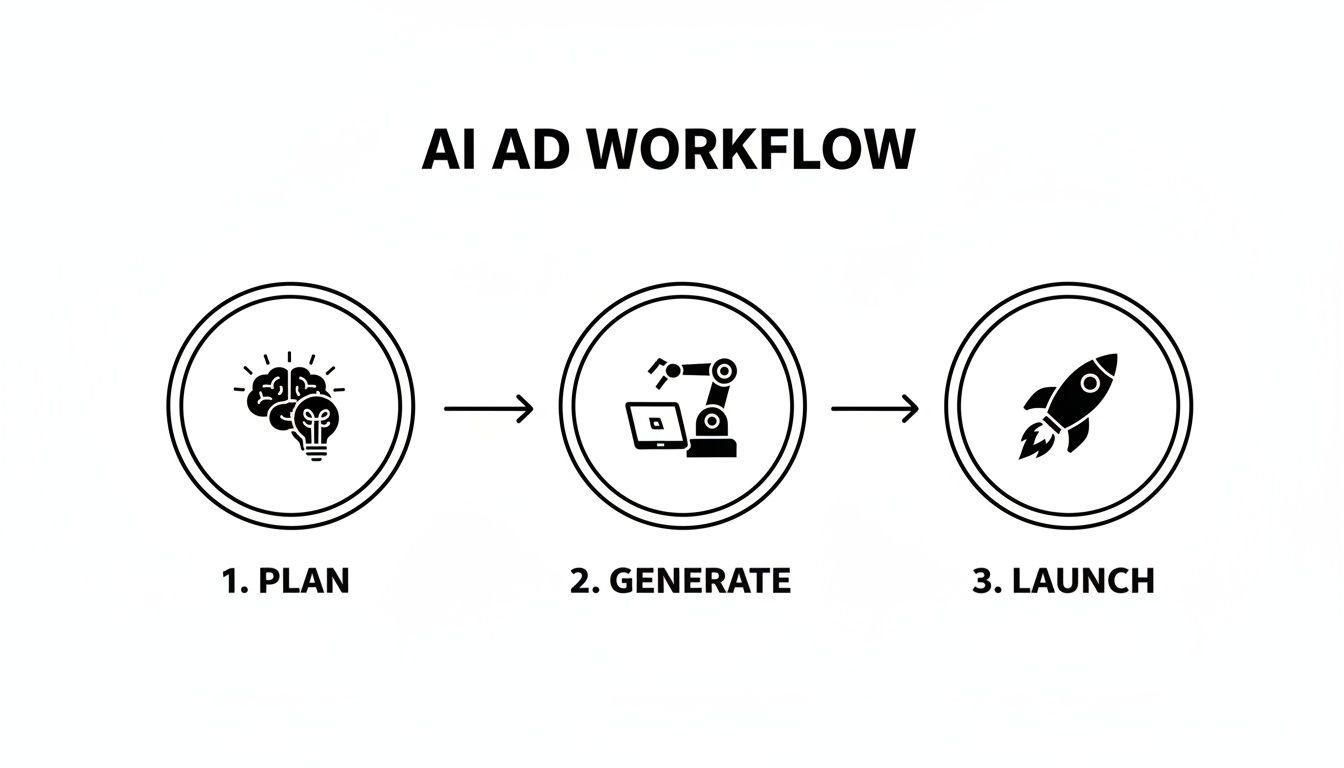
The real magic happens in the feedback loop created by this Plan, Generate, Launch model. The data you get from launched campaigns feeds directly back into the planning stage for your next round of ads.
Of course, a one-size-fits-all approach won't cut it. To really make this work, you have to tailor your strategy to each platform. The polished, high-production feel that often works on a Meta feed will likely fall flat in TikTok's raw, authentic environment.
Key Takeaway: The point of an AI ad workflow isn’t just to make ads faster. It’s to build a scalable system for creative experimentation, where live campaign data constantly refines and improves your next batch of creatives.
This guide will walk you through each stage of this AI workflow. We’ll cover concrete steps, share prompt examples you can actually use, and give platform-specific advice for both Meta and TikTok. We'll also point out how tools like ShortGenius can tie these steps together, turning your ad creation process into a real competitive edge.
Building Your Ad Strategy with an AI Co-pilot
Amazing ads aren't just a flash of creative genius; they're the result of a rock-solid strategy. Before you even touch a script or an image, the very first step in a modern AI workflow for creating Meta and TikTok ads is to bring AI into the planning room. Think of it as your strategic partner for digging deep into your audience and mapping out your creative direction. This groundwork is what separates the campaigns that truly connect from the ones people instantly scroll past.
Forget about working off broad assumptions. You can feed AI tools your raw customer data, survey responses, and even the transcripts from your competitor's ads. The whole point is to unearth detailed audience personas. AI can chew through all that data to nail down the specific pain points, secret desires, and—most importantly—the exact language your customers use. That's pure gold for writing ad copy that feels like it's reading their minds.
Finding Those Killer Ad Angles
Once you have a sharp picture of who you're talking to, it's time to brainstorm some killer angles. This is where smart prompt engineering really shines. You're not just telling an AI to "write an ad"; you're coaching it to think like a seasoned strategist.
For instance, if you're launching a new productivity app, a good prompt would be way more specific, something like this:
"You're a direct response copywriter. Look at the customer feedback I've attached. Pull out the top 3 emotional pain points people have with project management chaos. Now, for each one, give me 5 scroll-stopping hooks for a TikTok ad targeting overwhelmed freelancers aged 25-35. The vibe should be empathetic but with a shot of high energy."
This kind of detailed instruction forces the AI to move past generic ideas and give you laser-focused concepts to build on. It's the difference between a basic writing tool and a powerful brainstorming partner. An approach like this can spit out dozens of potential hooks and angles in minutes, something that would take a human team half a day. Of course, you can also use a dedicated AI ad generator to handle this entire process from one spot.
Tweaking Your Game Plan for Meta vs. TikTok
A crucial part of your strategy is recognizing that what crushes it on Meta might completely flop on TikTok. You need a different game plan for each.
-
For Meta (Facebook & Instagram): Here, you can ask your AI to help find angles that are all about the benefits. Your prompts should be geared toward generating concepts that scream ROI, convenience, or social proof. These are the things that tend to perform well in the more polished environment of the Facebook and Instagram feeds.
-
For TikTok: On TikTok, it's all about entertainment and authenticity. You’ll want your prompts to ask the AI for ideas that tap into current trends, mimic that popular user-generated content (UGC) style, or tell a quick story that feels native to the platform.
When you use AI to dissect your audience and then generate platform-specific angles, you're essentially creating a strategic blueprint. It guarantees that when you get to the fun part—actually making the ad—every single piece of creative is already aimed at the right person with the right message. That's how you seriously stack the odds of success in your favor.
Bringing Your Ad Concepts to Life with AI
Alright, you’ve got your strategy and you know who you’re talking to. Now for the fun part: turning those plans into actual ads. This is where we move from the whiteboard to the workshop, using AI to rapidly generate the scripts, visuals, and voiceovers that will power your campaigns on Meta and TikTok.
In the past, this was always the bottleneck. You'd spend weeks, sometimes months, on scripting, shooting, and editing. With AI, that entire production timeline gets compressed from weeks into mere minutes. The goal isn't to get one "perfect" script anymore; it's to create a whole library of compelling options you can test against each other.

Crafting Scripts That Actually Sound Native
The secret to getting great results from any LLM is all in the prompt. If you feed it a generic request, you'll get a generic script. The trick is to be incredibly specific and tell the AI exactly what kind of ad you’re making and for which platform.
- For Meta (Facebook & Instagram): Think benefits and clarity. Your prompts need to be direct. For instance: "Write 3 Facebook ad headlines, keep them under 40 characters. We're selling a vegan protein powder to a fitness audience. Focus on 'clean ingredients' and 'great taste'." This gives you punchy, benefit-focused copy that works perfectly in a busy feed.
- For TikTok: Here, you want to lean into authenticity and entertainment. A much better prompt would sound like this: "Generate a 15-second TikTok script with a UGC feel. Start with a relatable hook like, 'Tired of chalky protein shakes?' then show a fast, energetic solution using our product."
This difference is everything. TikTok’s ad revenue jumped over 35% in 2024, climbing past $17 billion, precisely because the winning ads don't feel like ads at all—they feel like native TikTok content.
Your New AI Production Studio: From Text to Visuals
With a batch of scripts ready, it’s time to create the visuals. This used to mean hiring a production crew, but now AI can generate entire video scenes, product shots, and striking images from a simple text prompt.
This is where you can really start testing at scale. Take one script and generate a dozen different visual concepts to see what resonates with different segments of your audience. Imagine you're a skincare brand. You could generate a scene showing your product in a bright, modern apartment for a 25-year-old demographic, and another version in a calm, nature-filled bathroom for an older audience.
Pro Tip: Don't just stop with the video. Use AI to create natural-sounding voiceovers, too. You can get different accents, tones, and even languages in seconds. Tools like ShortGenius let you upload a brand kit, so your logos, fonts, and colors are automatically applied, ensuring everything stays on-brand.
The ability to go from a simple idea to a finished, high-quality video is a massive shift for marketers. You can learn more about how today’s https://shortgenius.com/models/text-to-video make this a reality. And for the finishing touch on TikTok, a good TikTok caption generator can help you write text that grabs attention.
When you combine these tools, you're not just speeding things up. You're building a system for constant creative iteration, which is the key to keeping your campaigns fresh and performing at their peak.
Putting It All Together: Tailoring Your Ads for Each Platform
You can have a brilliant script and jaw-dropping visuals, but if the final ad feels out of place, it’s going to get scrolled past in a heartbeat. This is where your whole process comes together, adapting your creative to fit the unique vibe and technical rules of each platform. It’s the step that makes sure all your hard work actually leads to engagement.
Think of it this way: you wouldn't show up to a casual backyard barbecue in a full tuxedo. In the same way, a super-polished, horizontal ad made for a Facebook feed is going to stick out like a sore thumb on TikTok’s frenetic, vertical-only interface. The goal is to make your ad blend in seamlessly, feeling like a natural part of the user’s feed, not a jarring interruption.
Smart Resizing and Trimming with AI
First things first, let's talk about aspect ratios. TikTok and Instagram Reels live and breathe the 9:16 vertical format. Meanwhile, Meta’s in-feed ads often perform best as a 4:5 vertical or a 1:1 square. Modern AI editing tools can be a lifesaver here, automatically reframing your video for each placement while intelligently keeping your main subject perfectly in focus. No more awkward, clumsy crops.
But it’s not just about the size. Pacing is everything. AI tools can analyze your footage and pinpoint the most visually interesting three seconds to use as your hook. They can also take a 30-second ad and automatically trim it down to a punchy 15-second version for Instagram Stories, all without losing your core message.
Making Your Creative Feel Native
True optimization goes way beyond the technical stuff; it's about respecting the unwritten rules and culture of each platform. This is where you can use AI to rapidly spin up variations that feel like they truly belong. For Meta, getting the creative and audience right is everything, so brushing up on established Facebook Ads best practices will give your AI-generated content a much better chance of success.
Here are a few quick adjustments you can make with AI:
- Dynamic Captions: Instantly generate and burn bold, eye-catching captions right into your video. You might use a playful, trending font for TikTok, while a cleaner, more direct style often connects better on Meta.
- Voiceover Swaps: Why not test different voiceovers with the same visuals? A casual, friendly tone almost always wins on TikTok, but a more authoritative, benefit-focused voice might be the ticket for an ad on LinkedIn via Meta's Audience Network.
- Scene Shuffling: What happens if you show the product reveal in the first three seconds instead of building up to it? AI makes it easy to reorder your clips and create different narrative flows to test against each other in minutes.
The real magic here is letting AI handle the tedious, time-consuming work of resizing and tweaking. This frees you up to think about the bigger strategic picture: making ads that don't just run on a platform but belong there, driving better results and connecting with your audience on a real level.
Tools like ShortGenius are built to make this entire process flow smoothly. You can generate entire campaign concepts and then, in just a few clicks, produce all the specific variations you need for every single ad placement. If you really want to dive deep into this strategy, our guide on creating powerful https://shortgenius.com/ai-ugc-ads is packed with more insights and practical steps. This final optimization stage is what turns a single great ad into a high-performing machine for your campaigns.
Launching Campaigns and Measuring Performance

Creating a great video ad with AI is just the starting line. The real magic, and the real growth, happens when you launch, measure, and feed what you learn back into your creative engine. This is where your ai workflow for creating meta and tiktok ads becomes a powerful, self-improving feedback loop instead of a one-and-done production line.
Now that you have a library of AI-generated creative variations, you can stop guessing what your audience wants to see. Instead, you can build a structured testing framework to get real answers, letting the data guide your next move. It’s all about isolating variables to pinpoint exactly what drives results.
A Practical Framework for A/B Testing
The incredible speed of AI generation means you can test at a granular level that used to be a logistical nightmare. Forget testing two completely different ads and wondering what actually made the difference. Now you can test the micro-elements to build the perfect ad from the ground up.
Here’s an approach I've found incredibly effective:
- Test Your Hooks: This is your low-hanging fruit. Keep the main video and call-to-action identical, but test three different AI-generated hooks in the first three seconds. You'll quickly discover which opening line actually stops the scroll.
- Isolate Visuals: Use the exact same script and voiceover, but run it against three totally different visual concepts from your AI tool. Does a slick product demo beat a raw, UGC-style scene? Let your audience's behavior tell you.
- Compare CTAs: Once you have a winning hook and visual style, run a final test with two or three different calls-to-action to see what actually gets people to click and convert.
By testing one element at a time, you’re not just making ads—you’re building a library of proven components. You're discovering the fundamental building blocks of what resonates with your specific audience.
Decoding the Data from Meta and TikTok
Each platform speaks its own language, and you need to listen to the right signals to understand performance. Of course, ROAS (Return on Ad Spend) is the north star, but it’s the earlier metrics that tell you why your creative is winning or losing.
A low hook rate (first 3-second view rate) on TikTok is a dead giveaway that your opening is weak. A high click-through rate (CTR) but a dismal conversion rate on a Meta ad tells you the ad is compelling, but your landing page is dropping the ball.
Staying on top of platform trends is also critical. For instance, in Q4 2024, Meta saw a 15% year-over-year jump in ad spend. Meanwhile, TikTok's share of dual-platform budgets fell, with brands spending just $0.19 there for every dollar on Meta. You can explore more about these marketing spend trends to stay ahead. An efficient AI workflow is your key to navigating these shifts without burning through your budget.
Closing the Feedback Loop with AI
This is where it all comes together. Once you've identified a clear winner—like a specific hook format or a visual theme—you feed that insight directly back to your AI tools. Your next prompt is no longer a hopeful guess; it’s a data-backed instruction.
For example, your feedback becomes: "The hook '3 mistakes everyone makes with X' drove a 25% higher CTR. Generate five new hooks using this exact 'common mistakes' framework for our next campaign."
This creates a powerful cycle of continuous improvement. Performance data sharpens your prompts, which leads to better AI-generated content, which delivers even better data. This iterative process is the absolute core of a winning AI-powered advertising strategy.
Common Questions About AI Ad Creation
Making the leap to an AI-powered workflow for your Meta and TikTok ads is exciting, but it naturally comes with a few questions. It’s a different way of working, so let's walk through some of the things that are probably on your mind.
One of the biggest questions I hear is about AI making creative roles obsolete. Will it just take over everything?
The short answer is a hard no. It's much more useful to think of AI as a very, very powerful creative partner—not a replacement.
AI is fantastic at doing the grunt work. It can spit out a dozen script variations, come up with a hundred different hooks, or generate a library of visual assets faster than any human team could ever dream of. But the strategy, the brand's soul, and the final gut-check on whether an ad feels right? That’s all you. Your expertise is what steers the ship.
Can AI Actually Replace a Creative Team?
Honestly, the most successful campaigns I've seen come from a smart partnership between human and machine. The real magic happens when you let AI handle the speed and scale, which frees up your team to focus on what they do best: high-level strategy and the creative nuances that actually connect with people.
Your job changes, but for the better. You shift from being the person manually building every single ad to being the strategic director. You set the vision, and AI gives you the raw materials to test that vision at a scale that was impossible just a few years ago.
Do I Need to Be a Tech Wizard to Do This?
Not at all. You don’t need to know how to code or understand complex algorithms. The most critical skill in this new world is prompt engineering.
If you can write a solid creative brief, you already have the core skill you need. It's all about learning how to communicate your ideas clearly and effectively to the AI.
Modern AI platforms are built to be intuitive, hiding all the messy technical stuff behind a clean interface. The entire system is designed around your creative input, not your ability to configure servers. This means any marketer can get started right away.
The biggest shift is in your mindset. You're moving from a "doer" to a "director." Your ability to articulate what you want is far more valuable than any deep technical knowledge.
What's the Smartest Way to Test AI-Generated Ads?
This is where an AI workflow for creating Meta and TikTok ads truly shines: you can finally test ideas at a massive scale. The best way to approach this is with a disciplined A/B testing framework where you're only changing one thing at a time.
Here are a few ways you could structure your tests:
- Battle of the Hooks: Keep the main video creative identical, but run 3 different AI-generated hooks in the first 3 seconds.
- Visual Showdown: Use the exact same script and voiceover, but test 3 completely different visual styles that the AI created.
- CTA Tussle: Once you have a winning hook and visual, test 2 different calls-to-action to see which one actually drives clicks and conversions.
Set these up as a creative test on a small budget. Within a couple of days, you'll have clear data on metrics like hook rate, click-through rate (CTR), and cost per acquisition (CPA). From there, you just pick the winner and confidently put your real budget behind it.
Ready to transform your ad creation process? With ShortGenius, you can generate unlimited ad concepts, scripts, and high-performing video creatives in minutes. Stop the guesswork and start building campaigns that convert. Discover the future of advertising today.