Ultimate Guide: AI workflow for creating Meta and TikTok ads to drive results

Discover ai workflow for creating meta and tiktok ads to streamline campaigns, save time, and boost performance today.
When you think about an AI workflow for creating Meta and TikTok ads, it’s not just about using a couple of cool tools. It's a complete system where artificial intelligence acts as your co-pilot through every single step—from digging into market research and understanding your audience to cranking out creatives, writing ad copy, and optimizing for performance.
This approach takes the repetitive, time-draining tasks off your plate and automates them. Suddenly, you have more time to think about the big picture and strategy.
Your AI-Powered Starting Point for Social Ads
Welcome to a smarter way of running paid social campaigns. Here, AI isn't just a shiny object; it's a core part of your team. Building an effective AI workflow for your Meta and TikTok ads boils down to weaving intelligent automation into three key areas: research, creation, and analysis.
The whole idea is to let AI do what it's ridiculously good at—chewing through massive datasets and spitting out endless variations. This frees you up to focus on the high-level strategy and creative vision that only a human can provide. Forget about manually scrolling through competitor ads for hours or trying to brainstorm fifty different hooks from scratch. Now, you can use AI to uncover those insights and generate creative assets at a scale that was previously unimaginable.
Think of it as building a powerful advertising engine that gets smarter over time.
- Test at lightning speed. You can generate and launch dozens of creative variations in the time it used to take to make just one. This means finding your winning ads way faster.
- Create with data, not just gut feelings. Your ad concepts are now grounded in performance data and real-time trends.
- Get your time back. Automate the grunt work like writing ad copy, generating video scripts, or pulling performance reports.
This simple but powerful three-stage process is what it's all about.
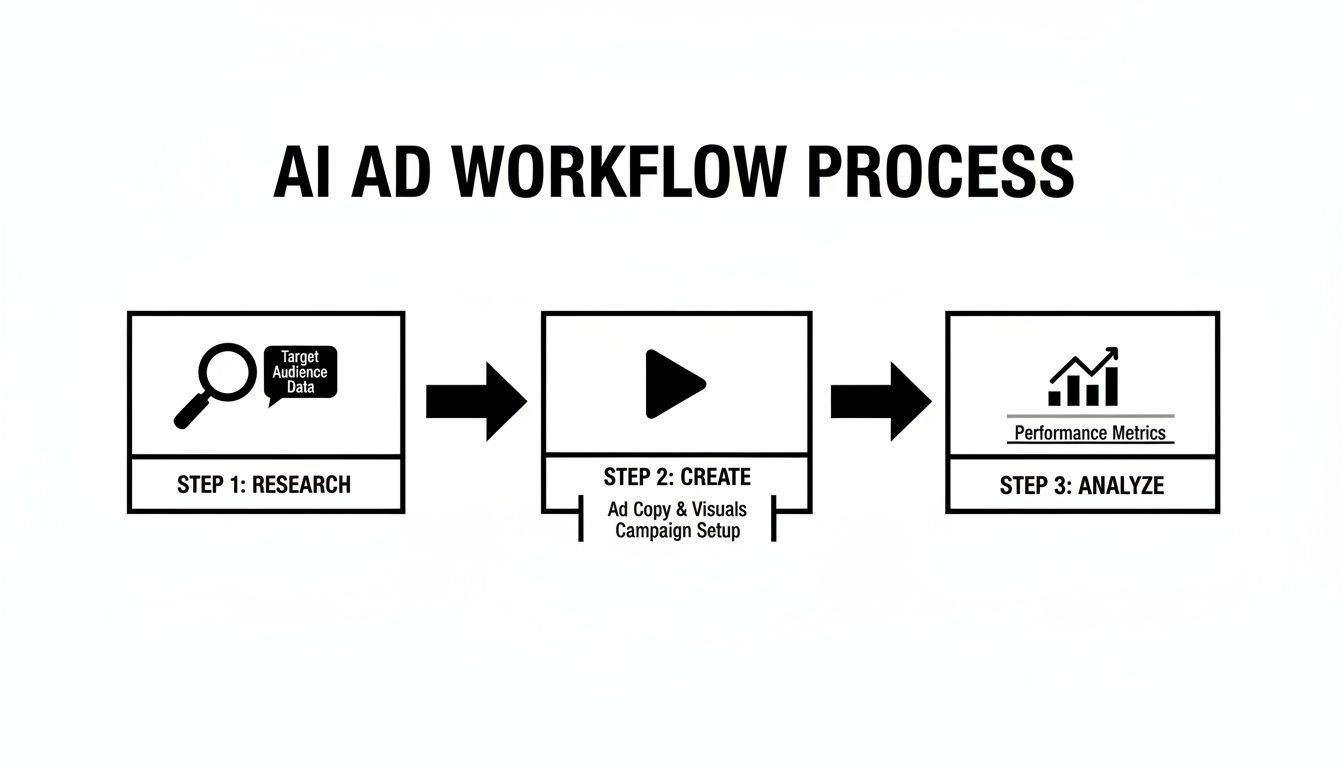
As you can see, this flow positions AI as the central nervous system for your campaigns. It creates a direct line from your research insights right into your creative production and analysis.
The table below breaks down these stages to show exactly how AI contributes at each point.
Table: Key Stages of an AI Ad Workflow
| Workflow Stage | Core AI Function | Key Objective |
|---|---|---|
| Research & Discovery | Data aggregation and pattern recognition | Uncover competitor strategies, audience pain points, and viral trends to inform your campaign angles. |
| Creative Production | Content generation and asset creation | Rapidly produce ad copy, video scripts, and visual concepts based on research insights. |
| Analysis & Optimization | Performance analysis and predictive modeling | Identify top-performing ads, understand why they work, and get data-backed recommendations for the next round of tests. |
Ultimately, this structure builds a continuous feedback loop where every part of the process informs the others, making your campaigns progressively smarter.
Why This Workflow Matters Now
This isn't just a futuristic concept; it's happening right now. The native tools on these platforms, like Meta's Advantage+ and TikTok's Creative Assistant, have made this kind of workflow incredibly accessible.
Looking ahead, AI is set to become even more integrated. By 2025, it's expected that workflows for Meta and TikTok will lean heavily on automation and creative optimization. This makes sense when you see that 92% of businesses are already looking to invest in generative AI, with the market projected to grow at a CAGR of 26.7% through 2034.
This isn't about AI replacing marketers. It's about giving them superpowers. The goal is to create a system where human creativity guides AI-powered execution. It’s a powerful loop of ideation, production, and optimization that will keep your brand ahead of the curve.
To get the most out of this, it's crucial to understand the nuances between the platforms. For a deep dive, check out a comprehensive comparison of Facebook Ads Manager and TikTok Ads Manager. While our AI-driven approach applies to both, their tools and user behaviors demand tailored strategies. This is where tools like https://shortgenius.com come in, helping you generate content perfectly suited for each platform’s unique environment.
Using AI for Ad Research and Ideation
Every killer ad campaign starts with a solid, data-backed idea. We're long past the days of just tossing ideas around a whiteboard and going with our gut. Now, the sharpest way to build ads for Meta and TikTok is to bring AI into the picture right from the start, using it as a research partner to dig up the insights that actually lead to high-performing creative.
Instead of guessing what might land with your audience, you can use AI tools to figure out what's already hitting the mark. This doesn't take the creativity out of the job; it just makes it smarter. When you feed AI a steady diet of performance data, market trends, and what your competitors are up to, you can be confident your ideas are relevant and ready to grab attention before you spend a single dollar.
Think of this first step as laying the foundation. It's the difference between throwing spaghetti at the wall and strategically building something you know will stand strong.
Analyzing Competitor Strategies with AI
Keeping an eye on the competition is non-negotiable, but doing it manually is a soul-crushing time-sink. AI can automate this, turning hours of scrolling through ad libraries into a few minutes of clear, actionable takeaways.
For a serious advantage on your Meta campaigns, you should get comfortable with using spytools on Facebook Ads. Many of these platforms are now powered by AI and can show you exactly which ad creatives, copy, and targeting strategies are bringing in the bacon for your competitors.
Once you find a few winners, you can drop them into a tool like ChatGPT with a prompt like this:
Prompt Example: "I'm a skincare brand. Here are 5 competitor ads that are performing well. I want you to analyze them and tell me what they have in common—hooks, CTAs, visual styles, and the main angles they're pushing. Based on that, give me 3 new ad concepts for my brand that use a similar formula but put our own unique spin on it."
This approach lets you learn from your competitors' ad spend without having to risk your own budget on guesswork.
Identifying Trends and Audience Sentiment
To make ads that don't feel like ads on platforms like TikTok and Instagram, you have to be in on the conversation. AI is incredibly good at picking up on what's about to pop off, whether it's a viral sound or a new video format.
- TikTok Trending Audio: AI can scan the "For You" page at a massive scale, flagging sounds that are starting to gain steam before everyone else jumps on them. This gives you a chance to weave trending audio into your ads, making them feel more native to the platform and giving them a nice little algorithmic boost.
- Meta Audience Sentiment: On Facebook and Instagram, AI can sift through thousands of comments in your niche to see what people are actually talking about. It can spot common pain points, questions, and desires, handing you a goldmine of raw material for ad copy that connects on a deeper level.
When you tap into these real-time signals, you stop reacting and start anticipating. You're putting your brand right where the culture is heading.
Generating Data-Driven Ad Concepts
Okay, you've done your homework. Now it's time to turn all that research into actual ad ideas. This is where generative AI really comes alive. If you give it the right context—what your product is, who you're talking to, and what you've learned from your research—it can spit out a huge variety of hooks, angles, and concepts to test.
Here’s a simple workflow I use:
- Give the AI Your Intel: I feed it a mix of our best-performing organic posts, the competitor ads I've analyzed, and the key audience pain points I uncovered.
- Ask for Variety: I then ask it to generate a range of concepts. For instance: "Give me 3 ad concepts focusing on this product feature, 2 that tackle a common customer objection, and 1 that tells a story."
- Flesh It Out: I'll pick the strongest ideas and ask the AI to expand on them, generating specific hooks, body copy, and even suggestions for the visuals.
This completely changes the brainstorming process. You’re no longer starting from a blank page. Instead, you're building on ideas already backed by real-world data, which dramatically increases your odds of launching an ad that actually converts.
Automating Creative Production on Meta
Alright, you’ve done your homework. Your AI research has given you a solid foundation of winning angles and audience insights. Now it’s time for the fun part: turning all that data into a pipeline of high-performing ad creative. This is where an AI workflow for creating Meta and TikTok ads really starts to pay off, moving you from planning to full-scale production.
Think of Meta's Advantage+ suite as your new creative engine. Instead of the old-school, tedious process of building every single ad variation by hand, you now feed the system your core assets—your product shots, your best video clips, your top-performing headlines—and let its AI do the heavy lifting.
This approach essentially turns your product feed into a dynamic creative factory. The platform will automatically mix and match elements, testing different image crops, video cuts, and calls-to-action to pinpoint the perfect combination for different segments of your audience. It’s not just a time-saver; it’s a discovery tool that often uncovers winning ad formulas you’d never think to test on your own.
Blending Authenticity with Polished Production
One of the most common questions I get is whether AI is better for creating authentic, user-generated content (UGC) or for more polished, studio-quality ads. My answer is always the same: you need both. A smart AI workflow is flexible enough to churn out a healthy mix of creative styles, because what works for one audience might fall flat with another.
-
UGC-Style Ads: These are gold for building trust. Use AI to brainstorm or even write entire scripts for creators. You can even use some newer tools to create shockingly realistic UGC-style videos from scratch. The goal is to feel native to the feed, which instantly lowers a user's "ad guard."
-
Polished Studio Content: Don't sleep on slick, professional creative. AI can rapidly generate dynamic product carousels and clean video ads that look amazing. This style is an absolute killer for retargeting campaigns where your audience already knows who you are and just needs a clear, benefit-focused nudge to buy.
The real secret is to test both styles relentlessly. Let the performance data—crunched by Meta's AI—be your guide. More often than not, a strategic blend of authentic UGC and polished content is what ultimately drives the best results.
The goal here isn't just about making more ads faster. It's about building an intelligent system that constantly tests creative hypotheses at a scale humans can't match. When you let the algorithm run wild with your headlines, images, and formats, you create a powerful feedback loop that gets smarter with every dollar spent.
Let’s take a clothing brand, for example. They could upload a folder of their high-quality, on-model product shots and another folder with all their best customer photos. Advantage+ can then create dynamic ads that pull from both sources, automatically figuring out if a polished studio shot or a real customer photo gets more clicks for a specific dress or pair of jeans. That’s the practical power of this workflow.

Meta’s system can even take things a step further by automatically adjusting brightness, applying popular filters, or remixing your assets into entirely new templates. This ensures your creative is always optimized for the specific placement it’s running on, whether that’s in Stories, Feed, or Reels.
Crafting High-Impact Reels Ads
In today’s market, short-form video is non-negotiable, especially on Instagram. Your AI workflow absolutely must be geared toward producing compelling 6-8 second Reels ads that can stop someone mid-scroll.
A fantastic way to scale this is by using a dedicated AI ad generator to produce dozens of video variations in minutes. These tools are built for speed; you can give them a single product image or a short video clip, and they’ll spit out multiple Reels-ready ads, each with a different hook, text overlay, or call-to-action.
The impact here is massive. We saw in Q1 2025 that Meta's Advantage+ suite was instrumental in driving a 15% year-over-year increase in video ad engagement. Even more telling, Reels captured a staggering 41% of all ad impressions, cementing its status as a must-win placement. Check out the full performance trends to see just how dominant it has become.
By integrating these specialized AI tools into your process, you graduate from basic A/B testing to a far more sophisticated, multivariate testing environment. You're no longer just testing A vs. B; you're testing hundreds of combinations simultaneously, letting Meta’s algorithm find and pour budget into your winners faster than ever. This isn’t just a nice-to-have anymore—it’s the new standard for performance marketing on the platform.
Mastering The TikTok AI Creative Workflow
Switching your ad strategy from Meta to TikTok isn't just a change of platform; it's a completely different mindset. While Meta's AI is pretty good at optimizing a wide range of creative, TikTok's algorithm is all about the creative itself. If you want to succeed, you absolutely have to produce content that feels native to the platform—entertaining, authentic, and plugged into what's trending right now. An AI-powered workflow is your secret weapon for making this happen.
Your whole approach has to adapt. You can't just take your Facebook image ads, slap them on TikTok, and hope for the best. It just doesn't work. What you need is a system for churning out those "snackable" short-form videos that grab attention in the first three seconds and look like they belong on someone's For You Page.
Leveraging TikTok’s Native AI
TikTok’s advertising AI is incredibly sophisticated, especially in how it understands the context of a video. It goes way deeper than just looking at keywords. The platform’s AI meticulously analyzes every single piece of your video, including:
- On-screen text: The AI actually reads and interprets the text you overlay on your videos.
- Captions and hashtags: It uses your caption to figure out the video's topic and who it’s relevant for.
- Spoken words: The algorithm even transcribes the audio, picking up on specific words, tone, and sentiment.
This level of detail is what allows TikTok to serve your ad to hyper-relevant audiences—people who have just been watching similar content, listening to the same sounds, or engaging with related themes. It's a creative-first approach that really pays off. In fact, this AI-driven ad workflow is delivering an average ROAS of 2.4x, a huge jump compared to traditional display ads, all because it prioritizes this deep creative analysis for targeting. You can see more data comparing Meta vs. TikTok ad performance on adfinity.agency.
Unlocking Potential with Spark Ads
One of the most effective tools in the TikTok playbook is the Spark Ads format. This lets you put paid ad spend behind existing organic videos, whether they’re from your own brand's profile or from a creator you've partnered with. This is where AI completely changes the game for influencer marketing.
Instead of spending hours manually scrolling through profiles to find the right creators, AI tools can sift through thousands of accounts in minutes. They identify people whose content style, audience, and engagement patterns are a perfect match for your brand. Once you find an organic video featuring your product that’s already performing well, you can turn it into a Spark Ad with just a few clicks. This process gives you the best of both worlds: the raw authenticity of user-generated content and the laser-focused targeting of paid ads. For a closer look at this tactic, check out our guide on creating high-performing AI UGC ads.
The real magic of Spark Ads is that they don’t feel like ads. They’re just authentic, engaging videos that are getting a boost. This approach breaks down the usual resistance people have to ads and leads to much higher engagement rates.
Accelerating Testing and Iteration
TikTok moves fast. An ad that's a viral sensation one week can feel completely stale the next. This means creative fatigue is a very real problem, and your workflow needs to be built for speed and constant testing. This is where AI becomes indispensable.
Both Meta and TikTok offer powerful native AI tools to help advertisers generate and optimize creative on the fly. Let's take a look at how they stack up.
Comparing Meta Advantage+ and TikTok Creative Assistant
When you're working across both platforms, understanding their native AI creative suites is crucial. Meta Advantage+ and TikTok's Creative Assistant both aim to simplify and enhance ad creation, but they approach the task from different angles reflecting their platforms' core philosophies.
| Feature | Meta Advantage+ | TikTok Creative Assistant |
|---|---|---|
| Core Function | Primarily optimizes and automates existing assets (images, videos) for placement across the Meta ecosystem. | Generates new video ad variations from scratch using your product assets, trending sounds, and templates. |
| Strengths | Excellent for catalog ads (Advantage+ catalog ads), dynamic creative, and audience expansion. Strong at finding winning combinations of copy, headlines, and visuals. | Fantastic for rapid idea generation, testing different hooks, and creating platform-native video ads quickly. |
| Best Use Case | E-commerce brands with large product catalogs; advertisers looking to scale proven creative across a broad audience. | Brands needing a constant stream of fresh video creative; advertisers who want to quickly jump on new TikTok trends. |
| Automation Level | High. Focuses on automating the delivery and optimization of creative elements you provide. | High. Focuses on automating the creation of new video assets from your inputs. |
Ultimately, Meta's tool is more about optimizing what you already have, while TikTok's is about generating new creative concepts for its video-first environment.
By building this kind of rapid, AI-driven cycle into your workflow, you can constantly feed the TikTok algorithm fresh, relevant content. This keeps your campaigns from going stale and your audience from scrolling past. You're no longer waiting on a video editor—your ad creation process becomes a powerful engine for growth.
Getting Your AI-Driven Campaigns Live and Optimized
You've got a solid library of AI-generated creatives ready to go. Now for the fun part: launching and optimizing. This is where your entire ai workflow for creating meta and tiktok ads really comes together. The platform's own machine learning algorithms are ready to take the baton and sprint towards your goals.
Forget the old days of obsessive manual tweaking. The modern approach is all about feeding the machine the right inputs and letting it discover the most efficient path to conversions.
When you go to launch, your role has shifted from picking exact placements to setting smart, broad parameters. Both Meta’s Advantage+ and TikTok’s Smart Performance Campaigns are built to automate the heavy lifting of bidding, budget allocation, and finding your audience. Your job is to give these powerful systems your best AI-generated creative variations and a crystal-clear objective. After that, you have to trust the process.
This shift allows you to stay focused on high-level strategy instead of getting bogged down in the weeds of campaign setup. The AI handles the micro-decisions—like whether an ad works better as an Instagram Story or in the TikTok feed—freeing you up to analyze the big picture.
Let AI-Powered Bidding Get the Most from Your Spend
The era of setting manual bids and crossing your fingers is over. Today's ad platforms use incredibly sophisticated AI to manage your budget with maximum efficiency. When you launch a campaign now, you're essentially telling the algorithm, "Here's my budget and here's what I want to happen—go find the cheapest way to make it happen."
The system crunches billions of data points in real-time, predicting which users are most likely to take action and adjusting your bids on the fly. It's a process far more powerful than any human could manage, ensuring your ad spend is always pointed toward the highest-potential opportunities.
The core principle here is simple: trust the algorithm. When you give the platform's AI more control over bidding and placements, you're empowering it to learn faster and optimize more effectively. Fighting the system with too many manual constraints usually just gets in its way and hurts performance.
A perfect example is using campaign budget optimization (CBO) on Meta. By enabling this, you let the AI dynamically shuffle your budget between different ad sets. If one of your UGC-style videos is crushing it while a static image is lagging, the system automatically sends more money to the winner. This maximizes your return on ad spend without you having to lift a finger.
A Powerful Tag-Team Strategy for TikTok and Meta
One of the biggest mistakes I see is marketers treating TikTok and Meta as if they're in a head-to-head battle for ad dollars. A much smarter way to think of them is as a powerful duo that works together. Each platform has its own unique strengths that, when combined, can create a seamless full-funnel experience.
Here’s how you can make them work in tandem:
-
TikTok for Grabbing Attention: This is your top-of-funnel powerhouse. TikTok’s algorithm is second to none for getting massive reach and tapping into what's culturally relevant right now. Use it to run your most entertaining, trend-focused, AI-generated videos to build brand awareness and spark that initial curiosity. The goal here isn't an immediate sale; it's about planting a seed.
-
Meta for Nurturing and Converting: Now, use Meta’s incredible retargeting tools to close the loop. You can create a custom audience of everyone who engaged with your TikTok ads and then find them on Facebook and Instagram. Hit these warm leads with more direct, benefit-focused ads—like a polished product demo or creatives loaded with social proof—to nudge them across the finish line.
This two-pronged attack uses each platform for what it does best, creating a customer journey that just makes sense.
Building a Self-Improving Advertising Loop
The final, and arguably most important, piece of the puzzle is creating a feedback loop. Your campaigns are constantly generating a goldmine of data. AI tools can help you interpret that data to make your next batch of ads even stronger. It’s a constant cycle: launch, learn, and iterate.
The key is to use AI-powered analytics to spot trends before they become obvious. Keep a close eye on creative fatigue—that inevitable point when an ad's performance dips because people have seen it too many times. AI can flag this far sooner than manual checks by detecting tiny drops in engagement or slight increases in your cost-per-result.
Once you spot a fatigued creative, don't just hit pause. Ask the AI: Why did this ad work so well in the first place, and what parts can we reuse? You might find that the winning elements were:
- The Hook: Those first three seconds were pure magic.
- The Angle: You really hit on a specific pain point that resonated.
- The Visuals: The raw, user-generated style felt more authentic and trustworthy.
Take those winning ingredients and feed them right back into your AI creative tools. This is how you turn your advertising from a one-and-done process into a self-improving loop, where every campaign makes the next one smarter. Your entire ai workflow for creating meta and tiktok ads becomes an engine for unstoppable growth.
Frequently Asked Questions About AI Ad Workflows
Switching to an AI-driven ad strategy always brings up a few questions. It’s a new way of thinking, for sure, but the fundamentals of solid marketing haven't changed. Here are the most common things we hear from marketers building out their first ai workflow for creating meta and tiktok ads.
My goal here is to give you clear, no-fluff answers to get you past any sticking points. This is your practical guide to getting started with confidence.
Will AI Replace My Creative Team?
This is always the first question, and the answer is a hard no. Think of AI as an incredibly powerful assistant, not a replacement for human creativity, intuition, and strategy.
AI is fantastic at doing the heavy lifting at scale—things like generating 100 ad variations or digging through performance data to find hidden patterns. This doesn't make your creative team obsolete; it makes them more valuable by freeing them up to focus on what humans do best:
- Big-Picture Strategy: Coming up with the core campaign concepts and the emotional hooks that actually resonate with people.
- Creative Direction: Guiding the AI's output, making sure it stays true to the brand's voice and vision.
- Performance Analysis: Looking at the results and understanding the why behind the numbers to make the next round of creative even better.
Simply put, AI handles the "how," so your team can own the "what" and the "why."
How Much Technical Skill Is Required?
You absolutely do not need to be a data scientist or a coder to make this work. The newest AI marketing tools are built for marketers, not engineers. Platforms like Meta's Advantage+ and TikTok's Creative Assistant have clean interfaces that walk you right through the process.
Most of these tools work on a simple "prompt-and-generate" model. If you can clearly describe the ad you want to create, you have all the technical skill you need. The real talent isn't technical, it's strategic—knowing your audience, your product's value, and the story you need to tell.
The real learning curve isn't in mastering the software. It’s in learning to trust the process. You'll see the best results when you give the AI high-quality inputs and enough creative freedom to do its job and find those winning combinations for you.
What Is The Best Way To Start Small?
Don't try to boil the ocean. Jumping headfirst into a massive, fully-automated workflow is a recipe for overwhelm. Instead, pick one high-impact area and start there. The easiest entry point is almost always creative testing.
Instead of automating everything at once, just use AI to enhance one piece of what you’re already doing.
Here’s a simple, low-risk way to dip your toes in the water:
- Find a winner: Grab your current best-performing ad on Meta or TikTok.
- Generate variations: Use an AI tool to spit out five new versions of that ad. Tweak the hook, the call-to-action, or the opening visual for each one.
- Run a clean test: Launch these five AI-generated ads in a new ad set and run them against your original control.
This hyper-focused approach shows you the direct impact of AI-driven creative on your bottom-line metrics without having to blow up your entire system. It’s a practical first step that delivers real data and builds the confidence to expand your ai workflow for creating meta and tiktok ads later on.
Ready to stop guessing and start generating ads that actually convert? ShortGenius gives you an end-to-end AI workflow to create high-performing video ads for Meta and TikTok in minutes, not days. Generate unlimited variations, test new concepts at scale, and find your next winning creative faster than ever.