Your Guide to a Powerful AI Video Ad Maker

Discover how to use an AI video ad maker to create high-converting video ads. This guide covers scripting, visual generation, and optimization.
An AI video ad maker is a platform that uses artificial intelligence to handle the entire video creation process—from writing the script and generating scenes to adding voiceovers and final edits. The real magic is how it slashes the time, cost, and technical know-how you’d traditionally need, letting just about anyone create a professional-looking ad in a matter of minutes.
Why AI Video Ad Makers Are a Game Changer
There’s a massive shift happening in digital advertising, but it’s not just about spending more money or making bigger, flashier campaigns. The change is coming from the ground up, thanks to tech that puts seriously powerful creative tools in the hands of everyday marketers and business owners. AI video ad makers are quickly becoming a must-have tool for anyone serious about growth.
For years, creating a decent video ad was a massive headache. It was expensive, took forever, and required a whole team of specialists. That's all changing. AI is tearing down those barriers, making professional ad production accessible to everyone. A solo e-commerce entrepreneur can now dream up, create, and launch a multi-variant ad campaign in a single afternoon—without hiring a single freelancer.
Meeting the Demand for Endless Content
Let's be honest, the content monster is always hungry. Platforms like TikTok, Instagram Reels, and YouTube Shorts have created a relentless demand for fresh, short-form video. Audiences have come to expect a constant stream of new stuff, and it's exhausting for brands to keep up.
This is where AI tools are a perfect fit.
They give you the speed and scale to feed the algorithm without your quality taking a nosedive. Your marketing team can suddenly produce 10x the creative output without needing a bigger budget. You can finally test all those different hooks, visuals, and calls-to-action to find out what actually works.
The numbers back this up. The global AI video generator market was valued at $554.9 million in 2023 and is expected to rocket to $1,959.24 million by 2030. That kind of growth only happens when a tool is solving a real, painful problem for businesses.
A True Strategic Advantage
Using an AI video ad maker isn't just a nifty shortcut anymore; it’s a genuine strategic advantage. It gives you an agility that was impossible just a few years ago.
The real power here is the ability to move at the speed of culture. With AI, you can jump on trends, launch timely promotions, and personalize ads for different audiences faster than your competitors can even book a studio.
This isn’t about just doing the old things faster. It’s about unlocking entirely new ways to run a marketing campaign. By getting on board with this tech now, you’re setting your brand up to be more creative, more responsive, and—let's face it—more successful. To see just how vital video has become, this ultimate guide to marketing with video breaks down why it’s so critical for growth.
Ultimately, these tools free up your team to focus on what humans do best: strategy and big ideas. Let your new AI partner handle the production grind.
Crafting Scripts That Convert
Let’s be honest: the fanciest AI video tool is useless if you feed it garbage instructions. A lazy prompt like "write a script for a skincare ad" will get you exactly what you deserve: a bland, forgettable script that no one will watch. If you want to create something that actually stops the scroll and gets people to click, you have to start with a solid strategy.
Think of your AI tool as a super-fast junior copywriter. It’s eager and has a ton of potential, but it needs a clear creative brief to do its best work. Before you even think about writing a prompt, you need to nail down the answers to a few core marketing questions. This prep work is what separates an ad that gets ignored from one that actually makes you money.
Define Your Ad’s Foundation
First things first, who are you actually talking to? And I mean really talking to. "Women aged 25-40" is way too broad. A much better starting point is something like, "Busy millennial moms who want clean ingredients but don't have time for a 10-step skincare routine." See the difference? That level of detail gives the AI a real person to write for.
Next, what's the one thing you want this ad to achieve? Are you gunning for immediate sales of a new product? Or are you playing the long game, just trying to get your brand name out there? An ad designed to sell needs a sense of urgency and a punchy call-to-action. An awareness ad, on the other hand, might lean more into storytelling to create an emotional connection.
And finally, what’s your unique selling proposition (USP)? What makes your product undeniably different or better than everything else on the market? Maybe it's a breakthrough ingredient, a promise of faster results, or a mission-driven brand story people can get behind. Whatever it is, that USP has to be the beating heart of your script.
A great AI-generated script isn't magic. It's the direct result of a detailed, human-led strategy. The quality of your input—your deep understanding of the audience, goal, and USP—will always dictate the quality of the AI's output.
From Strategy to a Powerful Prompt
Once you’ve got that foundation locked in, you can start translating it into a prompt the AI can actually work with. Let’s walk through a real-world example. Imagine you’re a direct-to-consumer (DTC) brand launching a new, all-natural energy drink.
A weak, generic prompt would be: "Write a 30-second video ad script for a new energy drink."
The AI is going to spit back every cliché in the book. You’ll get lines about "a boost of energy" paired with stock footage of people jogging at sunrise. It’s boring, and it won’t work.
Now, let's try again using a strategic prompt built from our foundational questions:
- Audience: Health-conscious remote workers, 28-35, who hit that afternoon slump hard and are sick of sugary, artificial energy drinks.
- Goal: Drive clicks to the product page and get that first purchase (conversion).
- USP: Our drink is powered by adaptogens and has zero sugar, giving you sustained energy without the dreaded crash.
Armed with this info, we can build a much more powerful prompt. This kind of detail is absolutely essential for creating effective AI UGC ads, which have to feel authentic to have any impact.
The Anatomy of a High-Converting Script Prompt
To get the best results, your prompt needs to be a detailed creative brief. I’ve found that structuring it this way consistently gets me closer to a final script on the first try.
You have to guide the AI by providing context, defining the audience, and outlining the narrative arc. A well-crafted prompt gives the AI the constraints it needs to be creative in the right direction. Below is a framework that helps translate your marketing strategy into a set of clear instructions for any AI scriptwriter.
Effective Prompting Framework for AI Ad Scripts
| Component | Description | Example for a DTC Skincare Brand |
|---|---|---|
| Objective & Product | Clearly state the goal and introduce the product. | "Generate a 45-second Instagram Reels script to drive sales for 'Glow Serum,' a vitamin C serum for sensitive skin." |
| Target Audience & Pain Point | Describe the ideal customer and the specific problem they face. | "Target women aged 30-45 with sensitive skin who are afraid to try vitamin C because it often causes irritation and redness." |
| The Hook (First 3 Seconds) | Dictate the opening to grab attention immediately. | "Start with a relatable hook: 'I thought I could never use a vitamin C serum with my sensitive skin... until I found this.'" |
| Solution & USP | Introduce your product as the answer and highlight what makes it unique. | "Introduce Glow Serum as the solution. Emphasize it's formulated with a gentle, non-irritating form of vitamin C and hyaluronic acid to soothe skin." |
| Visual & Narrative Flow | Suggest key scenes and talking points to guide the story. | "Show a close-up of the serum's texture. Include a shot of the user applying it with no redness, looking happy and confident. Add on-screen text: 'No irritation, just glow.'" |
| Call to Action (CTA) | Tell the viewer exactly what to do next. | "End with a strong CTA: 'Tired of angry skin? Tap the link to shop the serum that actually works!'" |
By getting this specific, you're not just asking for a script; you're directing a creative process. You're telling the AI video ad maker exactly who to talk to, what to say, and how to say it. This is how you produce a script that’s not just well-written, but also strategically engineered to hit your business goals.
Bringing Your Visual Story to Life
You’ve got a solid script—that's your blueprint. Now for the fun part: actually building the video. This is where a good AI video ad maker really proves its worth, taking your words and spinning them into a visual story that can hook an audience in just a few seconds.
The entire goal here is to match your script's core messages with powerful visuals. Forget about endlessly scrolling through stock footage libraries or the headache of organizing a shoot. You can now generate completely custom scenes just by typing a few words. It's less about being a technical wizard and more about being a creative director.
Prompting for a Specific Visual Style
Your prompts are everything when it comes to controlling the look and feel of your ad. A lazy prompt like "a person using a laptop" is going to get you a bland, generic result. To create visuals that actually feel like your brand, you have to get descriptive.
Think about the mood you're trying to set. Do you want a slick, modern vibe or something more rustic and warm? Use specific, evocative language to steer the AI.
- For a cinematic feel: Try using phrases like
dramatic lighting,shallow depth of field,wide-angle shot, orslow-motion. - For a vibrant, energetic look: Prompts with
bold colors,dynamic movement,fast-paced cuts, orneon glowwork wonders. - For a clean, minimalist style: I often use terms like
uncluttered background,neutral color palette,soft shadows, orsimple composition.
Getting this right is crucial. The quality of your prompts has a direct impact on the quality of the scenes you get back. This is a fundamental concept in how all modern text-to-video models operate.
Creating the All-Important Scroll-Stopper
Let's be real: you've got about three seconds to earn a viewer's attention. That’s it. You need a "scroll-stopper"—an opening shot so visually arresting it literally stops someone's thumb in its tracks. AI's ability to generate truly unique, eye-popping imagery gives you a massive advantage here.
Don't be afraid to get a little weird with it. Prompt for something unexpected that ties back to your product's core benefit. For a coffee brand, instead of showing a generic cup of coffee, you could prompt: "An ultra-realistic close-up of a single coffee bean cracking open, with golden light pouring out." It sparks curiosity and immediately gives off a premium vibe.
Your opening shot shouldn't just show your product; it should spark an emotion or a question. The goal is to make the viewer think, "What is this?" and stick around to find out.
This flow chart really breaks down how your initial strategy feeds the prompts that ultimately create the script and visuals.
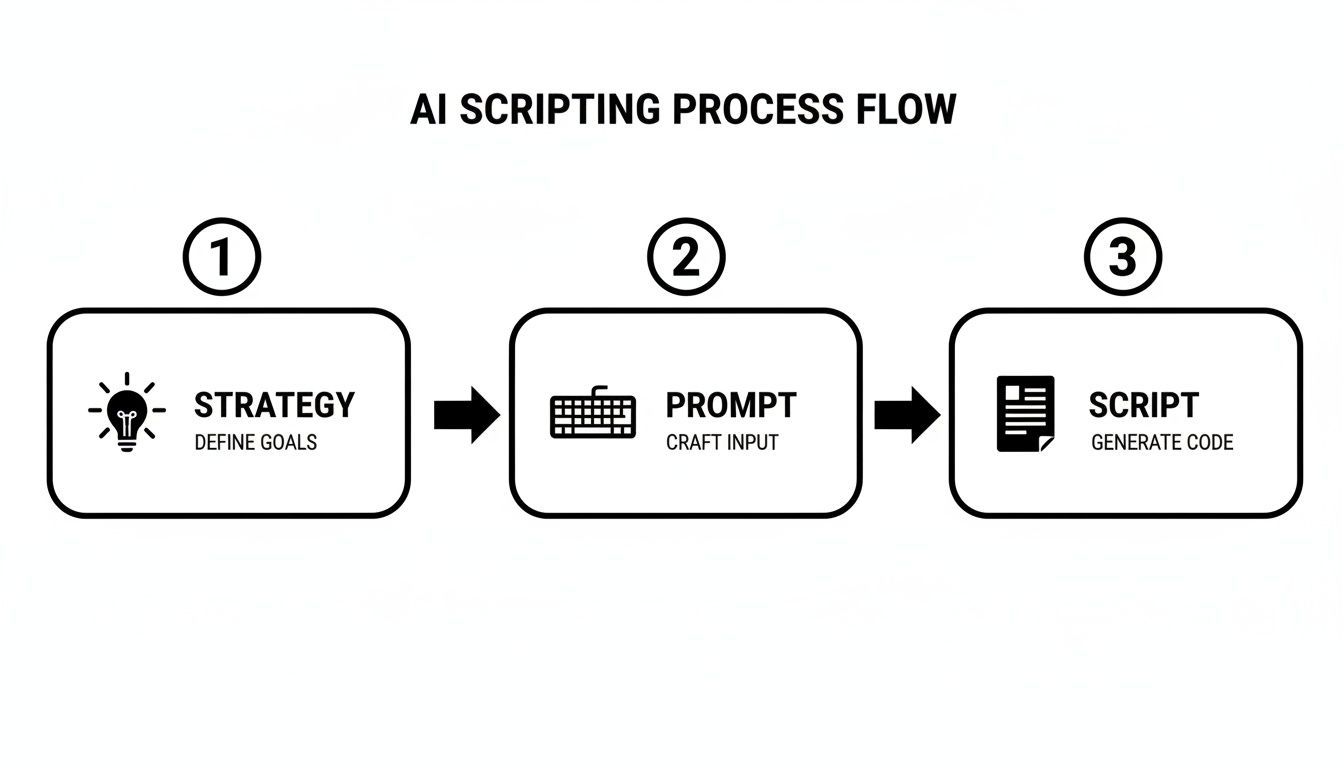
It all starts with a strong strategic foundation. Without that, you're just making pretty pictures with no purpose.
Selecting the Perfect AI Voiceover
Once the visuals are starting to come together, it’s time to give your ad a voice. The right voiceover gives your brand a personality and helps build a connection with the viewer. Modern AI voice generators offer an incredible variety of tones, accents, and speeds, so you can find the perfect match without the cost and hassle of hiring a voice actor.
When you're listening to samples, think about your audience. Would a warm, friendly voice land better, or does your brand need something more authoritative and confident? Most tools let you preview different voices with a line from your script. I always recommend testing a few to see what feels right. Having this feature built into an AI video ad maker is a huge timesaver, keeping your whole creative process in one place.
This isn't just a niche trend; it's rapidly becoming the industry standard. A recent report found that 86% of ad buyers are already using or plan to use generative AI for creative work. That number is expected to jump to nearly 90% by 2026. This shift is happening fastest on social platforms, where an estimated 52% of TikTok and Instagram Reels are already AI-generated short-form videos. By getting comfortable with these tools now, you’re not just saving time—you’re staying ahead of the curve.
Adding Polish and Brand Identity
The first draft you get from an AI video ad maker is just the starting point. Think of it as your raw clay—it's got the right shape, but the real artistry comes from molding and refining it. This is where you step in to turn that AI-generated foundation into an ad that not only performs but also feels distinctly you.
This isn't about redoing the AI's work. It's about making smart, strategic edits. You're the director in the editing bay, and your tools are simple sliders and drag-and-drop features. The AI gave you speed; now you add the vision.
Fine-Tuning Your Video’s Pacing and Flow
The first thing I always look at is the timing. An AI might generate a scene that drags on for a second too long or create a transition that just feels a bit clunky. In the world of short-form ads, every single frame matters.
Get comfortable with the trimming tools. Does a scene linger after the voiceover makes its point? Cut it. Could the jump from your hook to the product shot be quicker for more punch? Shorten that clip. It’s these tiny adjustments that separate a decent ad from a scroll-stopping one.
Don't be afraid to swap things out, either. If a specific image isn't hitting the mark, regenerate it with a slightly different prompt. Maybe one of the voiceover lines feels a little flat—try a new take. This is the beauty of an all-in-one platform; you can experiment and iterate in minutes, not hours.
Adding Captions and Optimizing for Every Platform
Let's be real: a huge number of people watch social media videos with the sound off. If your ad is all talk and no text, you’re missing a massive audience. That's why dynamic, readable captions are non-negotiable.
Most modern AI tools can auto-generate captions from your script with one click. But don't just leave the default settings. You'll want to customize them to fit your brand’s look and feel.
- Pick a clean, legible font.
- Use your brand colors for the text or its background.
- Double-check the timing to make sure captions sync perfectly with the audio.
Next up is aspect ratio. A 16:9 ad designed for a YouTube pre-roll will look awful cropped into a 9:16 TikTok feed. Good ad makers let you resize your video for every platform instantly, intelligently reframing the content so it looks native on vertical, square, or horizontal screens.
An ad only works if it feels like it belongs on the platform. Resizing and captioning aren't optional—they're fundamental to meeting people where they are and how they actually watch content.
Injecting Your Unique Brand Identity
This is where everything comes together. You need to make the ad undeniably yours. A generic-looking ad, no matter how clever, does nothing to build brand recall. It’s time to apply your brand kit.
A brand kit is simply a saved collection of your company’s visual assets that you can apply instantly. It should include:
- Your Logo: Pop it in as a subtle watermark or use it in your intro and outro.
- Brand Colors: Make sure every text overlay and graphic element uses your exact hex codes.
- Custom Fonts: Ditch the defaults and use the same typography from your website and other marketing materials.
Applying your brand kit creates a consistent experience. It’s the final step that transforms a piece of AI content into a genuine brand asset. If you find you need to tweak specific images further, it's worth learning about the capabilities of a modern AI image editor to get even more control.
Ultimately, consistent branding builds trust and makes your ads instantly recognizable in a crowded feed. This final layer of polish is what elevates your project from just another video to a powerful piece of advertising.
Testing and Distributing for Real Results
So you’ve got a polished, branded video ad ready to go. Great. But hitting "export" isn't the finish line—it's the starting gun. Now the real work begins: getting your creation in front of the right eyeballs and figuring out what’s actually resonating.
This is where the agility of an AI video ad maker becomes your secret weapon. It lets you test, learn, and pivot faster than your competitors can even book a studio.
The old way of spending weeks obsessing over one "perfect" ad is officially dead. Winning today is all about volume and variation. Instead of betting the farm on a single creative, you should be launching three or four versions, each with a small but meaningful twist. This is the heart of A/B testing, and AI tools make it almost laughably easy.
Launching Smarter A/B Tests
Effective A/B testing isn’t just about throwing spaghetti at the wall to see what sticks. It's a calculated process of isolating variables to learn exactly what makes your audience tick. With AI, you can spin up these variations in minutes, not days.
I always recommend focusing your tests on the elements that deliver the biggest bang for your buck:
- The First Three Seconds (The Hook): This is everything. Test a question-based hook ("Struggling with...?") against a bold, declarative statement ("This is the last... you'll ever need."). Pit a visually striking opening against a simple, text-driven one.
- The Call to Action (CTA): You'd be amazed how much a few words can impact your results. Try testing "Shop Now" against "Get Yours Today," or "Learn More" against "See How It Works." Your goal is to find the phrase that feels the most natural and compelling to your specific audience.
- The Core Visuals: Does your market respond better to bright, energetic visuals or something a bit more cinematic and moody? You can quickly swap a few key scenes to test the overall aesthetic without having to rebuild the entire ad from scratch.
The real objective here isn't just to find one "winner." It's to build a library of proven components—hooks, visual styles, and CTAs—that you know work. You can then mix and match these high-performing elements in all your future campaigns. That's how you drive sustainable growth.
Smart Distribution for Every Platform
Once you've got your ad variations, you need a distribution plan. Just blasting the same 16:9 widescreen video across TikTok, Instagram Reels, and YouTube Shorts is a surefire way to get ignored. Every platform has its own vibe, its own culture, and its own technical quirks.
An integrated AI video ad maker handles this beautifully. With a single click, you can resize your ad for every format. But it's about more than just cropping. A good tool lets you tailor the content, too—maybe adding platform-native text styles or even incorporating trending audio to make your ad feel more at home. The built-in schedulers are also a lifesaver, letting you plan out your content calendar and push your ads live at the optimal engagement times for each platform.
This kind of speed is essential. Digital video ad spend on short-form content is expected to hit a jaw-dropping US$219.71 billion by 2030. In this environment, AI gives you a serious advantage; 67% of social users are already saying they prefer AI for creating personalized videos, while 42% of brands are now using real-time analytics to tweak their campaigns on the fly. You can find more data on the future of video advertising over at statista.com.
Measuring What Actually Matters
You can't improve what you don't measure. It’s easy to get distracted by vanity metrics like views and likes, but to build a profitable ad strategy, you have to focus on the key performance indicators (KPIs) that actually affect your bottom line.
Here are the metrics I live and die by for video ads:
- Click-Through Rate (CTR): What percentage of people who saw your ad actually clicked it? A high CTR means your hook and creative are doing their job and grabbing attention.
- Cost Per Click (CPC): Simple enough—how much are you paying for each of those clicks? The game is to push your CTR up while driving your CPC down.
- Conversion Rate: Of all the people who clicked, how many followed through and did the thing you wanted them to do (like buy a product or sign up for a list)? This is the ultimate proof that your ad and your offer are effective.
- Return on Ad Spend (ROAS): This is the big one. For every dollar you put into ads, how many dollars in revenue are you getting back? A ROAS of 3:1 is a solid benchmark, but you should always be aiming higher.
After your AI video ad is live, the crucial next step is optimizing your Google Ads campaign for success to make sure you’re getting real results. This data creates a powerful feedback loop. The insights from one campaign should directly inform the creative choices you make for the next one. This is how you get smarter and more efficient with every dollar you spend.
Got Questions About AI Video Ad Makers? We Have Answers.
Jumping into any new tech, especially something as powerful as an AI video ad maker, naturally brings up some questions. It's smart to wonder how these tools actually work, what they can realistically pull off, and if they're the right move for your brand. Let's tackle some of the most common things marketers are asking.
Will My Ads Sound Like a Robot Made Them?
This is probably the biggest concern, and for good reason. Nobody wants their brand to feel robotic or stuck in that creepy "uncanny valley." Can AI-generated ads actually feel human and connect with an audience?
The short answer is yes, but it all depends on you.
Think of an AI ad platform as a creative co-pilot, not a fully autonomous autopilot. The best work happens when human strategy directs the AI's incredible production speed.
Authenticity isn't a feature the AI just spits out; it's something you guide it to create. The key is feeding the AI detailed, brand-specific prompts. When you dial in your unique tone of voice, describe your customer's pain points with genuine empathy, and guide the visual style, you're building the foundation for a real connection. The magic really happens when you step in at the end to make those final human-touch edits and apply your brand kit.
How Much Time Can I Actually Save?
This is where you'll feel the most immediate and dramatic impact. A traditional video ad is a slow, painful process that can easily eat up days, if not weeks. You're juggling scriptwriters, designers, voice actors, and editors, with endless back-and-forth at every stage.
An AI video ad maker brings that entire workflow under one roof.
- Scripting: Forget hours of brainstorming. You can generate a dozen solid script ideas in just a few minutes.
- Visuals & Audio: Instead of endlessly scrolling through stock footage libraries or hiring talent, you get instant scene and voiceover generation.
- Editing & Formatting: Adding captions, resizing for TikTok vs. Instagram, and applying your brand colors become a few simple clicks.
For a small business owner or a slammed marketing team, this is a total game-changer. What used to block off an entire week can now be done in an afternoon. That saved time isn't just about efficiency; it's about freeing you up to focus on what really moves the needle—strategy, testing, and big-picture thinking.
What Kind of Results Can I Realistically Expect?
Here’s the honest truth: the tool itself isn't a silver bullet for amazing results. The performance of your AI-generated ads is directly tied to the quality of the strategy behind them.
The biggest advantage AI gives you is the ability to A/B test on a massive scale—something that used to be out of reach for most teams. You can spin up and launch multiple ad variations in a flash to test what truly works.
- The Hook: Does starting with a provocative question grab more attention than a bold statement?
- The Visuals: Does your audience prefer polished, cinematic scenes or something that looks more like user-generated content?
- The Call-to-Action: Which exact phrase compels people to actually click?
Because AI makes this level of testing not just possible but easy, brands are seeing real, measurable lifts in performance. When you can learn and adapt based on real-world data that quickly, you’re always optimizing. That leads directly to better click-through rates, higher conversion rates, and a healthier return on ad spend.
Ready to trade weeks of production headaches for high-performing ads made in minutes? ShortGenius brings AI scriptwriting, scene generation, voiceovers, and powerful editing tools together in one place. Discover how ShortGenius can transform your content strategy today.