Your Guide to the AI Video Ad Generator

Discover how an AI video ad generator can transform your marketing. Learn to create high-performing video ads for social media in minutes, not weeks.
Imagine having an entire video production team on standby, working around the clock, with a deep understanding of the latest marketing trends. Now, imagine they can deliver a finished, polished ad in just a few minutes. That's the reality an AI video ad generator brings to the table. It’s a tool that uses artificial intelligence to automatically create compelling video ads from nothing more than a simple text prompt, opening up high-quality video production to anyone.
How an AI Video Ad Generator Works
Think of an AI video ad generator as an expert creative director and a full production crew all rolled into one. You give it the creative brief—a simple text prompt, a link to your product, or a rough script idea—and the AI gets to work, pulling together all the necessary elements to build a professional-grade video ad. It intelligently combines several different AI technologies to understand your request and then assembles the final product.
This completely sidesteps the long, drawn-out process of traditional video creation. You no longer need to hire a film crew, scout locations, or spend weeks wrestling with editing software. Instead, you can generate a complete ad in the time it takes to grab a coffee. The AI handles everything from writing the script to finding the right visuals and rendering the final cut.
The Core Technological Components
So, what’s actually happening under the hood? A few key AI models work in concert to turn your initial idea into a finished ad.
- Natural Language Processing (NLP): This is the "brain" of the operation. When you type in a prompt, NLP models get to work analyzing your words to understand your product, who you're trying to reach, and the overall vibe you're going for. From there, they can generate a persuasive script, attention-grabbing hooks, and a clear call-to-action.
- Computer Vision: This is the AI's set of "eyes." It sifts through massive libraries of stock footage, images, and even user-generated content (UGC) to find visuals that perfectly match the story being told in the script. It’s smart enough to identify objects, settings, and even the emotional tone of a scene to make sure the visuals and the narrative are perfectly aligned.
- Speech Synthesis (Text-to-Speech): This is what gives your ad a voice. Modern text-to-speech engines can create incredibly realistic, human-sounding voiceovers in a huge range of languages and accents. They take the script and turn it into engaging audio narration that syncs up with the video. You can see how ShortGenius uses text-to-video technology to make this whole process seamless.
From Prompt to Polished Ad
When these technologies come together, you get a remarkably efficient production pipeline. The NLP model drafts a script, scene by scene. As it does, the computer vision model finds the perfect video clip for each scene. To top it off, the speech synthesis engine lays down a synchronized voiceover. In essence, the tool functions as an AI Ad Video Generator, making it unbelievably simple to create ads for any platform.
This integrated workflow is why we're seeing such explosive growth in this space. The AI video generator market is on a tear, projected to jump from USD 788.5 million in 2025 to a staggering USD 3,441.6 million by 2033. This growth is being driven by brands and creators who are tired of the old way of doing things and are turning to AI tools to create high-quality ads for platforms like TikTok and Instagram in seconds.
The real game-changer here isn't just the speed. It's the ability to test creative concepts at a scale that was simply unimaginable before. Marketers can now spin up dozens of ad variations to discover what truly connects with their audience.
By taking on the technical and creative grunt work, these platforms free up marketers to do what they do best: focus on strategy and results instead of getting bogged down in the nuts and bolts of production. This leads to a much more nimble, data-backed approach to video advertising.
Traditional Video Production vs AI Video Ad Generator
To really appreciate the shift, it helps to see a side-by-side comparison. The old, manual process looks worlds away from the speed and efficiency of AI-driven creation.
| Factor | Traditional Video Production | AI Video Ad Generator |
|---|---|---|
| Time | Weeks to Months. Involves pre-production, shooting, and extensive post-production editing. | Minutes. Generate complete, ready-to-publish ads almost instantly. |
| Cost | High. Requires budget for crew, actors, equipment, locations, and editing software. | Low. Typically a small fraction of the cost, often a monthly subscription. |
| Complexity | Very High. A multi-stage process requiring specialized skills and coordination. | Very Low. An intuitive process where users simply provide text prompts or links. |
| Scalability | Difficult. Creating variations or new ads is a full-scale project each time. | Effortless. Produce dozens of ad variations for A/B testing in a single session. |
| Flexibility | Rigid. Changes after shooting are difficult and expensive to implement. | Highly Flexible. Tweak scripts, visuals, and voiceovers on the fly with a few clicks. |
As the table shows, the advantages of using an AI video ad generator are clear, especially for teams that need to move fast and test ideas continuously without breaking the bank.
Your Workflow for Creating High-Performing Ads
Knowing the tech is one thing, but actually using it to make ads that work is what really matters. So, let's walk through the entire process, from a simple idea to a polished ad that’s ready to launch. This isn't just about making one video; it's about creating a repeatable system for testing and finding what truly works.
It all starts with a single, simple input. This could be anything from a link to your product page, a quick description of what you're selling, or even just a few bullet points on its main benefits. The AI takes that little spark and runs with it, doing all the heavy lifting that used to take a team days or even weeks.
Think of it like giving a destination to your GPS; the AI figures out the best and fastest way to get you to a finished ad.
This visual gives you a bird's-eye view of the three main stages, showing how you go from a basic idea to a finished video.
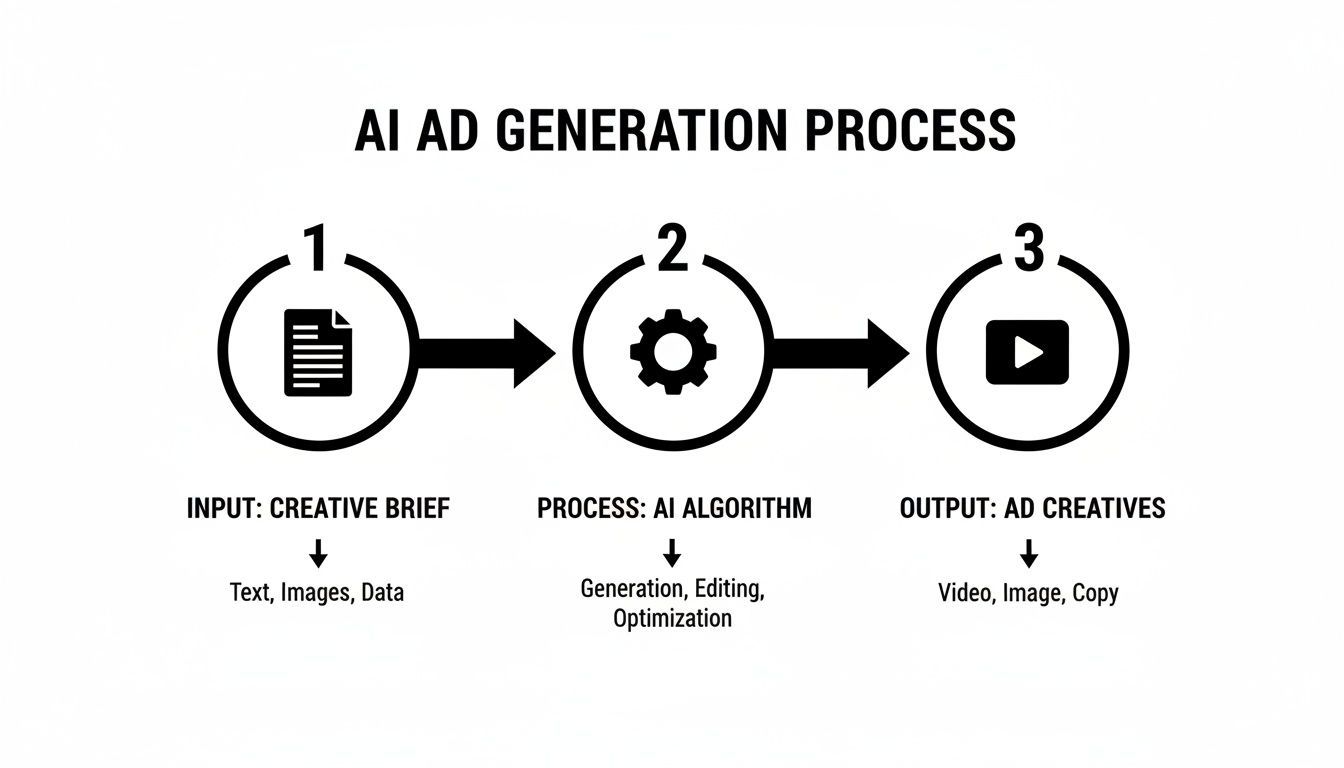
As you can see, the AI engine takes a simple text prompt and generates a complete video ad, making the whole production process incredibly efficient.
Stage 1: Generating the Core Creative Assets
First up, the AI handles the brainstorming and scriptwriting. Based on what you’ve provided, the platform’s language models will spit out multiple ad concepts, scripts, and opening hooks. You’re not just getting one script; you get several options, each with a slightly different angle or vibe.
One of the biggest wins here is that it helps you break through creative ruts. The AI can suggest approaches you'd never think of by analyzing what's already working on platforms like TikTok and Instagram.
Once you’ve picked a script you like, the AI gets to work on the visuals. Using computer vision, it finds or generates video clips and images that perfectly match each line of the script. If your script says "sets up in seconds," the AI will find a clip of someone putting something together effortlessly. You get a video where the words and pictures are perfectly in sync, without ever having to dig through stock footage libraries.
These days, many platforms are getting really good at creating authentic, user-generated style content. In fact, you can dive deeper into how to create AI-generated UGC ads, which are fantastic for building social proof.
Stage 2: Enhancing and Branding the Ad
With the basic script and visuals locked in, it’s time to add the polish and make the ad feel like yours.
- Voiceover and Captions: The AI’s text-to-speech engine turns your script into a natural-sounding voiceover. You can usually pick from a library of voices, accents, and languages to find one that fits your brand. At the same time, it creates animated captions. This is a non-negotiable, since up to 85% of social media videos are watched on mute.
- Applying Your Brand Kit: A consistent look is key. Most good AI tools let you upload your brand kit—your logo, specific fonts, and color scheme. The AI then automatically applies these to every video, so all your ads look professional and on-brand.
- Adding 'Scroll Stopper' Effects: Let's be honest, people have short attention spans. Platforms like ShortGenius come with built-in visual effects—think dynamic camera zooms, cool filters, or slick transitions—designed to grab someone’s attention in the first three seconds and stop them from scrolling.
Stage 3: Finalizing and Deploying for Testing
The last step is all about getting your ads out into the wild. In performance marketing, you rarely hit a home run with your first creative. Success comes from testing, and this is where an AI generator is a game-changer.
With just a couple of clicks, you can create dozens of variations of your main ad. Test different opening hooks, calls-to-action, background music, or visual clips to see what your audience responds to. This kind of A/B testing is built right into the workflow, so you can easily build out a whole campaign's worth of creatives.
Finally, the platform handles all the boring technical stuff. It can instantly resize your video for any platform, whether you need a 9:16 vertical video for TikTok Reels or a 16:9 widescreen format for YouTube. This removes that last production headache, letting you go straight from creating to launching your campaign, fully armed with a diverse set of ads ready for optimization.
Key Benefits for Modern Marketers
So, why are so many businesses and creators flocking to AI video ad generators for their campaigns? It’s about more than just convenience. These tools offer some serious advantages that can completely reshape how you approach marketing, unlock new creative ideas, and actually boost your bottom line. This is a fundamental shift away from the old, slow, and expensive way of making videos toward something much more agile and data-driven.
The first and most obvious win is the massive cost savings. Let's be honest, traditional video production is expensive. You've got to budget for equipment, actors, locations, and a whole post-production team. An AI video ad generator slashes nearly all of those costs, swapping them for a simple and predictable subscription fee.
This really changes the game. Suddenly, it’s not just big corporations with huge budgets that can pump out high-quality video ads. Now, startups, small businesses, and even solo creators can produce professional-looking content without that scary five-figure price tag.

Unlocking Unprecedented Scalability
Beyond the budget, the sheer scalability you get with AI is a massive perk. In the time it used to take a creative team to painstakingly produce one single video ad, a marketer can now spin up dozens of different versions. This is a game-changer for modern performance marketing.
Instead of sitting in a room guessing which hook, call-to-action, or visual might work, you can just test them all. This opens the door to rapid A/B testing, giving you hard data on what your audience actually responds to.
This isn't just about making more ads; it's about making smarter ads. The high-volume testing capability creates a powerful feedback loop, allowing you to continuously refine your campaigns based on real-world performance data, not assumptions.
Ultimately, this frees up your team. They can spend less time stuck in the production weeds and more time analyzing results and thinking about big-picture strategy.
Driving Superior Ad Performance
An AI video ad generator is built from the ground up to create content that actually converts. These platforms are trained on huge datasets of top-performing ads from all over social media, so they learn what kinds of hooks, pacing, and visuals grab attention and get people to act.
When the AI drafts a script, it’s not just pulling words out of thin air. It’s using proven copywriting formulas designed to stop the scroll and keep people watching. This data-backed approach means your ads have a much better chance of performing well right from the start.
And the numbers back this up. A recent report showed that 22% of video ad creative is already being built or touched up with generative AI, and that number is expected to jump to 39% by 2026. Smaller advertisers are especially all-in, predicting that 45% of their videos will use these tools by 2026. This just proves you don't need a massive budget anymore to make a real impact. You can explore more findings on the rise of genAI in video ads to see how it's shaking up the industry.
Maintaining Creative Consistency
Finally, these tools solve a problem that has plagued brands for years: keeping everything looking consistent. With features like brand kits, you can set your company's logos, color palettes, and fonts once. From then on, every video ad the AI creates will automatically have them.
This kind of consistency is crucial for building brand recognition and trust. No matter how many ad variations you're testing or who on your team is creating them, you can be sure every single video perfectly aligns with your brand guidelines. It delivers a cohesive and professional look, every single time.
How to Choose the Right AI Ad Generator
The world of AI video ad generators is exploding, and with so many new tools popping up, figuring out which one to choose can feel like a real challenge. The truth is, they aren't all built the same. Some are designed for marketers who need to churn out lots of ads for performance campaigns, while others are geared more toward creating beautiful, brand-focused visuals.
Think of choosing an AI ad generator like bringing a new specialist onto your team. You have to make sure they have the right skills, fit into your existing process, and can actually deliver the results you're after. The wrong tool can lead to a lot of wasted time and money, but the right one can completely change the game for your creative strategy and campaign numbers.
Start With the Core Creative Engine
The absolute heart of any AI video ad generator is its ability to create high-quality, compelling ad creative on its own. This is where you need to start your digging. Don’t get distracted by the shiny, polished examples on a company’s homepage; you need to look at the quality of the individual pieces the AI puts together.
First, look at the scripts. Does the AI write copy that genuinely grabs your attention and makes you want to act, or does it spit out generic, robotic-sounding lines? A top-tier platform will give you several script options with strong hooks and clear calls-to-action that are based on what actually works in marketing.
Next up is the audio. The voiceover is just as critical as the visuals, if not more so. When you're comparing tools, really listen to the voice options. For those who want to get technical, looking into the capabilities of different AI voice generator APIs can give you a better sense of what's possible with today's technology.
Finally, you have to judge the visual quality. Does the tool pull from a high-quality, diverse library of stock video and images? More importantly, can it create visuals that feel authentic to your brand? Some platforms, like ShortGenius, are even finding new ways to turn still images into captivating video clips. You can learn more about how an image-to-video model works to bring your static assets to life.
Make Sure It's Easy to Use and Fits Your Workflow
A tool can have all the power in the world, but if your team can’t figure out how to use it, it's worthless. The best platforms feel intuitive from the start, letting just about anyone create a professional-looking ad without needing a degree in video editing. The process should be smooth, taking you from a simple idea to a finished video in a handful of clear, simple steps.
To help you decide, here's a checklist of key features to look for when you're evaluating different AI video ad generators. This will help you systematically compare your options and find the tool that best fits your marketing goals and team's workflow.
Feature Checklist for an AI Video Ad Generator
| Feature Category | Key Capabilities to Evaluate | Why It Matters |
|---|---|---|
| Creative Generation | Script quality, voiceover naturalness, visual library, asset generation (like image-to-video) | The final ad is only as good as its individual parts. High-quality components are non-negotiable. |
| Ease of Use | Intuitive user interface, simple workflow, clear step-by-step process | A complex tool creates a bottleneck. Simplicity empowers more people on your team to create. |
| Brand Customization | Brand Kit uploads (logos, fonts, colors), control over brand elements in templates | Every ad must feel like your brand. Consistency builds trust and recognition with your audience. |
| Editing & Flexibility | Scene swapping, script tweaking, timing adjustments, music changes | AI gives you a starting point, but you need the final say to refine the ad for maximum impact. |
| Performance Tools | Easy ad variation/A/B testing, platform-specific formatting (e.g., TikTok, Reels) | The goal is to drive results. The tool should make it easy to test, learn, and optimize your campaigns. |
Finding a platform that ticks these boxes means you’re not just buying a tool; you're investing in a smoother, more efficient creative process that will pay dividends in your campaign performance.
The goal is to find a tool that works with your team, not against them. It should reduce friction in the creative process, empowering your team to focus on strategy and testing rather than getting bogged down by technical hurdles.
Look for Features That Actually Drive Performance
At the end of the day, you're making ads to get results. A great AI video ad generator should be more than a creative toy—it should be a performance marketing machine. This means you should be on the lookout for specific features built to help you test what works, learn from the data, and make your campaigns better over time.
Think about what you really need to move the needle:
- A/B Testing Support: How fast can you create multiple versions of an ad to test different hooks, visuals, or CTAs? The whole point of AI is to make this kind of testing fast and easy.
- Platform-Specific Formatting: Does the tool automatically resize and reformat videos for TikTok, Instagram Reels, and YouTube Shorts? This saves a ton of manual work.
- Attention-Grabbing Effects: Look for built-in features like animated captions, dynamic transitions, and other "scroll stoppers" that are proven to keep people watching.
Your final choice should come down to the platform that gives you the best tools to not only make ads but to make them better. By focusing on creative quality, ease of use, and real performance features, you can pick an AI video ad generator that will become one of the most valuable assets in your marketing toolkit.
Best Practices for Maximizing Ad Performance
Having a powerful AI video ad generator in your toolkit is a great first step, but the tool itself is no magic bullet. The real wins come from knowing how to use it strategically. If you follow a few core principles, you can go from just making ads to crafting high-impact campaigns that actually move the needle.
These aren't about getting lost in technical jargon. They're about understanding what grabs people's attention and convinces them to act in a space that’s more crowded than ever. Nail these, and you'll unlock the full power of your AI tool, turning it into a growth engine you can count on.
Master the Art of the Prompt
Think of your prompt as the creative brief you'd give to a human copywriter. The better the brief, the better the result. It’s that simple. Vague prompts will give you generic, forgettable ads. Rich, detailed prompts are what lead to compelling creative that feels like it was made just for your audience.
So, instead of a lazy prompt like, "Create an ad for my coffee beans," you need to give the AI something to work with:
"Generate a 15-second TikTok ad script for our new 'Morning Rush' dark roast coffee. My target audience is busy young professionals. I want the tone to be energetic and motivational. Make sure to highlight the bold flavor, smooth finish, and that the beans are ethically sourced. End it with a clear CTA to 'Fuel Your Ambition' and give them a 10% off code."
See the difference? That level of detail gives the AI the guardrails it needs to create a script that’s specific, persuasive, and perfectly aligned with what you’re trying to achieve.
Always Start with a Powerful Hook
You have maybe three seconds to stop someone from scrolling past your ad. That's it. This means every single video has to open with a hook that immediately grabs them by the collar. Your ai video ad generator is perfect for this—it can spit out dozens of hook variations in seconds, giving you plenty to test.
Here are a few proven formulas to get you started:
- Ask a pointed question: "Are you still drinking boring coffee?"
- Make a bold statement: "This isn't just coffee; it's your new secret weapon."
- Hit on a common pain point: "Tired of hitting that 2 PM slump?"
By constantly testing different hooks, you'll quickly learn which opening lines connect with your audience and keep them watching.
Embrace Rapid A/B Testing
One of the biggest game-changers with AI tools is the sheer speed at which you can A/B test your creative. Forget making one ad and crossing your fingers. The modern marketing playbook is all about creating multiple variations to test every single component.
This creates a powerful feedback loop. You stop guessing what works and start letting the data tell you exactly what your audience wants.
- Test Headlines and CTAs: Does "Shop Now" outperform "Learn More"? Does a question-based headline get more clicks than a statement? Test them and find out.
- Experiment with Visuals: Try the same script with different background clips or stock footage. You might be surprised by which imagery resonates.
- Vary the Voiceover and Music: A calm, soothing voiceover might work for one product, while an energetic, upbeat one works for another. Test different audio styles to see how they change the ad's vibe and performance.
Repurpose Your Winning Creatives
When you find an ad that’s crushing it, its job isn't done. Your top performers are gold. You should be squeezing every last drop of value out of them by repurposing them across every platform you’re on. An ai video ad generator makes this incredibly easy.
Take that winning 9:16 TikTok ad and have the AI instantly reformat it to a 1:1 square for your Instagram feed or a 16:9 widescreen version for a YouTube pre-roll ad. You can even pull the core message and have the AI generate static image ads based on it for Facebook.
This approach ensures your best ideas are working for you everywhere, creating a consistent and effective message across your entire marketing ecosystem.
Measuring the Success of Your AI-Generated Ads
Making ads in a flash is a huge plus, but let's be honest—it’s the results that count. To figure out if your AI-generated ads are actually working, you have to look past vanity metrics like views and likes. Real success is tied directly to business growth.
This is where the speed of an AI video ad generator becomes a strategic advantage. When you can churn out dozens of ad variations in minutes, you unlock the ability to test everything and optimize for the metrics that truly move the needle. You're essentially creating a rapid feedback loop where campaign data tells you exactly what to create next.
Key Performance Indicators That Matter
To get a true read on your campaign's health, you need to focus on the metrics that tell the whole story, from the first glance to the final sale.
- Click-Through Rate (CTR): This is your first test. It shows the percentage of people who saw your ad and were curious enough to click. A high CTR means your creative is doing its job—stopping the scroll and grabbing attention.
- Conversion Rate: This is where the rubber meets the road. It tracks how many of those clicks turn into a desired action, like a purchase or a sign-up. This tells you if you're attracting the right kind of people.
- Cost Per Acquisition (CPA): This is your efficiency score. It’s your total ad spend divided by the number of new customers you brought in. The game is to get this number as low as possible without sacrificing quality.
- Return on Ad Spend (ROAS): The ultimate bottom line. ROAS calculates how much revenue you're making for every single dollar you spend on ads. A high ROAS is the clearest sign that your campaigns are a financial home run.
The impact of AI-driven creative isn't just theoretical. Businesses have seen an 82% increase in ROI over traditional methods and 40% higher conversion rates from AI-powered product demos. Add in features like AI subtitles that can boost retention by 65%, and you can see how these tools are built for performance. You can explore the latest video marketing statistics to see more of these trends.
Using Data to Refine Your Strategy
Once the numbers start rolling in, you can make much smarter decisions. For instance, what if an ad has a fantastic CTR but a terrible conversion rate? That’s a classic sign that your hook is brilliant, but your landing page or offer isn't closing the deal for the audience you've attracted.
Let the data be your guide. Double down on what works, cut what doesn’t, and never stop testing new creative angles. This constant cycle of improvement is how you scale your advertising successfully.
An AI generator makes this process almost effortless. You can instantly swap out a call-to-action, try a new voiceover, or test a completely different visual hook based on what the data tells you. By constantly tweaking your ads based on real-world feedback, you turn creative work into a data-driven science.
Frequently Asked Questions
Jumping into any new technology brings up questions. Here are some clear, no-nonsense answers to the most common things people ask about AI video ad generators.
Can an AI Video Ad Generator Replace a Human Creative Team?
Think of it less as a replacement and more as a super-powered assistant. An AI generator is brilliant at handling the grunt work—the stuff that eats up hours and drains creative energy. We're talking about generating dozens of script variations, churning out versions for every ad format, and sifting through mountains of stock footage.
This automation frees up your creative team to do what they do best: focus on big-picture strategy, dream up original concepts, and add that final human touch that makes an ad resonate emotionally. The best tools are designed to amplify human talent, letting a lean team punch way above its weight.
How Do I Keep AI-Generated Ads On-Brand?
This is a huge, and valid, concern. The good news is that modern AI ad generators are built for this. Top-tier platforms let you upload a ‘brand kit’—your logos, specific color palettes, and fonts—which the AI then applies to everything it creates. No more off-brand blues or rogue fonts.
You're also in the driver's seat when it comes to tone. Your initial prompts guide the AI's voice, and you can always jump in to tweak a script or swap a visual. You always have the final say, ensuring every ad feels like it came straight from your team.
The magic happens when you pair AI’s efficiency with human oversight. The AI gives you speed and scale, but you provide the strategic vision and brand nuance that makes the creative perfect.
Are AI-Generated Ads Effective On All Social Platforms?
Absolutely, and here’s why: the best AI video ad generators make it almost effortless to tailor your content to each platform's specific quirks and audience expectations. That ability to adapt is what drives real engagement.
For instance, you can create a fast-paced, vertical video for TikTok, then instantly have the AI reframe it into a sleek Instagram Reel or a widescreen version for YouTube. This completely removes the headache of manual re-editing and ensures your message hits home, no matter where it's seen. It’s this kind of flexibility that helps you build a strong, consistent presence everywhere you are.
Ready to see how this can change your creative workflow and get high-performing ads out the door in minutes? With ShortGenius, you can generate unlimited concepts, scripts, and visuals to discover what truly moves the needle. Start creating for free today!