Ai UGC Ads Generator: Create Compelling Campaigns with AI - ai ugc ads generator

Discover how ai ugc ads generator can transform your marketing with streamlined scripting, visuals, and scalable campaigns.
At its core, an ai ugc ads generator is a tool that uses artificial intelligence to create ads that feel like authentic user-generated content (UGC). Think of it as blending the genuine, relatable vibe of a real customer video with the incredible speed and scale only AI can offer. This lets marketers pump out high-performing, trustworthy ads without the hefty price tags and long waits that come with typical creator partnerships.
Why AI UGC Ads Are Reshaping Social Media

Let's be real—the era of slick, overproduced commercials dominating our social feeds is on its way out. Today's consumers are smart. They can spot a hard sell from a mile away and have zero patience for anything that feels forced or inauthentic. This has become a huge headache for marketers who need a constant pipeline of fresh creative to even stand a chance.
The answer, for a while now, has been user-generated content. Time and again, ads that look like they were shot by a real person on their phone blow polished, high-budget productions out of the water. Why? Because they feel real, and that builds trust.
The Problem with Scaling Authenticity
Here’s the catch: as powerful as traditional UGC is, it’s a pain to scale. The whole process—finding good creators, haggling over contracts, shipping out products, and then just waiting for them to deliver content—can easily drag on for weeks, sometimes months. This snail's pace makes it nearly impossible to test new ideas quickly or jump on a trending topic.
This is exactly where an AI UGC ads generator comes in. It’s not about replacing human creators entirely; it's about giving marketing teams the superpowers they need to amplify their work. Instead of spending a month to get one or two videos, you can now generate dozens of variations in minutes. This means you can finally test different hooks, visuals, and calls-to-action to see what actually resonates with your audience.
The numbers don't lie. The global UGC marketing market, valued at USD 6.7 billion in 2024, is expected to explode to USD 132.73 billion by 2034. That's a staggering 34.8% compound annual growth rate. This growth is all about trust—ads featuring UGC get a 73% increase in positive feedback compared to traditional ads because they create a genuine emotional connection. You can dive deeper into the data by checking out the full User-Generated Content Marketing Market research.
The real magic of an AI UGC ads generator is its ability to fuse the relatability of a user-shot video with the raw efficiency of AI. It gives marketers the power to create authentic content at a scale that was just a pipe dream a few years ago.
By merging AI-powered production with the proven appeal of UGC, brands can finally crack the code: producing compelling, trustworthy ads without the usual production bottlenecks. This opens the door to a much more nimble and data-driven approach to advertising.
AI UGC Ads vs Traditional Advertising at a Glance
To put it all into perspective, here’s a quick breakdown of how generating AI UGC ads stacks up against the old way of doing things.
| Metric | Traditional Advertising | AI UGC Ads Generation |
|---|---|---|
| Time to Create | Weeks to months | Minutes to hours |
| Production Cost | High (creators, shoots, editing) | Low (subscription-based) |
| Scalability | Extremely limited | Virtually unlimited |
| A/B Testing | Slow and expensive | Fast and affordable |
| Authenticity | Varies; can feel staged | Designed to feel authentic |
| Approval Process | Lengthy back-and-forth | Instantaneous |
The difference is pretty stark. What used to be a long, drawn-out process has become something you can manage in an afternoon, freeing up teams to focus on strategy and performance instead of just logistics.
Developing Scripts That Sound Genuinely Human
The secret to a great AI-generated UGC ad isn't just the visuals—it's the script. You can have the most stunning, hyper-realistic video, but if the words sound robotic, the whole thing falls flat. The magic happens when you can guide the AI to write like a real person, not a machine churning out marketing copy.
Think of it like being a director. You wouldn't just tell an actor to "sell this product." You'd give them a character, a backstory, and a motivation. That’s exactly what we need to do with the AI to get a script that actually connects with people.
From Vague Prompts to Vivid Personas
Let's take a new productivity app as an example. If you feed the AI a generic, feature-based prompt, you'll get a generic, feature-based script. It's predictable.
- Vague Prompt: "Write a 30-second video script for a new productivity app that organizes tasks."
- Likely Result: "Are you tired of feeling disorganized? Our new app helps you manage your daily tasks with ease. Download now to boost your productivity!"
It’s not wrong, but it has zero personality. It sounds like an ad from a decade ago. To get scripts that feel real, you have to master how to prompt AI to write like a human.
Now, let's try again, but this time we'll give the AI a character to play.
- Persona-Driven Prompt: "Write a 30-second script from the perspective of a slightly overwhelmed but optimistic small business owner who just discovered a productivity app. They should sound relieved and excited, using conversational language like 'game-changer' and starting with a relatable hook about their messy desk."
See the difference? We’ve given the AI a rich character brief. This gives it the raw material to create something with genuine emotion and a relatable hook, which is what makes for a compelling ad.
Crafting Scroll-Stopping Hooks and Narratives
You have about three seconds to stop someone from scrolling. That’s it. Your script’s opening line—the hook—is your one shot to grab their attention by hitting on a pain point or sparking some serious curiosity.
Here are a few hook formulas I like to use when prompting an AI:
- Problem-Agitate: "My brain has way too many tabs open, and honestly, so does my laptop. It was getting bad."
- Surprising Statement: "I honestly thought I was just a disorganized person for life. Turns out, I just had the wrong tools."
- Direct Question: "Okay, be honest—does your to-do list give you anxiety just looking at it?"
The key is to shift from a script that lists features to one that tells a story. Don't just explain what your product does; show how it solved a real problem for someone your audience can relate to.
This move toward authentic storytelling is why UGC has exploded. The UGC market is expected to jump 69% to USD 7.6 billion by 2025, and with short-form video driving a +7.8% CAGR on platforms like TikTok, a killer script is no longer optional.
If you're ready to create ads that capture this authentic, story-driven feel, you can start building them with our AI ad generator today.
Generating Visuals That Feel Authentic and Raw
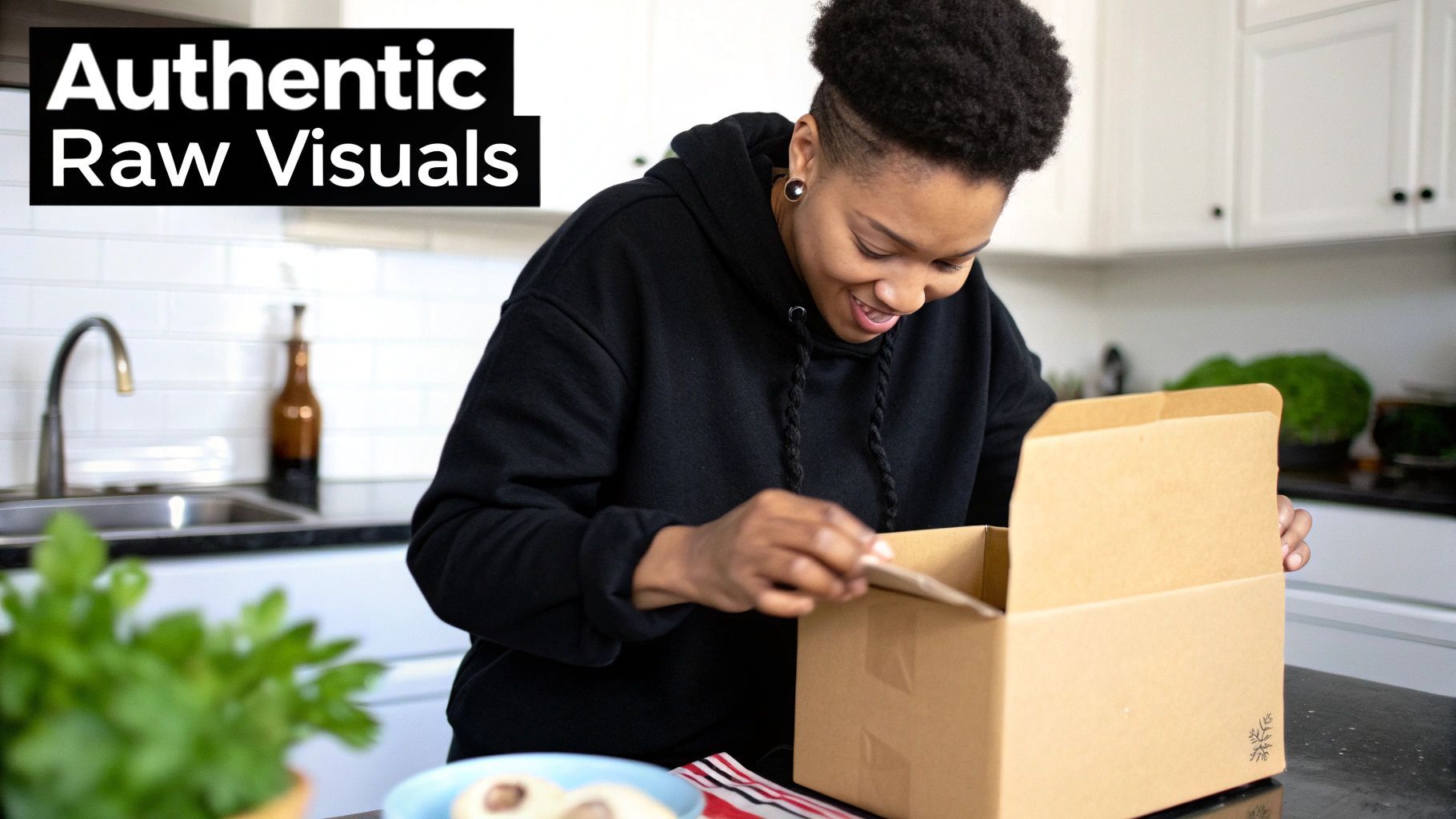
Alright, you've got a script that sounds like a real person wrote it. The next hurdle—and it’s a big one—is creating visuals with that same raw, unpolished energy. This is where so many AI-generated ads stumble and fall flat.
What they often churn out is imagery that's just too perfect. The lighting is flawless, the backgrounds are sterile, and the people look like they walked off a catalog set. That’s the polar opposite of what makes user-generated content actually work.
The trick is to intentionally bake in the subtle imperfections that scream authenticity. You want visuals that look like they were shot on a whim with a smartphone by a happy customer, not rendered in some pristine digital void. This means you have to be very deliberate in how you prompt your ai ugc ads generator.
Prompting for Imperfection and Realism
To sidestep the "uncanny valley," your prompts need to be packed with details that ground the scene in the real world. Forget asking for a generic "person using a laptop." We need to get way more specific about the environment, the mood, and the little details that make a scene feel lived-in.
Think about what makes a space feel real. A slightly cluttered desk, maybe a dog snoozing in the background, or the way sunlight streams through a window—these are the things that add a crucial layer of realism and break the illusion of AI perfection.
- Specify Natural Lighting: Instead of generic light, use terms like “warm morning light,” “overcast day,” or “golden hour lighting.”
- Describe Everyday Settings: Prompt for scenes in a “messy home office,” a “cozy, lived-in kitchen,” or a “park on a sunny afternoon.”
- Request Diverse, Realistic Talent: Ask for “a woman in her late 30s with laugh lines” or “a college student with a casual, relaxed expression.”
The best AI-generated UGC visuals don't try to hide their imperfections; they embrace them. Your job is to prompt the AI to create the kinds of happy accidents and candid moments that make real-life content so compelling.
This careful prompting process is everything. If you're looking for tools to help with this, exploring an AI Social Media Content Generator can show you how different platforms approach visual creation.
Adding Dynamic Movement and B-Roll
Nothing screams "fake" like a perfectly static shot. Real UGC has that slight, natural camera movement—a little shake, a slow pan, a quick zoom. Many of the more sophisticated generators let you add these effects after the fact or even specify them in your initial prompts.
Don't forget to generate some b-roll footage to splice into your main ad. These are the supporting shots that add context and keep things visually interesting. Think close-ups of the product, a screen recording of an app in action, or just a quick cut to the user's reaction.
For an ad promoting a new skincare product, you could combine:
- Main Shot: The user talking to the camera in their bathroom.
- B-Roll 1: A close-up showing the product's texture on their fingertips.
- B-Roll 2: A quick, satisfying clip of the bottle being opened.
Mixing these shots makes the final ad feel much more dynamic and achieves that "professionally amateur" vibe—the sweet spot for authentic UGC. For those wanting to animate still images, looking into an https://shortgenius.com/models/image-to-video can be a great way to create this kind of varied and engaging visual content.
Choosing AI Voices and Captions That Connect
Your visuals might grab their attention, but it's the voice and captions that will keep them watching. Nothing screams "this is an ad" faster than a flat, robotic voiceover. We need to find an AI voice that feels like it truly belongs to the person in the video, making the whole thing feel authentic and trustworthy.
The wrong voice creates an instant disconnect. Think about an ad for a new energy drink narrated by a slow, sleepy voice—it just feels off. The best AI tools now offer a huge library of voice profiles, so you can really dial in the perfect sound for your brand and the specific audience you're trying to reach.
Finding the Right Voice Persona
Treat the AI voice as if you're casting an actor for a role. The choice has to be deliberate, matching the exact vibe you're going for.
- Selling a tech gadget? Go for a clear, confident voice that speaks a bit faster. It conveys expertise and efficiency.
- Promoting a wellness app? A calm, warm, and reassuring tone will build trust and feel more personal.
- Showcasing a new clothing line? You'll want something upbeat, trendy, and conversational—almost like getting a style tip from a friend.
When you're generating the voiceover, don't just dump your script into the text box. Give the AI some direction. Add notes like "(pause for effect)" or "(speak faster here with excitement)" or "(soften tone for this part)." These little tweaks make a world of difference, turning a simple narration into a believable performance.
The best AI voiceovers don't just read words; they perform them. Your job is to direct that performance, guiding the AI on how to say something, not just what to say.
Crafting Social-First Captions
Let’s be real: a ton of people on TikTok and Instagram scroll with the sound off. This makes your on-screen text as critical as the voiceover. Your captions can't just be a word-for-word transcript; they need to be a part of the show.
Thankfully, modern AI video editors are getting really good at this. You should look for tools that offer "social-first" caption styles. I'm talking about the bold, colorful text that animates word-by-word or highlights key phrases—the kind of stuff top creators use. This style makes your ad look like it was made for the platform, not just dropped there.
Here are a few quick tips for captions that work:
- Make Key Words Pop: Use a different color or a bigger font for words like “50% OFF,” “free shipping,” or the main benefit of your product.
- Sprinkle in Emojis: The right emoji adds personality and breaks up the text, making it easier to read and more engaging.
- Keep It Short & Sweet: Avoid long blocks of text. Break your sentences into short, punchy phrases that appear on screen in sync with the audio.
By pairing an emotionally resonant AI voice with dynamic, native-looking captions, you're closing the loop on creating truly believable UGC. This two-part punch is a non-negotiable for building campaigns that actually convert. If you want to dive deeper into how this works, check out our guide on text-to-video AI technology.
Scaling Your Campaigns with Smart A/B Testing
Nailing one viral ad is a great feeling. But building a repeatable system that churns out winners? That’s the real goal. This is where an ai ugc ads generator completely changes the game. It turns A/B testing from a slow, expensive headache into a fast, data-backed process. Instead of waiting weeks for a new creative, you can spin up dozens of variations in a single afternoon.
That kind of speed means you can finally test every little thing that makes an ad work. The difference between a decent ad and a campaign-saving performer can be as small as the first three words of your hook. With AI, you can actually afford to test those subtle but powerful variables at scale.
This flow is all about quick, iterative improvements. It's a simple loop of refining the script, tweaking the voice, and polishing the captions before you even think about spending a dollar on traffic.
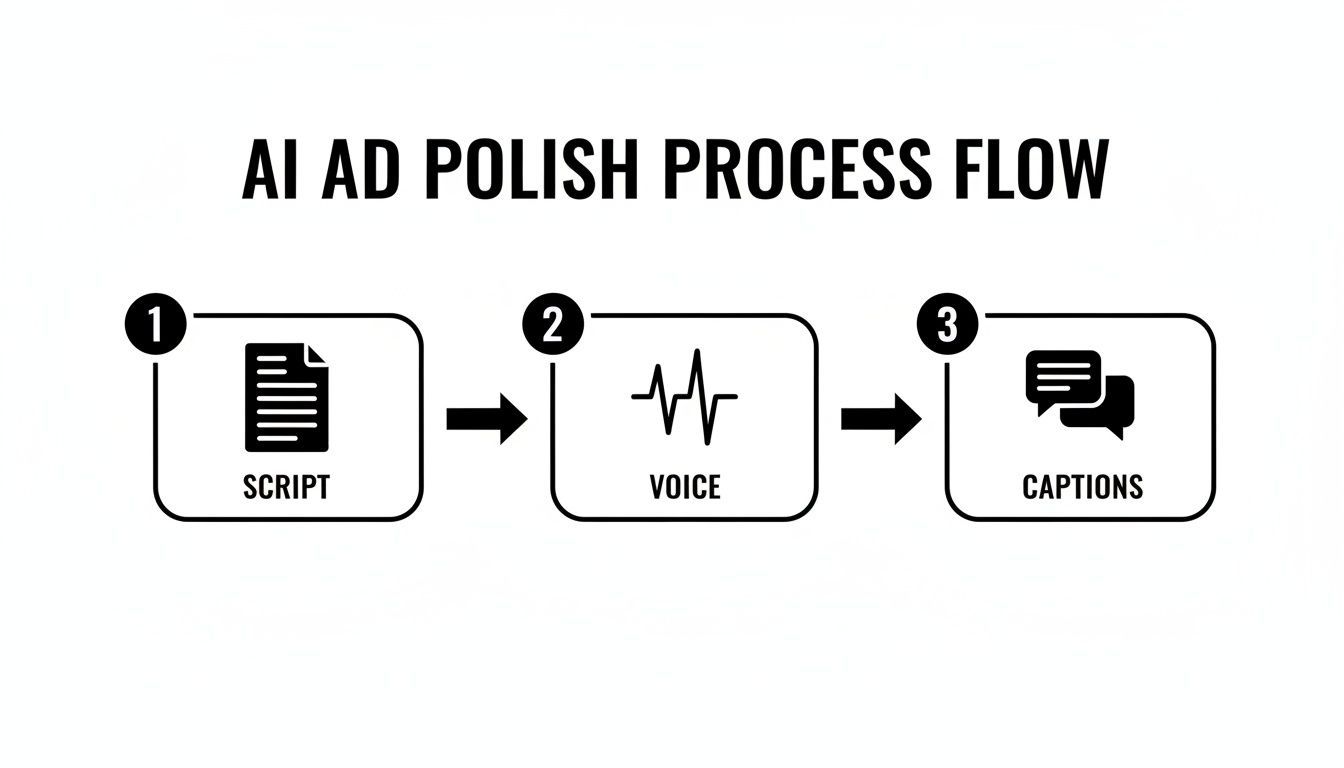
Think of it this way: script, voice, and captions are your three core levers. Each one is a chance to test something new and find what resonates with your audience before going live.
Identifying Your Key Testing Variables
To get clean results from your A/B tests, you have to be disciplined. Don't throw everything at the wall to see what sticks—that just muddies your data and leaves you guessing why something worked. Isolate one variable at a time.
Start with the elements that tend to have the biggest impact on performance:
- The Hook: Test a problem-first hook ("Is your to-do list a total nightmare?") against a benefit-driven one ("What if you could be done with work by 3 PM every day?"). The first few seconds are everything.
- The Visuals: How does a home office setting perform against an outdoor shot? What about a close-up of the product versus a shot of a person's reaction to using it?
- The Call-to-Action (CTA): This is a classic but crucial one. Pit a direct CTA like "Shop Now" against something a little softer, like "See how it works." The right wording here can make a massive difference in click-through rates.
This isn't just theory; the numbers back it up. We've seen brands using AI to optimize their ads report as much as a 72% higher return on ad spend (ROAS). More specifically, AI-generated creatives have been shown to boost click-through rates by 47% on major ad platforms, which helps slash acquisition costs by an average of 29%. And on a platform like TikTok, where a staggering 90% of users trust UGC, these authentic-style ads are an absolute goldmine. You can dig into more of these AI ad performance stats to see the full picture.
Structuring Your A/B Tests for Clear Results
Once you have your variations, setting up a clean test is straightforward. The best practice is to run your "control" ad (your current best performer) and test just one new variable against it at a time.
My rule of thumb: Run your tests for a fixed period—say, 72 hours—or until each variation hits a statistically significant number of impressions. This stops you from making knee-jerk decisions based on a lucky first day and ensures your choices are backed by real data.
For instance, if you're a skincare brand, your test might look like this:
- Control Ad: Your original, proven video.
- Variation A: The exact same ad, but with a different AI voiceover (maybe one that's more energetic).
- Variation B: The same ad again, but this time with a completely new opening hook.
When the test is done, dive into the metrics that matter: click-through rate (CTR), cost per click (CPC), and of course, conversion rate. The winner becomes your new control ad, and you start the cycle all over again with a new variable. This constant loop of generating, testing, and optimizing is how you turn a single good idea into a predictable, high-performing campaign.
A/B Testing Ideas for Your AI UGC Ads
Not sure where to start? Here are some simple, high-impact variables you can test right away to see what moves the needle for your brand.
| Element to Test | Variation A (Example) | Variation B (Example) |
|---|---|---|
| Hook Angle | Problem-Focused ("Tired of weak coffee?") | Benefit-Focused ("Imagine a perfect brew every morning.") |
| AI Voiceover | Upbeat, energetic female voice | Calm, reassuring male voice |
| Visual Scene | Product in a clean, studio-like setting | Product being used in a real-life kitchen |
| Caption Style | Bold, yellow captions (MrBeast style) | Simple, minimalist white text captions |
| Call-to-Action | Direct ("Get 20% Off Now") | Urgency-driven ("Offer Ends Tonight!") |
| Background Music | Lo-fi, chill background track | Upbeat, trending pop song |
| Video Length | Short & punchy (15 seconds) | More detailed (45 seconds) |
This table is just a starting point. The key is to be systematic. Test one thing, find a winner, make it your new control, and then test the next thing. This methodical approach is what separates the brands that get lucky once from the ones that win consistently.
Common Questions About AI UGC Ad Generators
As marketers start weaving AI into their creative process, a lot of good questions are coming up. The idea of an AI UGC ads generator is definitely exciting, but it also brings up real concerns about authenticity, platform rules, and whether this stuff actually works. Let's break down some of the most common questions I hear.
Think of this technology less like a magic button and more like a new creative partner. Knowing how to work with it is the key to getting the results you want.
Can AI-Generated UGC Ads Truly Look and Feel Authentic?
Absolutely, but it’s not a given—it all comes down to how you steer the ship. What makes user-generated content feel real are its relatable imperfections, not a slick, polished look. The real power of an AI UGC ads generator is your ability to direct those imperfections.
When you're writing scripts, tell the AI to use conversational language. Think casual slang or even adding realistic pauses to make it sound like a real person talking off the cuff. For the visuals, prompt for natural lighting, everyday settings like a kitchen or a messy desk, and a diverse range of people. You’re essentially guiding the AI to mimic the human-centric vibe that makes UGC so powerful to begin with.
How Is a Dedicated AI UGC Generator Different from General AI Video Tools?
This is a great question. While general AI video tools are fantastic for creating cool visuals, a dedicated AI UGC ads generator is built from the ground up for the entire advertising workflow. The biggest difference is having everything you need—scriptwriting, scene generation, voiceovers, and brand-safe editing—all in one place built for marketers.
It's the specialized features that really set them apart and save you a ton of headaches:
- Social-First Caption Styles: These tools know how to create captions that look native to platforms like TikTok and Instagram.
- Brand Kit Implementation: You can instantly apply your brand’s specific fonts, colors, and logos across every video, keeping things consistent.
- Integrated Asset Libraries: All your generated scenes, scripts, and voiceovers live in one central hub, so you're not digging through folders.
These purpose-built features are massive time-savers. They let you focus on the bigger picture—strategy and scaling—instead of getting bogged down juggling five different apps.
What Do I Need to Know About Platform Compliance for AI Ads?
Compliance is non-negotiable, and it’s something you have to take seriously. Big players like Meta and Google are constantly updating their policies, and they now require you to disclose when AI-generated content looks realistic. Your job is to stay on top of the latest ad policies for every single channel you're running ads on.
Often, a simple, low-key disclaimer like #MadeWithAI is all you need to meet the disclosure rules. But beyond that, you still have to make sure your ad's claims, visuals, and overall message follow all the standard advertising guidelines. At the end of the day, you, the advertiser, are always responsible for what you publish.
The core return on investment from AI UGC ads comes from pure efficiency and speed. Instead of shelling out thousands for a single creator video, you can generate and test dozens of ad variations for a tiny fraction of the cost.
This incredible speed lets you find winning creative concepts way faster than you could with traditional methods. We already know from tons of data that UGC-style ads drive higher engagement and build more trust. AI just puts that on steroids by slashing production costs and timelines, which leads directly to a better return on ad spend (ROAS) and a lower customer acquisition cost (CAC).
Ready to create compelling, authentic ads at scale? ShortGenius unifies scriptwriting, visual generation, voiceovers, and scheduling into one powerful platform. Start creating high-performing AI UGC ads today!