What Is an AI Commercial Generator and How Does It Work?

Discover how an AI commercial generator transforms marketing. Learn the tech, workflow, use cases, and best practices to boost your brand's video ROI.
Let's break down what an AI commercial generator really is. Think of it as a complete video production studio packed into a single piece of software. It takes a simple idea, typed out as a text prompt, and turns it into a finished, ready-to-air commercial in just a few minutes.
This whole approach flips the old, painfully slow process of creating video ads on its head.
A Radically New Way to Create Commercials
Remember what it takes to make a single, 30-second TV spot the old-fashioned way? It’s a marathon. You’re looking at weeks of brainstorming and script rewrites. Then comes storyboarding, casting calls, and finding the perfect location. After all that, you have a full day of shooting with a massive, expensive crew, followed by weeks of editing in post-production.
From start to finish, you could easily sink three to six months and tens (or even hundreds) of thousands of dollars into one ad. For most businesses, creating video content at that pace just doesn't work for today's fast-moving digital campaigns.
Now, let’s look at the AI way. A marketing manager types in a simple prompt: "Create a 15-second vertical video ad for our new eco-friendly sneakers, highlighting their comfort and style for a young, urban audience." Before they can finish their coffee, the AI generator spits out a complete video—script, visuals, voiceover, and music included.
From Months of Work to Minutes of Waiting
This isn't just a small step forward; it's a giant leap. When you can generate ads almost instantly, you unlock entirely new ways to approach your marketing strategy.
Instead of pouring your entire budget into one "perfect" ad and hoping it works, you can create dozens of different versions. Test different hooks. Swap out the visuals. Try a new call-to-action. This lets you iterate at lightning speed, find out what your audience actually responds to, and put your money behind the ads that are proven winners.
The benefits of using an AI ad generator are incredibly straightforward:
- Blazing Speed: Go from a simple idea to a finished commercial in minutes, not months.
- Huge Cost Savings: Forget about paying for production crews, actors, locations, and expensive gear.
- Scale on Demand: Create unique video ads for every social platform, audience segment, and product in your catalog without hiring a single person.
This shift levels the playing field. A small startup can now churn out a volume of high-quality video ads that, until recently, was only possible for Fortune 500 companies with massive marketing teams.
The difference between the two workflows is pretty stark. Here’s a quick look at how the timelines compare.
Traditional vs AI Commercial Generation
This table shows just how much time and effort AI generators can save at every stage of the creative process.
| Phase | Traditional Process | AI Generator Process |
|---|---|---|
| Concept & Scripting | 2-4 weeks | 2-5 minutes |
| Production & Filming | 1-3 weeks | 5-10 minutes (scene generation) |
| Post-Production | 2-4 weeks | 5-10 minutes (assembly & edits) |
| Total Time | 2-3 Months | Under 30 Minutes |
As you can see, what once took a full quarter to accomplish can now be done in less time than a lunch break. This allows teams to spend less time on manual production and more time on creative strategy.
How an AI Commercial Generator Actually Works
Turning a simple idea into a polished, market-ready commercial might feel like some kind of magic, but it’s actually a well-defined process. Think of an AI commercial generator as a complete production studio crammed into a single piece of software, shrinking a workflow that used to take months into just a few minutes. The whole thing happens in four main stages.
It’s a bit like building a custom car. First, you need the blueprint (the script). Next, you create all the individual parts (the visual scenes). Then, you install the engine and sound system (the voiceover and audio). Finally, you put it all together and give it a final polish.
Stage 1: The AI Director Writes the Script
Everything starts with your idea. You feed the AI a prompt, which essentially serves as your creative brief. This is where you outline the product, who you’re trying to reach, the core message, and the overall vibe you're going for. For example: "Create a 15-second TikTok ad for a new vegan protein powder. Target gym-goers and make it high-energy and motivational."
From there, the AI's Natural Language Processing (NLP) model gets to work. It doesn't just string words together; it analyzes your request, figures out your intent, and generates a punchy script. It draws on its training from thousands of successful ad campaigns to build a narrative that has a hook, a clear value proposition, and a strong call-to-action (CTA). In seconds, you have a full script and a rough storyboard ready to go.
Stage 2: Visuals and Scenes Come to Life
Once the script is locked in, the generator starts creating the visuals. This is where diffusion models—the same tech powering popular AI image tools—come into play. The AI reads each line of the script and generates video clips or images to match.
This stage is like having an automated film crew. The AI acts as the director, cinematographer, and set designer all at once. It picks the camera angles, sets the lighting, and fills the scenes with the right objects and backgrounds. If your script calls for a shot of someone enjoying a protein shake at the gym, the AI creates that specific scene from scratch, making sure the visual style stays consistent with your original prompt.
Key Takeaway: The AI isn't just grabbing clips from a stock video library. It creates original, custom visuals for your script, giving you unique assets for every single campaign.
Stage 3: Adding Voice and Sound
A silent commercial isn’t going to grab anyone’s attention, so the next step is adding audio. Modern Text-to-Speech (TTS) technology is miles ahead of the robotic voices we used to hear. Today's AI can produce incredibly natural-sounding voiceovers in different languages, accents, and emotional tones.
You can tell the AI you want a "friendly and upbeat" female voice or a "deep and authoritative" male voice. The system then synthesizes the voiceover and syncs it perfectly with the visuals. At the same time, the AI will find royalty-free background music that fits the commercial's mood—maybe an energetic track for a fitness product or a calming melody for a wellness app. Getting the voice and music right is what sets the emotional tone.
This flowchart really puts the difference into perspective, showing the old-school workflow right next to the streamlined AI process.
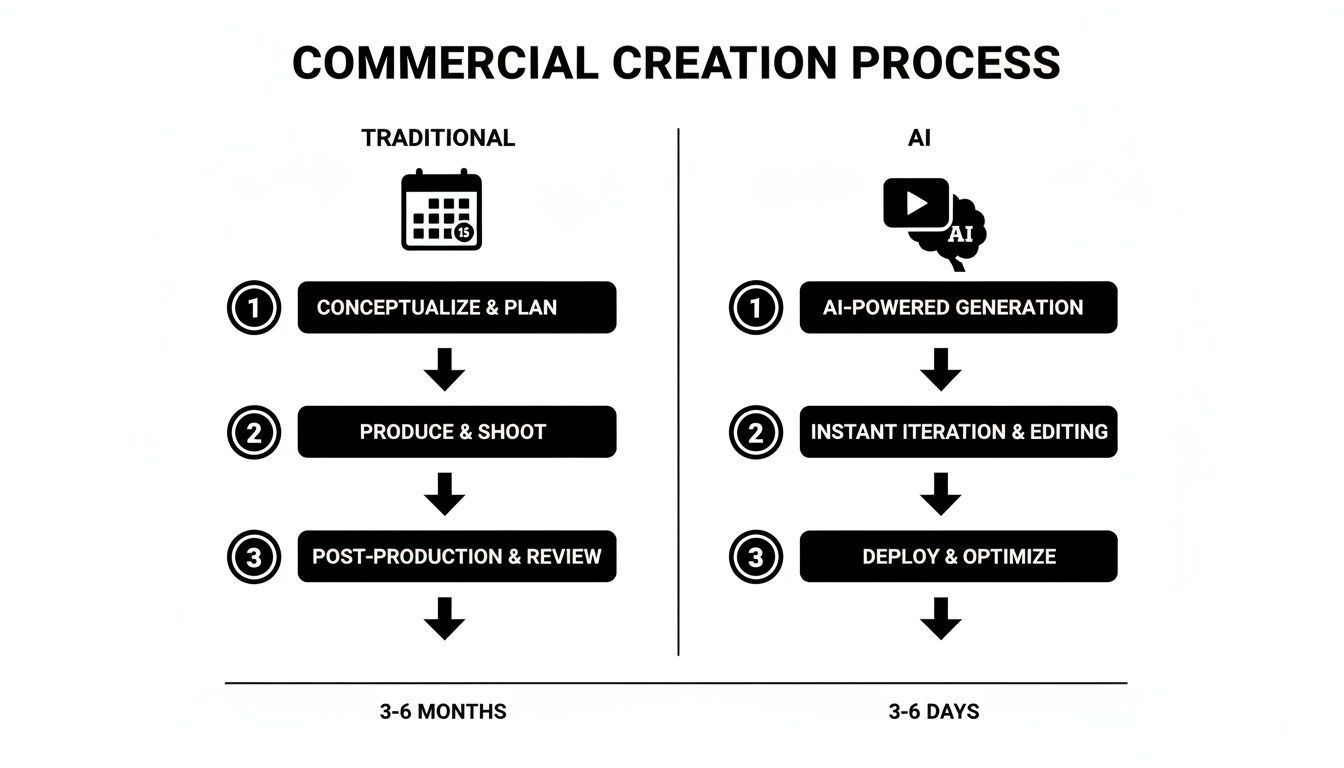
As you can see, AI takes several long, separate stages and collapses them into one automated workflow, cutting down timelines from months to just a few days or even hours.
Stage 4: Final Assembly and Post-Production
In the last stage, the AI brings everything together. It acts like a skilled video editor, assembling the scenes, syncing the audio, and adding all the professional finishing touches.
This automated post-production handles a lot of the tedious work:
- Adding Dynamic Text Overlays: Key messages or special offers are layered onto the video.
- Generating Captions: It automatically creates subtitles, which are crucial for silent viewing on social media.
- Applying Brand Elements: Your logo, brand fonts, and specific colors are integrated seamlessly.
- Optimizing Aspect Ratios: The video is automatically formatted for different platforms, like TikTok (9:16) or YouTube (16:9).
This final assembly relies on sophisticated algorithms to ensure perfect timing and a clean, professional finish. It’s also worth remembering that all of this heavy lifting happens on powerful cloud servers. The infrastructure needed for these AI tasks is massive; the global generator market that powers these data centers is projected to hit USD 67.45 billion by 2034, largely because of the huge computational demands of AI. You can find more insights on this growing market on Precedence Research.
The end result? A complete, launch-ready commercial, all created from a single idea.
What to Look For in a Top-Tier AI Video Tool
Not all AI video platforms are built the same. While plenty of tools can stitch together a basic video, a real AI commercial generator comes loaded with features designed specifically for marketing impact and, ultimately, a solid return on investment. Choosing the right one means looking past the flashy demos and zeroing in on the functions that actually help you stay on brand, work faster, and get your content everywhere.
It's a bit like picking a vehicle. A scooter gets you around the block, sure. But if you need to haul inventory for your business, you're going to need a truck with the right power and cargo space. In the same way, a serious AI video tool is built for the heavy lifting that modern ad campaigns demand.
The image below from ShortGenius shows what this looks like in practice—a central dashboard that brings all your ad formats and performance data into one clean, manageable space.

The big idea here is that a great tool doesn't just make videos; it gives you a command center to create, manage, and see what's working across all your social channels.
Integrated Brand Kits
Brand consistency is everything. People trust brands they recognize, and a consistent look and feel is the bedrock of that recognition. This is why an integrated Brand Kit is probably one of the most important features a generator can have.
This goes way beyond just pasting your logo onto a video. A proper Brand Kit lets you save your core brand assets right inside the platform.
- Logos: Have your primary and secondary logos automatically and correctly placed in every single video.
- Color Palettes: Lock in your brand's exact hex codes so that text, backgrounds, and graphics are always on-point.
- Custom Fonts: Use your brand’s unique typography to keep your voice consistent with all your other marketing.
Using a Brand Kit takes the guesswork and manual effort out of staying on-brand. It's an automation feature that acts as a brand guardian, protecting your identity as you start creating content at scale.
Robust Template Libraries
While starting from a simple text prompt is amazing, sometimes you just need a reliable starting point. A deep template library acts as a creative launchpad, offering you pre-built video structures that are already optimized for specific goals and platforms. To get a better sense of the technology that makes this possible, it's helpful understanding how various AI video generators function and what makes some more suitable for commercial use than others.
A good library isn't just a collection of pretty layouts. It should include templates for all kinds of ads:
- Product explainer videos
- User-generated content (UGC) style ads
- Flash sales and special offer announcements
- Customer testimonial spots
These templates are based on ad formats that have a proven track record of getting results. They give you a strategic shortcut, helping you produce commercials that work even when you're drawing a creative blank.
Multi-Format and Aspect Ratio Outputs
Your audience is scattered across a half-dozen platforms, and each one has its own rules for video. A commercial that looks fantastic on YouTube (16:9) is going to get awkwardly cropped on TikTok (9:16). A powerful AI commercial generator solves this headache with one-click aspect ratio adjustments.
Instead of painstakingly re-editing the same video for every channel, the AI automatically reframes the content. It intelligently repositions text and adjusts scenes to fit perfectly, saving a massive amount of time for any team running multi-channel campaigns.
This capability is non-negotiable for maximizing your reach and making sure your ads look professional everywhere, from Instagram Reels to YouTube Shorts. Our guide on the https://shortgenius.com/ai-ad-generator dives deeper into creating ads for these different formats. With this feature, you can take one core video concept and instantly spin it out into multiple native versions, multiplying your output without multiplying your workload.
How AI Video Makers Actually Help Your Business
Okay, let's move past the technical jargon and talk about what really matters: results. What does an AI commercial generator actually do for a business? It all comes down to speed and scale—two things every marketing team dreams about. It’s about getting more high-quality work done, faster and smarter than ever before.
Picture this: an e-commerce brand is prepping for a huge holiday sale. In the old days, they'd spend weeks and a small fortune creating one or two big-budget ads. Now? They can generate a dozen different video ads in a single afternoon. Each one can test a different angle—a unique product feature, a punchier call-to-action, or a different visual hook to grab attention. This kind of rapid A/B testing lets them see what actually works, so they can put their ad budget behind a winner and watch their return on ad spend (ROAS) climb.
Smarter Campaigns and Better ROI
This ability to test and tweak on the fly completely changes the game. Marketing teams no longer have to cross their fingers and hope a single creative concept lands. Instead, they can let the data guide their decisions.
Here’s where it gets really practical:
- For Real Estate Agents: Imagine creating a unique virtual tour video for every single property listing in just minutes. No videographer needed. You get compelling, personalized content for Zillow and social media instantly.
- For Marketing Agencies: A single account manager can now handle video campaigns for multiple clients at once. They can pump out fresh, on-brand content without needing to hire more people. Talk about scaling.
- For SaaS Companies: Instead of one generic demo, a software company can create targeted videos for each type of user. They can highlight the specific features that matter most to each audience, which helps boost conversions on their landing pages.
This is a massive shift. It gives businesses the agility to jump on trends, launch flash sales, and connect with their audience in real-time. That used to be something only companies with massive budgets could even dream of.
The Impact on Your Bottom Line
This isn't just about being more efficient; it's about real, measurable financial wins. By automating the most tedious parts of video production, companies can drastically cut their cost-per-acquisition (CPA) and launch new campaigns in a fraction of the time.
This is part of a much bigger trend. The market for AI document generators—a similar tool for written content—is projected to skyrocket from USD 13.6 billion in 2025 to an incredible USD 77.4 billion by 2035. That kind of explosive growth tells you just how much value businesses are getting from automating content. You can dig into the numbers yourself in this report on the AI document generator market from Future Market Insights.
The same logic applies directly to video. A brand might see their cost to produce one UGC-style ad drop from thousands of dollars with an agency to just a few bucks with an AI tool. To see exactly how this works for user-generated content, check out our guide on creating amazing AI UGC ads with ShortGenius. These savings mean you can test more, which leads to higher click-through rates (CTR) and lower campaign costs. Suddenly, a great ROI isn't a long-term hope—it's a direct result of using smarter tech.
Crafting AI Commercials That Actually Convert
Having an AI commercial generator in your toolkit is a game-changer, but the tool alone won't get you across the finish line. The real wins come when you blend its incredible speed with smart, conversion-focused creative thinking. It’s about moving past simple prompts to truly direct the AI, guiding it to create content that moves the needle.
Think of yourself as a film director. You wouldn't just tell an actor to "act"—you'd give them a backstory, a specific tone, and clear motivations. The exact same idea applies here. Your prompts are your creative direction, and the quality of your input has a direct line to the quality of the output. The goal isn't just to make ads that look good, but ads that get people to act.
Start with a Crystal-Clear Goal
Before you type a single word, you have to know what you’re trying to achieve. Is it more website clicks? App installs? Or are you just trying to get your brand name out there? Your main objective will shape every decision you make, from the script’s opening hook to the final call-to-action.
A fuzzy goal will always lead to a fuzzy commercial. Instead of asking for "a cool ad," be precise. For instance: "Create a 15-second TikTok ad designed to get women aged 25-35 to sign up for our new fitness app." That kind of clarity gives the AI the guardrails it needs to build something that actually works.
The growth in this area is just mind-boggling. The market revenue for generative AI—the technology powering these tools—is expected to jump from USD 16 billion in 2024 to a staggering USD 85 billion by 2029. This explosive growth tells you everything you need to know about how essential these tools are becoming. You can dig into the data behind this explosive AI market growth on S&P Global.
Master the Art of the Prompt
Learning how to write a good prompt is probably the single most important skill for using an AI commercial generator effectively. Your instructions need to be rich, descriptive, and full of detail.
Let's look at a quick "bad vs. good" example:
- Bad Prompt: "An ad for our new coffee."
- Good Prompt: "A cozy, 10-second vertical video ad for our new ‘Morning Rush’ dark roast coffee. Show a person happily sipping coffee on a misty morning balcony. Use warm lighting and an upbeat, gentle acoustic soundtrack. End with the text overlay: ‘Your perfect morning starts here.’"
See the difference? The second prompt paints a complete picture, leaving far less up to guesswork.
Pro Tip: Your first draft is almost never your final draft. Don't be afraid to experiment. Use what the AI gives you as a starting point, then tweak the script, try out a different scene, or test a new voiceover until it feels just right.
Keep It Punchy and Add a Strong CTA
Let's be real: attention spans are shorter than ever. You have about three seconds to grab someone's attention and stop their scroll. Keep your sentences short, your message focused, and get straight to the point.
And most importantly, every single commercial needs a clear, compelling call-to-action (CTA). Don't just let the video fade to black. Tell your audience exactly what you want them to do next.
- Weak CTA: "Check us out."
- Strong CTA: "Tap 'Shop Now' to get 20% off your first order!"
When you combine a clear goal with detailed prompts and a direct CTA, you turn your AI commercial generator from a simple content-making tool into a genuine conversion machine.
Accelerating Your Workflow with ShortGenius
It’s one thing to understand the moving parts of an AI commercial generator, but it’s another thing entirely to actually use one to grow a business. This is exactly where a dedicated platform like ShortGenius comes in. It's built to bridge that gap between a great idea and a finished video ad that gets results.
Plenty of tools can spit out a generic video, but ShortGenius was clearly built with performance marketing in mind. It simplifies the whole script-to-video process into a workflow that makes sense for marketers and founders, not necessarily for professional video editors. The focus is on getting you from A to B quickly so you can spend your time on campaign strategy, not fighting with confusing software.
The platform is designed around smart automation that directly impacts your ROI. Need to test 10 different hooks, 5 different visuals, and 3 calls-to-action? Instead of a week-long project, you can generate all those variations at once. This kind of rapid A/B testing is how you find out what your audience really responds to and stop wasting ad spend on guesses.
Built for Marketers, Not Editors
The whole idea behind ShortGenius is speed and ease of use. You shouldn't need a degree in video production to create a commercial that looks professional and drives sales. The platform walks you through everything, from brainstorming the first script to exporting the final ad.
This user-friendly approach means your whole marketing team can get up and running fast, pumping out more video content without hiring more people or getting stuck in a technical bottleneck. A few key features are designed to take the friction out of the creative work:
- AI-Powered Scripting: Feeds the AI your product info and campaign goals to get back compelling ad scripts.
- Automated Scene Creation: Instantly turns that script into a series of dynamic scenes with relevant visuals.
- One-Click Brand Kits: Keeps your videos consistent by applying your brand's logos, fonts, and colors across everything with a single click.
A Strategic Partner for Scaling Content
Think of ShortGenius less as a single tool and more as an engine for your entire content strategy. As your brand grows, the demand for fresh, engaging video content feels almost endless. This is where automation becomes your best friend, letting you refresh winning ads or create new versions without starting over from square one every time.
ShortGenius helps you shift from making ads one at a time to building an automated system for video creation. That change is crucial for keeping up in today's fast-moving market.
By pulling all the necessary steps into one place, the platform multiplies the impact of your marketing efforts. A great way to get even more mileage out of a tool like this is to repurpose long-form content into engaging shorts without losing what made the original great. This mindset ensures every podcast, webinar, or blog post can become a powerful new ad.
Got Questions About AI Commercial Makers? We've Got Answers.
Jumping into any new piece of technology, especially one as powerful as an AI commercial generator, is bound to raise a few questions. It’s smart to be curious about quality, brand control, and what it actually takes to get your first video out the door.
Let's walk through some of the most common things people ask. Think of this as the quick-start guide to clearing up any confusion and getting you comfortable with the whole process.
How Do I Keep My Branding Consistent?
This is probably the biggest question on every marketer's mind. You've spent years building a specific look and feel, and the last thing you want is an automated tool messing it up. The best platforms solve this with a feature often called a Brand Kit.
This isn't just about uploading a logo and calling it a day. A real Brand Kit is your command center for all things visual. You set it up once, and you're good to go.
- Logos: Upload your official logos for any situation.
- Colors: Lock in your exact brand color palettes using hex codes.
- Fonts: Add your custom brand fonts to keep all text on-point.
Once you’ve done this, the AI acts like a brand manager on autopilot. Every single video it generates will automatically pull from these assets, ensuring every background, title card, and logo pop-up is perfectly aligned with your guidelines. No more chasing down the right hex code or font file.
It's a simple concept, but it's a game-changer. You can pump out dozens of ads knowing an off-brand color or the wrong font will never accidentally slip through.
Can AI-Made Commercials Really Look Professional?
It's a fair question. Let's be realistic: if you're trying to produce a Super Bowl ad with a famous director, you're still going to need a human crew. But for the world of digital advertising? AI is already there, and it’s getting better every single day.
For the ads that run your business—the ones on TikTok, Instagram Reels, and YouTube—the quality from a top-tier AI commercial generator is often indistinguishable from what a small agency would produce. You get that polished, professional look without the six-figure budget or three-month timeline. The goal isn't to replace Hollywood; it's to give you the power to create effective, high-quality digital ads whenever you need them.
What Kind of Skills Do I Need to Use This?
Here’s the best part: you don’t need to be a video editor, a graphic designer, or a film school grad. Not even close. These tools were built from the ground up for marketers, founders, and people who are focused on growing a business, not on learning complex software.
The experience is usually built around simple text prompts and maybe some drag-and-drop. The most important skill you already have: knowing your business. If you know who you're trying to reach and what you want to say, you have everything you need to guide the AI. Your real skill lies in writing a clear, descriptive prompt—not in mastering timelines and keyframes.
Ready to see how an AI commercial generator can speed up your marketing without the headaches? With ShortGenius, you can take an idea and turn it into a campaign-ready video in just a few minutes.