AI Actors vs Human Influencers for UGC Ads an In-Depth Guide

Explore our guide on AI actors vs human influencers for UGC ads. Compare costs, authenticity, and performance to choose the best strategy for your brand.
At the end of the day, the choice between AI actors and human influencers for your UGC ads boils down to one thing: scalability versus authenticity.
AI-powered tools like ShortGenius give you incredible speed and efficiency, letting you crank out and test countless ad variations without breaking the bank. On the other side, human influencers bring a genuine, trust-building connection that’s tough for any machine to fake. The right move depends entirely on your campaign's main goal—are you chasing quick, data-driven wins or building a brand that lasts?
AI vs. Human Creators: The New UGC Battleground
This is the big question on every performance marketer's mind right now. Should you use an AI actor or a real human influencer for your User-Generated Content (UGC) ads? It's a critical decision, especially if you're trying to scale your campaigns on TikTok, Instagram, and Meta. This isn't just a tech trend; it’s a strategic choice that forces you to balance ruthless efficiency with real human connection to get the best bang for your buck.
We'll get into the weeds of how AI delivers speed and savings versus how human creators build genuine trust and community. My goal here is to give you a solid framework, some real-world examples, and clear advice to help you decide which approach—or maybe even a mix of both—will get you the results you need.
What's the Real Difference?
At its core, the AI actors vs. human influencers for UGC ads debate is about two totally different ways of creating value. Each has its place, and figuring out which one fits your strategy is the first step to making the right call.
-
AI Actors: Think of these as hyperrealistic digital personas created by platforms like ShortGenius. Their superpower is scale. You can generate hundreds of ad variations—different hooks, calls-to-action, even different "actors"—in a fraction of the time and for a fraction of the cost of a human shoot.
-
Human Influencers: These are real people, plain and simple. They have their own audience, their own credibility, and their own voice. Their magic lies in telling authentic stories, building a real community, and making people genuinely trust your product.
The question we should be asking isn't just "Who should make our ads?" It’s "What are we trying to achieve with this campaign?" Are you focused on rapid-fire creative testing to find a winning formula? Or are you playing the long game, building a brand people love and trust?
This table lays out the fundamental trade-offs:
| Feature | AI Actors (e.g., ShortGenius) | Human Influencers |
|---|---|---|
| Superpower | Speed, cost, and massive scale for testing | Authenticity, trust, and community engagement |
| Best Use Case | Performance marketing, A/B testing, direct-response ads | Brand awareness, product launches, building loyalty |
| Turnaround Time | Minutes to hours | Days to weeks |
| Cost | Low-cost subscription or per-video fee | Higher, variable fees (based on reach, deliverables) |
| Creative Control | Total control over every detail: script, tone, appearance | Limited control; you're relying on the creator's style |
| Brand Safety | Low risk; outputs are predictable and on-brand | Higher risk; potential for off-brand messaging or PR issues |
The Unmatched Scalability and Speed of AI Actors

In performance marketing, speed is everything. It's not just a nice-to-have; it's the difference between winning and losing. This is where AI actors completely rewrite the rulebook. When you're weighing ai actors vs human influencers for ugc ads, the sheer ability of AI to produce content at a pace and volume humans can't touch is its most compelling feature.
Think about the old way of doing things. Sourcing human UGC is a slow, manual grind: find creators, negotiate deals, write briefs, wait for drafts, give feedback, and finally get the video. This entire dance can easily take weeks just to get a few ads out the door.
An AI platform like ShortGenius takes that timeline and crushes it from weeks into mere hours. A single person can generate dozens—or even hundreds—of ad variations in one afternoon. This isn't just a small step forward; it's a total reinvention of how we approach creative testing and campaign optimization.
The Power of Iterative Testing at Scale
The real magic of this speed is the freedom it gives you to test everything, and I mean everything, at a massive scale. You no longer have to rely on gut feelings about which hook or call-to-action will land. You can test them all at once and let the data tell you what works.
This rapid iteration cycle means you find your winning ads exponentially faster. A human creator might give you a couple of takes on a script. With AI, you can generate fifty versions, each with a tiny tweak aimed at a different audience segment or psychological trigger.
The ability to generate and test creative at scale is the single greatest advantage of AI actors. It transforms advertising from an art based on intuition into a science based on data, allowing you to discover what truly resonates with your audience with statistical certainty.
Let's break down what this looks like for a single campaign. Imagine testing:
- Ten different opening hooks to see which one actually stops the scroll.
- Five unique value propositions to pinpoint the most persuasive benefit.
- Three distinct calls-to-action to optimize for clicks versus sign-ups.
- Four different AI actors with varying looks to match your target personas.
Do the math: that's 600 unique ad creatives. Trying to manage a human-led campaign of this size would be an absolute logistical and financial nightmare. With AI, it’s just a standard workflow. This is precisely where a text-to-video generator becomes an indispensable part of a modern marketer's toolkit.
Driving Down Costs While Boosting Performance
This kind of scale has a direct, and massive, impact on your bottom line. By quickly identifying what works and pouring your budget into the winners—while immediately cutting the losers—you make your campaigns drastically more efficient. The result is a real, measurable improvement in key metrics like Cost-Per-Click (CPC) and Cost-Per-Result (CPR).
And this isn't just theory. The data is already backing it up. Brands leaning into AI-generated UGC are seeing incredible performance lifts. One analysis found AI UGC campaigns generated engagement rates up to 350% higher than human-made videos. On TikTok, the difference was stark: 18.5% engagement for AI versus just 5.3% for humans. These same AI campaigns also delivered 4× higher click-through rates and cut CPC almost in half.
Another case study reinforced this, showing AI video ads achieved a 28% lower CPR and a 31% lower CPC compared to the brand's best-performing human UGC. This kind of efficiency levels the playing field, allowing businesses of any size to execute high-volume ad strategies without needing a huge creative team or an astronomical budget.
The Power of Human Connection: Authenticity and Trust
AI actors have a clear edge in efficiency, no doubt. But they operate on logic and data, not emotion and trust. This is where human influencers still hold a powerful, and frankly, irreplaceable advantage. When you're weighing AI actors vs human influencers for UGC ads, you have to remember that a real human connection is what builds lasting brand equity.
Today's consumers are incredibly savvy. They can sniff out a scripted performance from a mile away. It's the real person sharing their genuine story—how a product actually solved a problem for them—that creates a bond AI just can't touch. That raw authenticity is the bedrock of trust.
Think about it: when an influencer puts their reputation on the line for a product, their audience sees it as a legitimate endorsement from someone they already follow and respect. That borrowed credibility is often far more persuasive than the most polished AI-generated ad, turning casual viewers into actual brand fans.
Building Communities, Not Just Audiences
Human influencers do more than just broadcast a message; they actively cultivate communities. They jump into conversations, reply to comments with personal stories, and build real relationships over time. This back-and-forth fosters a sense of belonging that you simply can't manufacture.
An AI actor can nail a script flawlessly, but it can't share a laugh in the comments or offer a thoughtful, heartfelt reply to a question. That two-way communication is what makes a brand feel real and accessible.
The true value of a human influencer isn't just their follower count; it's the trust they've meticulously built with their community. For a brand, that trust is pure gold, turning a single purchase into long-term advocacy.
Here’s a practical example: an AI actor can list the features of a new skincare product. A human influencer, on the other hand, can take you on their personal skin-clearing journey over several weeks. That lived-in experience, complete with all its imperfections and genuine excitement, is what truly sells.
The Undeniable Edge in Emotional Resonance
And the data backs this up. The human touch delivers tangible results, especially on platforms like Instagram and TikTok where authenticity is everything. While AI can certainly drive clicks, human influencers are masters at creating the kind of raw, emotional engagement that actually sticks with people.
For instance, recent studies show a staggering gap. Human influencer posts can pull in an average of over 414,000 likes, a figure that's 5.8 times higher than what AI influencers typically see. This isn't just for organic content, either. For sponsored posts, human-led content generates 2.7 times more engagement, proving its superior power to captivate and persuade. This emotional connection is a massive differentiator when considering AI actors vs human influencers for UGC ads. You can dig deeper into these findings on Superagi.com.
This difference in performance is even reflected in how much they earn. Real influencers command much higher rates per post, which shows the premium that brands are willing to pay for that genuine human connection. It's an investment that often pays dividends in higher-quality engagement and fierce brand loyalty.
Brand Safety and Relatability
Working with human influencers also provides a unique kind of brand safety that's rooted in pure relatability. A trusted human face can handle sensitive topics or complex product categories with a nuance an AI would struggle with. Their ability to deliver a message with empathy and understanding can make or break a campaign.
Of course, human creators have their own risks, but picking the right partner means aligning your brand with a real person whose values mirror your own and those of your target audience. That alignment builds incredible credibility and makes your brand feel less like a corporation and more like a friend. For top-of-funnel campaigns designed to build awareness and trust, that human connection is almost always worth the investment.
When you're trying to create UGC-style ads, you're faced with a big decision: should you use an AI actor or a real human influencer? One offers incredible efficiency, the other an undeniable human touch. The right choice really hinges on what you’re trying to achieve with your campaign.
Let's break down this choice across a few critical areas to help you figure out which path makes the most sense for your brand. We'll go beyond a simple pros and cons list and dig into the real-world implications of each option, from cost and speed to the nuances of audience trust and legal headaches.
Cost and Speed
Right off the bat, the most significant difference between AI and human creators is the time and money involved.
-
AI Actors: The big win here is efficiency, hands down. With a platform like ShortGenius, you can go from an idea to a finished ad in a matter of hours, not weeks. Costs are predictable—usually a flat subscription fee—which means you can create dozens, or even hundreds, of ad variations without your budget spiraling out of control. This completely changes the game for A/B testing.
-
Human Influencers: Going the human route is a different beast entirely. The costs are much higher and can swing wildly, from a few hundred bucks to tens of thousands of dollars for a single video. The process is also a slow grind of negotiations, contract signing, shipping products, and back-and-forth feedback that can easily drag on for weeks.
For campaigns where getting to market fast and testing a ton of creative ideas is the top priority, AI actors offer an almost unbeatable advantage. The ability to test hundreds of angles for less than the cost of one human influencer is a massive unlock for performance-focused teams.
Scalability and Creative Control
What happens when an ad starts working? Your ability to scale that success and keep control over your message looks very different with AI versus a human.
-
AI Actors: The scalability is practically infinite. Once you find a script that converts, you can instantly spin up countless variations with different AI actors, backgrounds, or voice tones. You also have 100% creative control. Every word, every pause, every visual element is exactly as you designed it.
-
Human Influencers: Scaling with people is a manual, one-by-one process. If you want more ads, you have to find and hire more influencers, starting the whole cycle of outreach and briefing all over again. You also give up a good deal of creative control. You’re collaborating, which means you have to trust their style will mesh with your brand’s voice.
Authenticity and Trust
While AI nails the logistics, nothing beats a real person when it comes to building a genuine connection with an audience.
-
AI Actors: They're getting incredibly realistic, but AI can still sometimes trip into the "uncanny valley," feeling just a little off to a sharp-eyed viewer. The authenticity is manufactured, which works perfectly for direct-response ads but isn't as effective for building long-term brand love.
-
Human Influencers: This is where they truly shine. A real person sharing a real opinion builds instant credibility. Their followers already know, like, and trust them, and that trust naturally extends to the products they recommend. That organic authenticity is something an AI simply can't fake.
A Detailed Look: AI Actors vs. Human Influencers
To really see the differences side-by-side, let's break down how each stacks up across the metrics that matter most for UGC ads.
AI Actors vs. Human Influencers Detailed Comparison for UGC Ads
| Criterion | AI Actors (Using Platforms like ShortGenius) | Human Influencers |
|---|---|---|
| Cost Per Creative | Extremely low; often part of a flat-rate subscription. | High and variable; ranges from hundreds to thousands of dollars per video. |
| Production Speed | Extremely fast; from concept to final video in hours. | Slow; can take several weeks for sourcing, briefing, and revisions. |
| Scalability | Virtually unlimited; create endless variations instantly. | Linear and manual; requires hiring new influencers for each new creative. |
| Creative Control | 100% control over script, visuals, and delivery. | Collaborative; requires trusting the influencer's creative style and interpretation. |
| Authenticity | Synthetic; can be effective but may lack genuine human connection. | Organic and high; based on pre-existing trust between the influencer and their audience. |
| Engagement Type | Best for driving direct-response actions (clicks, conversions). | Excels at building brand affinity, community, and positive sentiment. |
| Performance Data | Enables rapid, data-driven testing and optimization at scale. | Performance can be unpredictable and harder to A/B test systematically. |
| Brand Safety Risk | Very low; eliminates risks of personal scandals or off-brand content. | Moderate to high; brand is tied to the influencer's personal reputation. |
| Legal Compliance | Requires clear disclosure of AI generation. | Requires strict adherence to FTC disclosure rules for sponsored content. |
This table makes it clear that the "better" option is less about which one is superior overall and more about which one aligns with your specific campaign goals—whether that's rapid, data-driven performance or deep, authentic brand building.
Brand Safety and Legal Considerations
Finally, don't overlook the operational risks and legal hoops that come with each choice.
-
AI Actors: This is a much safer, more controlled environment. The output is predictable, so you don’t have to worry about an influencer going off-script, getting into a personal scandal, or posting something controversial. The main thing to watch for is transparency—disclosing that the content is AI-generated is quickly becoming a requirement on many platforms. If you're looking to turn your existing product shots into compelling ads, an image to video generator fits perfectly into this safe, controlled workflow.
-
Human Influencers: With people comes unpredictability. A creator's personal life can suddenly become a PR nightmare for your brand. On the legal side, you have to be vigilant about FTC guidelines, which require crystal-clear disclosure of sponsored posts. If they mess it up, both the influencer and your brand can face penalties. This means you need solid contracts and a thorough vetting process.
Choosing Your Strategy: When to Use AI and When to Use Humans
So, where does this leave us in the ai actors vs human influencers for ugc ads debate? It’s not about picking a winner. The real skill is knowing which tool to pull out of the toolbox for the job at hand. Your campaign goals should be your guide, telling you whether you need the raw efficiency of AI or the genuine connection of a human creator.
To make this crystal clear, think of it as a fork in the road. One path leads to performance-driven results, the other to brand-building.
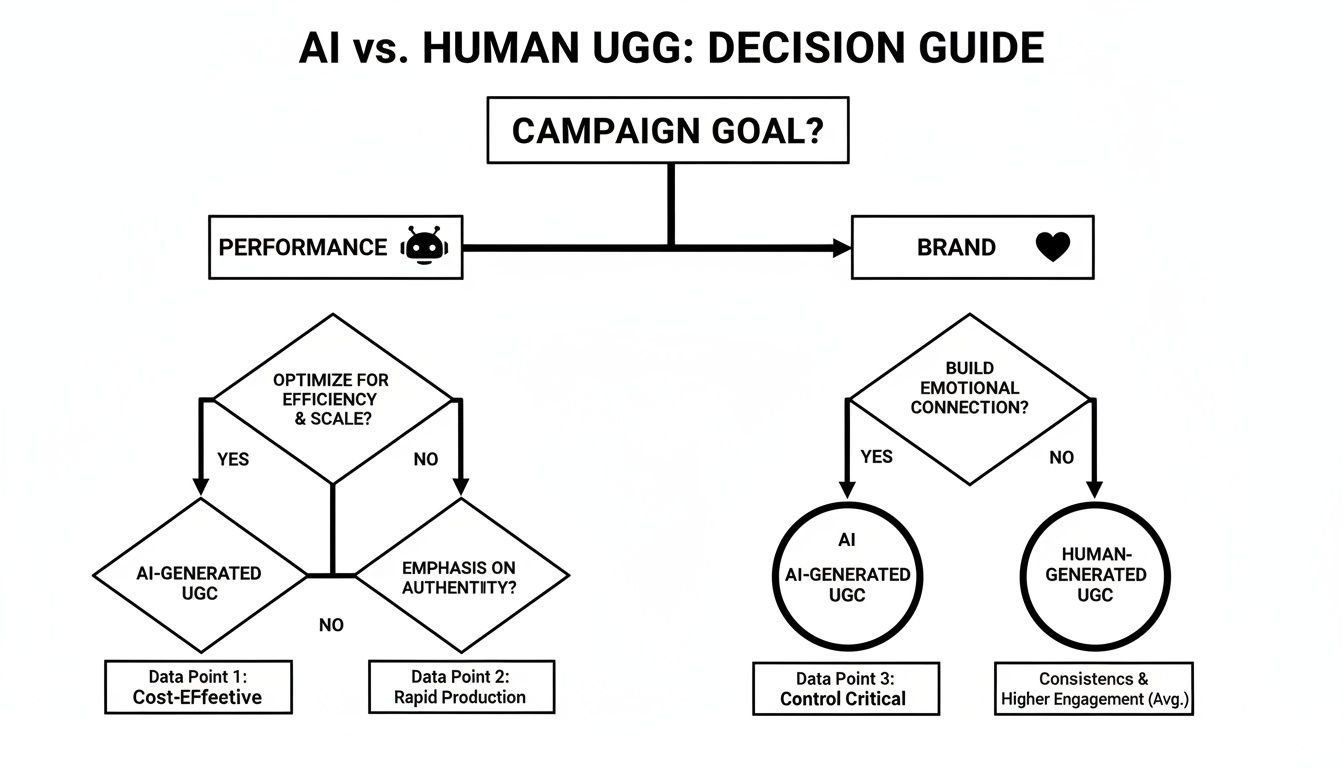
This visual breaks it down perfectly. If you're chasing hard numbers and high volume, AI actors are your workhorse. If you're building a brand people love, human influencers are your ambassadors.
When to Deploy AI Actors for Maximum Impact
Think of AI actors as your ultimate performance marketing engine. Their sweet spot is speed, scale, and cost-efficiency. You should lean on AI when your goals are tied directly to measurable actions like clicks, leads, and sales.
AI actors are the obvious choice for these scenarios:
- Aggressive A/B Testing: Need to test ten different hooks, five calls-to-action, and three value props by tomorrow? AI is your only real option. It allows you to let the data tell you what works, taking the guesswork out of creative optimization.
- High-Volume Performance Marketing: For campaigns laser-focused on driving conversions, you need a constant stream of new creative to combat ad fatigue. AI can pump out variations faster than any human team, keeping your results from going stale.
- Rapid-Response Campaigns: Did a trend just pop off on TikTok? Need to get a flash sale live now? AI lets you go from an idea to a live ad in hours, not the days or weeks it takes to coordinate with a human creator.
When your success is measured in clicks, conversions, and cost-per-result, the sheer volume and testing capability of AI actors provide a decisive advantage. They turn ad creation into a scientific process of iterative improvement.
When to Partner with Human Influencers for Brand Building
While AI is crushing performance, human influencers are the undisputed champions of brand equity. Their value isn't just in the click; it's in the trust, community, and feeling they build around your product. You absolutely want a human creator when your goals are bigger than a single transaction.
Human influencers are the right call for:
- Top-of-Funnel Brand Awareness: When you’re introducing your brand to a cold audience, a trusted human face is like a warm handshake. It provides instant credibility that an AI simply can't fake.
- Building Community and Trust: If you want to cultivate a loyal following, you need influencers. They spark real conversations and make their audience feel like part of something special—a community, not just a customer list.
- Campaigns Requiring Emotional Resonance: For products that tap into personal stories, heartfelt testimonials, or sensitive topics, you need genuine human empathy. That’s a connection an AI can’t replicate.
A Powerful Hybrid Strategy: Combining Both Worlds
The smartest marketers I know don't choose one or the other. They use both. A hybrid approach uses the strengths of each to create a workflow that’s both authentic and incredibly scalable.
Here’s a simple way to think about it:
- Source Authentic Material: Start by partnering with a real human influencer. Get them to create a genuine piece of content, like an unboxing video or an honest product review. This is your foundation of trust.
- Leverage AI for Scale: Take that single, human-made video and feed it into a platform like ShortGenius. This is where you multiply your efforts.
- Test and Optimize: Now, you can use AI to create dozens of variations. Test new hooks, re-edit the footage for different platforms, and add AI voiceovers to hit different angles. You're scaling the reach of that core, authentic message far beyond what a single video could ever do.
This hybrid model truly delivers the best of both worlds: the undeniable trust that comes from a real person, combined with the ruthless testing and optimization power of an AI platform.
Executing Your UGC Strategy with an AI Platform
Knowing the strategic differences between AI actors and human influencers is a great start, but it's only half the job. Now comes the hard part: execution. This is where you turn those insights into high-performing ad campaigns that actually move the needle, and where a powerful AI platform becomes an indispensable part of your toolkit. Tools like ShortGenius are built to bridge that exact gap between a solid concept and a real conversion.
Instead of getting bogged down in the often complex and time-consuming back-and-forth of human creator collaborations, an AI platform gives you a direct, streamlined path to creating content. Think of it as your own in-house production studio, ready to handle everything from brainstorming initial ideas to adding the final polish that makes an ad click.
Generating Compelling Ad Concepts and Scripts
Every great ad starts with a solid creative idea. Platforms built for AI ad creation help you get past that intimidating blank page by generating compelling scripts and hooks on demand. You just feed it your product details and describe your target audience, and the AI will spit out a range of script options designed specifically for direct-response marketing.
This process lets you rapidly test multiple angles for the same product. In minutes, you can have a humorous script, a problem-solution script, and a benefit-driven script ready to go, giving you a diverse creative arsenal without weeks of brainstorming meetings. While AI actors are a key component, a truly robust UGC strategy also involves exploring various AI content tools to sharpen every stage of production, from ideation all the way to optimization.
Producing UGC-Style Videos with AI Actors
With a script in hand, the platform makes it surprisingly simple to bring it to life with an AI actor. The whole process is incredibly straightforward:
- Select Your AI Actor: Browse a library of diverse, AI-generated personas to find one that genuinely resonates with your target demographic.
- Apply Voiceovers: Generate a natural-sounding voiceover directly from your script. You can even tweak the tone and pacing to get it just right.
- Add Captions and Effects: The platform can auto-generate synchronized captions and layer on creative effects like "Scroll Stoppers" designed to hook viewers in those crucial first three seconds.
This kind of workflow gives a single marketer the power to do what used to require a whole team—a copywriter, a videographer, and a video editor. The focus completely shifts from managing logistics to making smart, strategic decisions about creative testing.
Resizing and Repurposing for Continuous Testing
One of the most persistent headaches for modern advertisers is creating content that looks and feels right on every single platform. A good AI tool solves this problem by making repurposing a breeze. You can take one master video and instantly resize it into the perfect formats for TikTok (9:16), Instagram Reels (9:16), and YouTube Shorts (9:16), making sure every ad feels native to the feed it appears in.
This capability is a game-changer for running continuous A/B tests. The moment an ad starts showing promise, you can create a dozen variations in minutes—swap the hook, try a different AI actor, or tweak the call-to-action—and deploy them across all your channels. This iterative cycle of creating, testing, and refining based on real-time data is how you truly maximize your return on ad spend. If you want to see how this works in practice, checking out an AI ad generator will walk you through the entire process, from script to final video.
Common Questions About AI in UGC Advertising
Jumping into AI-generated UGC brings up some fair questions, especially when it comes to brand safety and what's required legally. Let's clear up some of the most common things marketers wonder about when weighing AI actors against human creators.
Do I Have to Disclose That I'm Using an AI Actor in My Ad?
Yes, you absolutely do. Transparency is non-negotiable here.
Platforms like Meta and TikTok are rolling out policies that mandate clear labeling for AI-generated content. You need to make it obvious when an ad uses a synthetic actor to stay compliant and, just as importantly, to keep the trust of your audience.
Failing to do so can make people feel tricked, which is a fast way to tarnish your brand's reputation. The best approach is to use the built-in labels provided by the ad platform or add a simple, clear disclaimer like #AIGenerated in your caption.
Can an AI Actor Actually Come Across as Authentic?
This is a great question. While AI can't feel genuine human emotion, it excels at what I call "functional authenticity." Think about it: for ads focused on performance, an AI actor that gets straight to the point, explains a product's benefits, and shows how it solves a problem can be incredibly persuasive. The authenticity isn't about a personal story; it's about the value you're delivering.
Expert Take: The trick is to match the type of authenticity to your campaign's goal. AI is perfect for functional, solution-focused authenticity. Humans are unmatched for emotional, story-driven authenticity.
So, if your goal is to build a deep, emotional connection at the top of the funnel, a real human influencer with lived experiences is still your best bet. That's a level of trust and connection AI just can't replicate right now.
Is My Brand Image at Risk if I Use AI Actors?
It all comes down to how you use the technology. If you push out low-quality, obviously fake, or misleading AI ads, then yes, you can definitely hurt your brand.
But if you use AI strategically—say, for rapidly A/B testing different hooks or delivering a clear, helpful message—people often see it as an efficient and innovative way to advertise.
The danger isn't the AI itself; it's in the execution. Be transparent, focus on providing real value, and you'll find AI actors are an incredible asset, not a liability.
Ready to see how fast you can create high-performing UGC ads with AI? With ShortGenius, you can generate entire campaigns—scripts, videos, and voiceovers—in minutes. Explore the platform and start building your next ad today.