AI Actors vs Human Influencers for UGC Ads A Complete Guide

Explore the ultimate comparison of AI actors vs human influencers for UGC ads. This guide covers cost, authenticity, scale, and ROI to inform your strategy.
Deciding between AI actors and human influencers for your UGC ads really comes down to one simple question: What are you trying to achieve? If your main goals are speed, massive scale, and total creative control, AI actors are the clear winner. But, if you're aiming for genuine audience trust, a strong brand community, and authentic storytelling, you just can't replace a real human influencer.
The Evolving Landscape of UGC Ads AI vs Human Talent
The idea of "user-generated content" isn't just about actual users anymore. A new breed of AI-powered talent has entered the scene, forcing marketers to make a crucial choice when creating ads that have that authentic, person-to-person vibe. Getting this decision right starts with understanding the fundamental differences.
- AI Actors: Think of these as digital personas, often built from real human models but completely controlled by software. They can nail a script every single time, be customized into endless variations, and sidestep all the usual logistics like scheduling shoots or shipping out products.
- Human Influencers: These are the real deal—content creators who have invested time and effort into building a loyal following and real trust. They bring their unique personality, spontaneous moments, and built-in credibility to a campaign, though working with them requires a lot more hands-on coordination.
This space is moving fast. For anyone looking to get up to speed, this guide to AI generated influencers offers some great background on how brands are already putting these digital characters to work.
Quick Comparison AI Actors vs Human Influencers for UGC Ads
Before we get into the nitty-gritty, this high-level comparison should help you see where each option shines. It’s a quick way to gauge which approach fits your immediate needs.
| Attribute | AI Actors | Human Influencers |
|---|---|---|
| Speed & Scale | Nearly instant; hundreds of variations in minutes. | Slow; requires outreach, negotiation, and shipping. |
| Creative Control | Absolute; perfect script and brand alignment. | Collaborative; allows for authentic, unscripted input. |
| Cost Efficiency | Lower per-asset cost, especially at scale. | Higher upfront cost per creator, plus usage fees. |
| Authenticity | Stylistic mimicry of real UGC. | Genuine, lived experience and audience trust. |
| Engagement | Surprisingly high; data shows strong performance. | Variable; depends heavily on creator-audience fit. |
While you might think humans have the edge on engagement, the data is starting to tell a different story. In a surprising twist, virtual influencers are now hitting an average engagement rate of 5.8%, which is more than double the 2.3% typically seen with their human counterparts. We'll dig deeper into these numbers and what they mean for your strategy, helping you figure out when to lean on tech-driven efficiency and when to bet on that irreplaceable human touch.
Analyzing the True Cost and ROI of Your Campaign
When you're weighing AI actors against human influencers, the conversation almost always kicks off with cost. But just looking at the sticker price is a rookie mistake. To really know which is the smarter financial move, you have to dig into the total cost and the potential return you’ll get from each.
Picking a human influencer means more than just paying their fee. The final invoice can be a shock once you start tacking on all the other expenses that come with the territory.
Deconstructing Human Influencer Campaign Costs
Working with a human creator is a financial web, not a straight line. The fee they quote you is just the starting point; a bunch of variable costs can easily blow up your budget. These are the hidden expenses you absolutely have to account for.
Here’s a realistic look at what you’re actually paying for:
- Creator Fees: This is the base pay for their work, and it's all over the map—from a few hundred dollars to tens of thousands, depending on their follower count and how engaged their audience is.
- Product & Shipping: You have to send them your product for free. Shipping, especially for bulky items or creators overseas, adds up quickly.
- Usage Rights: The initial fee usually just covers an organic post on their channels. If you want to use that content as a paid ad, get ready to open your wallet again. Negotiating usage rights can dramatically inflate the cost.
- Agency & Management Fees: The best influencers have agents or managers, and that means another 15-20% cut gets added on top of everything else.
- Revision Rounds: Need a few tweaks or a complete reshoot? Unless it was in the original contract, that’s going to cost you extra, every time.
This messy cost structure makes it tough to budget accurately for influencer campaigns. It’s a constant source of "gotchas" and unexpected expenses.
Unpacking the Financials of AI Actors
The money side of AI actors works completely differently. You're moving away from one-off creator fees and into a predictable, scalable model. Instead of haggling with people, you’re usually just paying for access to a platform.
Here’s what your budget for AI-generated content typically covers:
- Platform Subscription: Most AI video tools run on a monthly or yearly subscription. This gives you access to their software and a library of AI actors.
- Content Generation Credits: Your plan will likely come with a certain number of video "credits." If you want to make more ads than your plan allows, you'll need to buy more.
- Internal Time Investment: You’re not paying for a creator’s time, but you are investing your own team’s time in writing scripts, picking the right avatars, and doing the final edits to get the video on-brand.
The real financial win with AI isn't just the lower upfront price—it's that all the logistical headaches and costs simply vanish. Things like shipping products, travel, reshoot fees, and endless back-and-forth on usage rights are completely off the table.
This straightforward model gives you incredible cost predictability. When you look at AI actors versus human influencers for UGC ads, the savings can be huge—switching to virtual talent can slash campaign expenses by up to 50%.
You can dive deeper into how this is changing budgets in this 2024 analysis on the rise of AI UGC. This shift frees up money that was once tied up in logistics and creator fees, allowing you to pour it directly into your ad spend. That means more reach, more impact, and a better shot at a killer ROI.
Balancing Creative Control with Genuine Authenticity

When you’re weighing AI actors vs. human influencers for UGC ads, you're really facing a classic marketing dilemma. Do you want flawless, on-brand execution, or are you after the unpredictable magic that comes from a real human connection? How you answer that question will define how your audience sees your ad—and your brand.
AI actors give you a degree of creative control that's simply not possible with a human. You command every single element of the ad, from the exact script and pacing down to the subtlest emotional inflections in the delivery.
This kind of precision is a lifesaver for brands in heavily regulated spaces like finance or healthcare, where one wrong word can land you in serious compliance trouble. It also guarantees 100% brand alignment every single time, so you never have to worry about a creator going rogue or misrepresenting a key feature.
The Power of Precision with AI Actors
With AI, the whole idea of a "bad take" just vanishes. You can generate a video, watch it back, and if the tone feels a little off, you just tweak the settings and spin up a new version in minutes. This lets you polish your creative meticulously without the time and money pits of a traditional reshoot.
- Script Adherence: The AI actor will say exactly what you wrote, period. No ad-libbing, no wandering off-message.
- Visual Consistency: You can keep the same look and feel across hundreds of ad variations, using the same actor in different scenes or outfits with ease.
- Risk Mitigation: AI actors are digital, which means they come with zero personal brand risk. You’ll never have to lose sleep over a creator's old tweets or future missteps reflecting badly on your company.
The real advantage of AI here is predictability. It turns the often-messy process of content creation into a controlled, scalable assembly line where the final product is guaranteed to hit your specs.
But that level of control comes with a trade-off, and it's a big one: authenticity. While AI is getting incredible at mimicking the style of UGC, it can’t fake the lived-in experience and raw emotion a real person brings. This is where the scales tip back in the other direction.
Championing Authenticity with Human Influencers
Human influencers succeed because of the very things AI is designed to eliminate: spontaneity, personal stories, and unscripted moments. Their power comes from the genuine trust they've built with their followers over months or years. When they recommend something, it lands less like an ad and more like a tip from a friend.
That connection is unbelievably potent. One study found that 79% of people say user-generated content has a high impact on what they buy, easily dwarfing the pull of traditional brand content. It all comes down to the unscripted credibility that a real person offers and that AI just can't replicate.
The catch? You have to give up most of your granular control. You send over a creative brief, but what you get back is a collaboration. The influencer will filter your message through their own unique personality—which is exactly why their audience follows them. It can result in absolute magic, but it also brings a healthy dose of unpredictability to the table.
Navigating the Risks of Each Approach
No matter which way you go, you're going to face some unique hurdles. With AI, the biggest pitfall is the "uncanny valley"—that creepy zone where an avatar looks almost human, but something is just off, making it feel weird or untrustworthy. A clunky AI actor can shatter a viewer's suspension of disbelief instantly and tank the ad's performance.
On the flip side, human influencers come with brand safety risks. Their actions, past and present, are linked to your campaign the moment you partner up. A creator can become a liability overnight, which makes thorough vetting and ongoing relationship management absolutely critical. Ultimately, you have to decide which risk you’re more comfortable managing: the technical risk of an imperfect AI or the human risk of an unpredictable creator.
Speed, Scale, and Getting Things Done
For performance marketers, speed isn't just a nice-to-have; it's everything. The faster you can test, learn, and iterate, the faster you find a winner. This is where the operational differences between AI actors and human influencers for UGC ads really come into focus. The two workflows are worlds apart, and choosing the right one depends entirely on your need for speed.
AI platforms are built for one thing: pure, unadulterated velocity. They take content creation from a multi-week headache to a task you can knock out in minutes. This isn't just a small improvement—it changes the entire rhythm of how you run campaigns.
Let's say you need to test five hooks, three calls-to-action, and two different backgrounds for a new launch. With AI, you can have all 30 unique ad variations generated and ready to go before you've even finished your first cup of coffee. There are no schedules to juggle, no products to mail out, and no back-and-forth feedback loops. The system is always on, ready when you are.
The AI Workflow: Built for Breakneck Speed
The AI process cuts out nearly all the traditional production bottlenecks. It’s so efficient that it frees up your team to think about strategy and analyze results instead of getting bogged down in logistics.
- Instant Creation: You can spin up hundreds of ad variations in one go, playing with different actors, scripts, tones, and even languages.
- Rapid-Fire Testing: A/B test hooks, value props, and CTAs at a scale that would be a logistical nightmare with real people.
- Zero Production Delays: Forget about the time sinks of influencer outreach, contract negotiations, shipping products, and endless revision cycles.
For a performance marketing team, this is a massive advantage. Imagine launching a huge creative test on Monday, getting clear data by Wednesday, and rolling out the winning campaign by Friday. That’s how you get a serious edge on the competition.
This workflow is especially potent for brands that need to localize content for different countries or jump on a new trend instantly. Instead of trying to find creators in multiple regions, you can generate culturally relevant ads in seconds, making sure your message hits home everywhere. Tools like a dedicated AI ad generator are designed specifically for this kind of high-velocity production.
The Human Workflow: A Slower, More Deliberate Path
The human influencer workflow, on the other hand, is a much more methodical, relationship-heavy process. It takes time and a lot of hands-on management. While the final ad can be pure gold, getting there is a journey you just can't rush.
First, you have to find and vet influencers who actually fit your brand. Then comes the outreach, where, let's be honest, you'll be lucky to get a response half the time. Once you find someone interested, you dive into negotiations over fees, deliverables, usage rights, and exclusivity.
Only after the ink is dry and the product has arrived does the actual content creation begin. From there, you're in a loop of drafts, feedback, and revisions. The whole thing, from first email to final approved ad, can easily eat up several weeks. This isn’t necessarily a flaw, but a different approach—it's about finding that one perfect partner for a single, killer piece of content.
Trading Speed for Impact: A Strategic Choice
Ultimately, the choice comes down to a classic trade-off. Do you need a ton of ad creative to find a statistical winner through relentless testing? Or are you betting on one perfectly crafted ad from the right person to catch fire and connect with your audience?
AI gives you a data-driven path to victory through sheer volume and speed. It lets you test your ideas at a wild pace, optimizing for metrics like CPA and CTR with brutal efficiency.
Human influencers offer something more qualitative. It’s slower and you can’t scale it, but a single, authentic video from a creator their audience trusts can resonate in a way that hundreds of AI-generated ads never could. It's a high-stakes, high-reward play that hinges on creative chemistry and genuine connection, not just algorithmic optimization. The right move depends entirely on your campaign goals, your timeline, and how much you're willing to bet on a single great idea.
When to Use AI Actors in Your UGC Ad Strategy
Choosing between an AI actor and a human influencer for your next UGC ad campaign isn't just a creative call—it’s a strategic one. The right move really boils down to your primary goals for the campaign. In my experience, AI actors are the hands-down winner in situations where speed, scale, and absolute control are your top priorities.
If your marketing lives and breathes high-velocity testing, AI actors are your secret weapon. Performance marketing is a numbers game, and AI lets you pump out dozens, even hundreds, of ad variations in the time it takes to brief a single human creator. This means you can A/B test hooks, scripts, and calls-to-action on a massive scale that would be a logistical nightmare and a budget-breaker with real people.
Maximizing Performance and Global Reach
Another slam-dunk use case is for global campaigns that need serious localization. Imagine you're an international brand. Instead of sourcing and managing influencers in ten different markets, you can use AI to generate ads instantly in multiple languages, complete with culturally relevant tweaks. You get a consistent brand voice that still feels local.
AI actors also solve a huge headache for anyone in highly regulated industries like finance or healthcare. In these spaces, one wrong word can land you in hot water. AI guarantees 100% script adherence, completely removing the risk of an influencer going off-script and causing a compliance nightmare. That kind of message control is priceless for brand safety.
This decision tree can help you visualize when to lean into an AI-driven workflow.
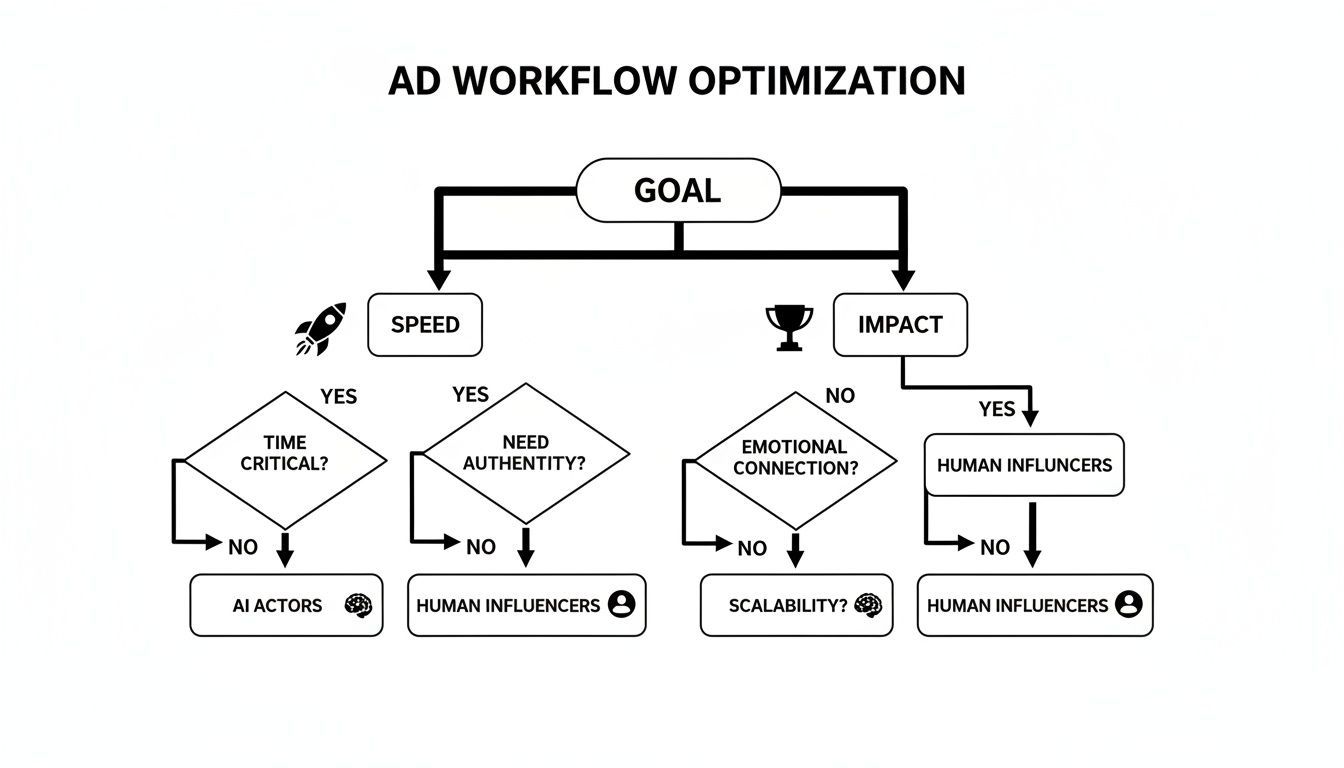
The bottom line is simple: when rapid iteration and optimization are what you're after, AI actors give you an operational edge that’s tough to beat.
Driving Efficiency in Content Production
For marketers who are all about efficiency, AI completely changes the game for ad creation. If you need a constant flow of new content without the hassle of shipping products, negotiating contracts, and going back and forth on revisions, AI is the obvious choice. Learning how AI generated social media posts can automate other parts of your visual strategy can provide some great ideas for getting started.
You should go with AI actors when your campaign goals are tied directly to performance metrics that depend on large-scale, rapid-fire creative testing. The goal is to out-learn and out-iterate your competition, and AI gives you the engine to do just that.
This kind of workflow is a lifesaver for direct-to-consumer brands that need a steady stream of fresh creative to keep ad fatigue at bay. You can see how to build this type of high-efficiency process with tools available at https://shortgenius.com/ai-ugc-ads, which are built specifically for performance marketers.
When the mission is to test, learn, and scale as fast as humanly—or inhumanly—possible, AI actors aren't just an option. They're a strategic necessity.
When to Partner with Human Influencers for UGC Ads
While AI actors are fantastic for speed and scale, some campaign goals hinge on something technology just can't fake yet: a genuine human connection. If your main goal is to build long-term brand equity, grow a community, and earn deep-seated trust, partnering with a human influencer is the only way to go.
In the ai actors vs human influencers for ugc ads discussion, the human element is non-negotiable for brands in certain spaces. Industries like wellness, beauty, and parenting run on personal stories and authentic testimonials. For these brands, a real person sharing a real experience offers a level of credibility that audiences not only trust but actively seek out.
When a consumer sees a creator they already follow and trust using a product in their daily life, it doesn't feel like an ad. It feels like a recommendation from a friend—a persuasive power that AI simply can't touch.
Building Credibility and Tapping into Established Communities
One of the biggest wins of working with human influencers is getting a direct line to their loyal communities. These creators have put in the time—often years—to build a strong rapport with their followers. For brands, this means instant social proof and a ready-made audience that already values the creator's opinion.
Think about these situations where a human influencer is clearly the better choice:
- High-Consideration Products: For big-ticket items or complex services (think tech gadgets or financial planning), trust is everything. An in-depth, honest review from a respected expert can be the final nudge a potential customer needs to commit.
- Brand-Building Campaigns: If you're playing the long game—aiming to build brand love and an emotional connection instead of just chasing quick sales—you need human stories. Their unscripted, relatable content is what builds a true community around your brand.
- Audience-Specific Niches: Need to connect with a very specific subculture, like vintage gamers or sustainable fashion enthusiasts? A creator who is already a respected voice in that space provides an authentic entry point that a generic AI actor never could.
Of course, creator compensation can vary dramatically, and it's important to know the going rates. If you’re planning a campaign, digging into resources that break down how much TikTok pays creators can give you a solid baseline for your budget.
When Authenticity Drives the Bottom Line
At the end of the day, choosing a human influencer means you're putting authenticity before automation. AI is brilliant for A/B testing creative and optimizing for short-term metrics like click-through rates. But humans are masters at building the foundational trust that turns one-time buyers into lifelong fans.
The data backs this up. Research consistently shows that a staggering 79% of people say user-generated content heavily impacts their purchasing decisions. That number speaks volumes about the power of a real human endorsement. When your brand’s story needs a genuine voice, investing in a human partnership isn't just a good idea—it's the right call.
Frequently Asked Questions
When you're trying to decide between AI actors and real people for your UGC ads, a few key questions always come up. Here are some straightforward answers to help you figure out the best path forward.
Can AI-Generated UGC Actually Feel Authentic?
This is the big one, isn't it? The trick with AI UGC is to think about authenticity differently. It's less about capturing a spontaneous, real-life moment and more about mastering a style. While an AI actor can't have a genuine experience with your product, it can be directed to replicate the look, feel, and tone of content that your audience already knows and trusts.
The goal isn't to trick anyone. It's about producing ads that feel familiar by using relatable scripts, casual filming techniques, and everyday backdrops. For performance marketing, where conversions are king, this "stylistic authenticity" works remarkably well, even if it doesn't forge the same deep connection as a story from a real person.
What Are the Biggest Ethical Risks with AI Actors in Ads?
The main ethical hurdles are transparency and data sourcing. If you don't clearly state that an ad features an AI actor, you risk misleading your audience and running afoul of advertising standards. That's a quick way to burn through brand trust.
Being upfront about using AI isn't just good practice; it's essential. Hiding it can backfire spectacularly, wiping out any performance gains and damaging your reputation.
The other major concern is how the AI was made. Was the training data sourced ethically? Does it use someone's likeness without their permission? To sidestep these landmines, always partner with reputable AI platforms that are transparent about their data practices and prioritize clear disclosure in your ads.
Is a Hybrid Strategy Combining AI and Humans a Good Idea?
Absolutely. In fact, a hybrid approach is often the smartest way to play the game. It lets you tap into the unique strengths of both humans and AI, creating a much more powerful full-funnel strategy.
Here’s a practical way to break it down:
- Top of Funnel: Kick things off with human influencers. They are fantastic for building brand awareness, credibility, and a genuine sense of community. Their authentic content provides the social proof you need to get started.
- Mid & Bottom Funnel: Once you see which concepts and messages resonate, use that winning human-generated content as a creative brief for your AI ads.
- Scale and Test: This is where AI shines. Recreate and remix the proven concepts into dozens of variations for aggressive A/B testing. You can rapidly optimize for clicks and conversions without burning out your human creators.
This approach gives you the best of both worlds. You use the trust-building power of real people to inform the scalable, efficient performance of AI. It's how you can truly settle the ai actors vs human influencers for ugc ads debate by making them work together.
Ready to scale your ad creation with the power of AI? ShortGenius helps you generate high-performing UGC-style video ads in minutes, not weeks. Start creating winning campaigns today.